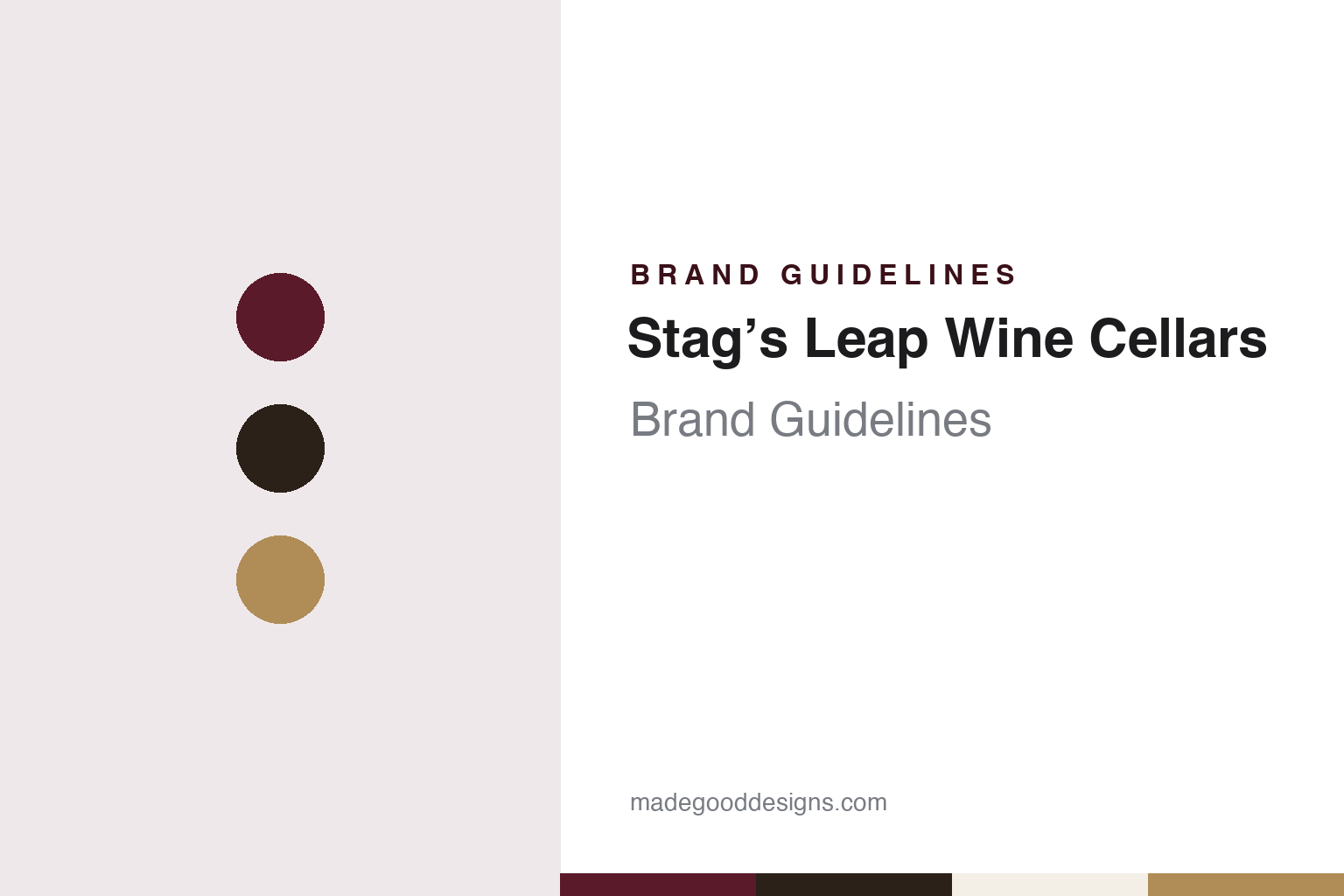
Stag’s Leap Wine Cellars Brand Guidelines
The Napa winery whose 1973 Cabernet won in Paris.
Aa
Two constants: a Cabernet red, oak brown and valley gold palette and a classical book serif register. Abstract homage — not a Stag’s Leap Wine Cellars product or mark; no label, logo or bottle is reproduced.
An orchard beside Nathan Fay
A Chicago lecturer, a neighbour’s Cabernet and a replanted orchard.
Stag’s Leap Wine Cellars was founded in 1970 by Warren Winiarski in what is now the Stags Leap District of the Napa Valley, California. English Wikipedia says Winiarski first came to wine during a year in Italy studying the work of Niccolò Machiavelli, began making wine at home in Chicago in the early 1960s, and moved his family to the Napa Valley in 1968, where he worked at Chateau Souverain and then at the newly started Robert Mondavi Winery.
The land he bought sat next to the vineyard of Nathan Fay, an early Cabernet Sauvignon grower in the valley. English Wikipedia, citing the wine writer Paul Lukacs, says Winiarski chose the site after tasting a homemade wine from Fay’s grapes. The plot was then planted with prune, cherry and walnut trees and a little Petite Sirah and Alicante Bouschet; these were replaced with Cabernet Sauvignon and Merlot, and the vineyard became Stag’s Leap Vineyard, written S.L.V. The winery itself says it was established with the purchase of S.L.V. in 1970.
The first vintage, 1972, was made in a rented facility, with the consultant André Tchelistcheff assisting, English Wikipedia says. The 1973 was the first made at the estate in commercial quantities. Club Oenologique gives 1974 as the first vintage of Cask 23, the wine named after a single cask that became the winery’s top Cabernet.
Colour
Paris, 1976, and a bottle in the Smithsonian.
The name was made at the Paris Wine Tasting of 1976, now known as the Judgment of Paris. In a blind tasting by French wine experts, the 1973 Stag’s Leap Wine Cellars Cabernet Sauvignon placed first among ten red wines from France and California, ahead of 1970 and 1971 wines from Château Mouton-Rothschild, Château Haut-Brion, Château Léoville Las Cases and Château Montrose. Decanter later called it “a victory that put California on the winemaking map.” At a re-tasting in San Francisco in 1978, with different judges, the wine placed first again, English Wikipedia says, citing George Taber’s 2005 book on the tasting. Later re-tastings were less kind: at the French Culinary Institute tasting of 1986, held ten years after Paris, it placed sixth, and in a Wine Spectator tasting the same year it placed fourth.
The result has been treated as part of American history as well as wine history. In 1996 a bottle of the 1973 Cabernet entered the collection of the Smithsonian’s National Museum of American History, and it was later included in The Smithsonian’s History of America in 101 Objects by Richard Kurin.
After Paris the estate grew. English Wikipedia says the winery bought Nathan Fay’s neighbouring Cabernet vineyard, now written FAY, in 1986, nearly doubling its vineyard holdings, and in 1996 bought the Arcadia Chardonnay vineyard from Mike Grgich, the winemaker behind the Chateau Montelena Chardonnay that won the white-wine side of the 1976 tasting.
The name itself was fought over. Stag’s Leap Wine Cellars and Stags’ Leap Winery, founded by Carl Doumani, are two separate wineries that both started in 1970 and both claimed the name. English Wikipedia says the dispute ended in court in 1986 with a ruling that the name came from the area, so both could use it, Winiarski keeping the apostrophe before the “s” and Doumani after it. The two later released a joint 1985 Cabernet called “Accord.” The Stags Leap District itself became an American Viticultural Area within the Napa Valley in 1989.
Typography
Design and documentation.
The seven brands in this group are all American wine names: Woodbridge, Josh Cellars, Meiomi, La Crema, Duckhorn, Caymus and Stag’s Leap Wine Cellars. American wine brands in general sit at many different points in the trade, from family houses that still carry a founder’s name to labels that now belong to much larger drinks groups, and a single brand can be sold everywhere from a corner shop to a restaurant list.
A wine brand’s identity is usually carried less by a single bottle than by a label, a name and the place it promises, because the company behind the name may have changed hands, moved its production or grown far beyond the place where it started. That makes the questions behind each name worth asking plainly: who started it, who owns it now, and where its wine is actually made and bottled.
Each guide separates what independent sources record from what the company says about itself — its founding story, its owners over time, where its wine is made and how its labels have changed — and marks plainly what rests only on the company’s own word.
Aa
A classical book serif for an estate name with a careful apostrophe. (Specimen set in Libre Caslon Text, a serif STAND-IN; NOT the Stag’s Leap Wine Cellars logo.)
Stag’s Leap Wine Cellars
From the founder’s family to an Italian wine house.
Winiarski ran the winery for close to four decades. In August 2007 he sold it to Chateau Ste. Michelle, the Washington State wine group, and Marchesi Antinori of Florence; the sale covered the winery and the S.L.V. and FAY vineyards, while the Winiarski family kept Arcadia, Decanter and the San Francisco Chronicle reported at the time. English Wikipedia says Winiarski agreed to stay on as a part-time adviser for three years after the sale. Wine Spectator reported in May 2023 that Antinori had bought Ste. Michelle’s 85 percent stake, taking over the winery, the brand, its stock and close to 300 acres of Napa vines, and making it the sole owner. The same report noted that Ste. Michelle had itself changed hands in 2021, when its parent, Altria, sold it to the private equity firm Sycamore Partners. Winiarski died in June 2024, Decanter reported.
The winery says its winemaking is led by Marcus Notaro, who joined in 2013, with Jorge Ramirez Perez and Luis Contreras as winemakers. Its best-known wines remain the estate Cabernets named for its vineyards — S.L.V., FAY and Cask 23, which Wine Spectator describes as a blend of the best fruit from the single-vineyard wines.
For a design guide, Stag’s Leap Wine Cellars shows how an estate name, a vineyard abbreviation and a single dated tasting can carry a brand for half a century, and how one apostrophe can separate two wineries. Compare it with its Napa neighbours Caymus and Duckhorn, and with the Australian house Penfolds. For this guide we use Cabernet red, oak brown and valley gold with a classical book serif, an unofficial interpretation; no product or logo is reproduced.
Explore & save
Keep Stag’s Leap Wine Cellars’s identity on hand — save it to a board in the Made Good inspiration library.
Stag’s Leap Wine Cellars identity set
Pin the Stag’s Leap Wine Cellars Cabernet red, oak brown and valley gold palette and the classical book serif register to your own board.