BrewDog Brand Guidelines
The Fraserburgh craft brewer behind Punk IPA, founded 2007.
Aa
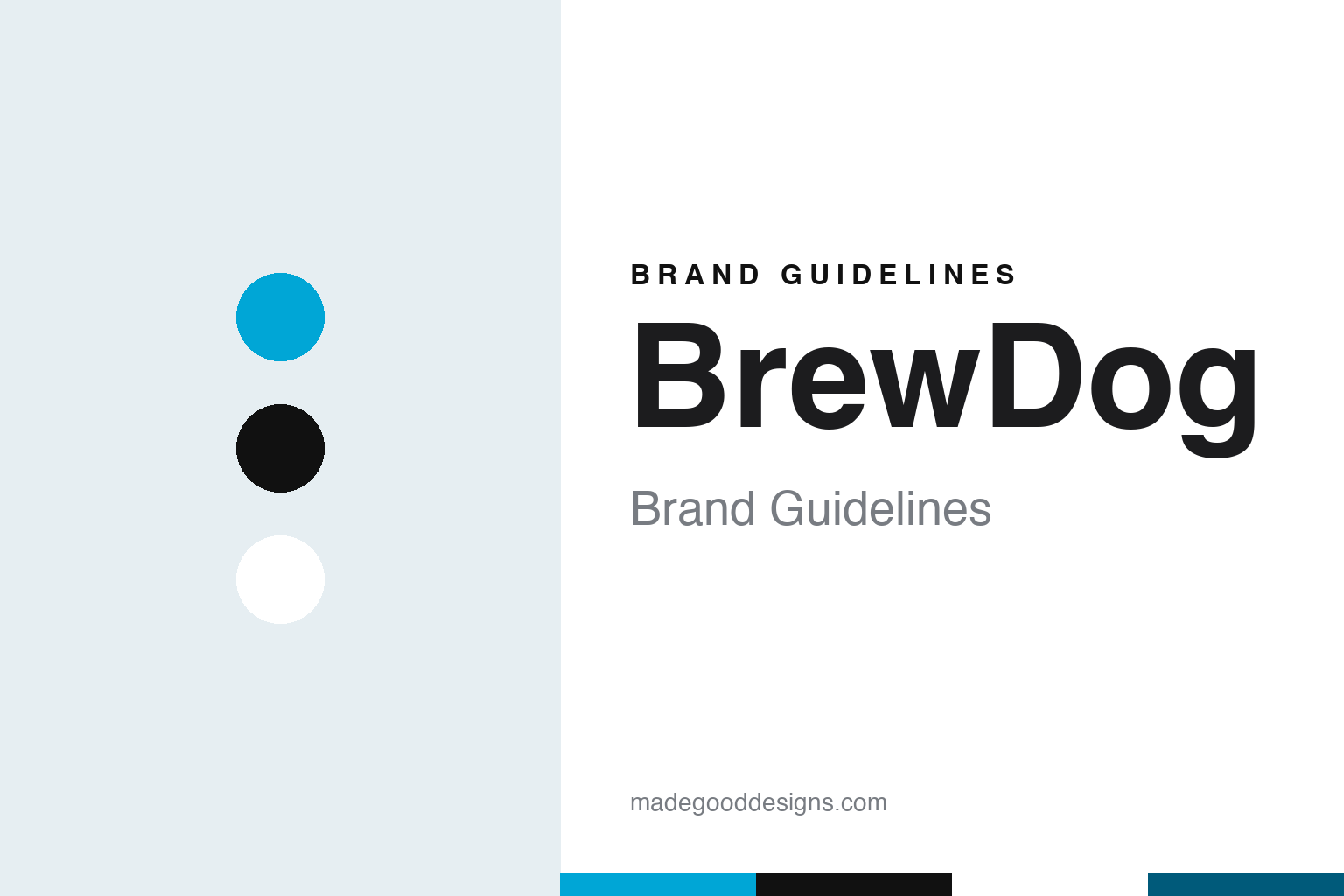
Two constants: a punk blue, can black and paper white palette and a heavy grotesque sans register. Abstract homage — not a BrewDog product or mark; no can, label or logo is reproduced.
Two founders in Fraserburgh
From a small brewery on the Aberdeenshire coast to Ellon.
BrewDog was founded in 2007 in Fraserburgh, a fishing town on the Aberdeenshire coast, by James Watt and Martin Dickie, English Wikipedia says, citing the BBC. Its signature beer, and the one that gave its crowdfunding scheme its name, is Punk IPA. The company opened its first bar, in Aberdeen, in 2009, The Morning Advertiser reported that October.
Growth took the brewing inland. The Herald reported in January 2013 that BrewDog had opened a new brewery just outside Ellon, north of Aberdeen, and English Wikipedia says the company ended operations in Fraserburgh in 2014; Ellon has been its home since. In February 2016 the company published the recipes of its beers for anyone to brew at home, the Scottish Business News Network reported, a project known as DIY Dog.
The money that paid for much of that growth came from drinkers. BrewDog’s crowdfunding programme, Equity for Punks, invited customers to buy shares in the company; the Irish broadcaster RTÉ dated the first campaign to 2009, while Scottish Financial News has dated the scheme to 2010. Later rounds followed in 2011, 2013 and 2015, Brewbound reported. In 2017 the private equity firm TSG Consumer Partners bought a 22 per cent stake, the BBC reported that April. By the end of 2018 the company had 78 bars around the world, The Morning Advertiser reported.
Leadership changed in the 2020s. The Guardian reported in May 2024 that James Watt had stepped down as chief executive after 17 years, taking the title of “Captain and Co-Founder,” and was succeeded by chief operating officer James Arrow; The Drinks Business reported in March 2025 that James Taylor had been appointed chief executive, with Lauren Carrol as chief operating officer.
Colour
A dog, a horizontal wordmark and a loud colour on the shelf.
The current BrewDog identity dates from February 2020. Design Week reported that month that the new look had been created with the London studio Made Thought and the brewer’s in-house team, and that it came with the launch of BrewDog Tomorrow, a six-point sustainability plan. The magazine described the main changes: the BrewDog wordmark now ran horizontally rather than vertically, and the dog icon no longer sat inside a shield-shaped lock-up but at the centre of the identity. The redesign kept the existing colour palette.
Reaction in the design press was mixed. Creative Bloq headlined its story “Brewdog gets neutered in sensible rebrand,” arguing that the brand had stripped out much of what made it distinctive, while Creative Review described the move as BrewDog cleaning up its look with a simplified visual identity.
The packaging moved again in May 2025. Food Manufacture reported that BrewDog had given four core beers, Punk IPA, Hazy Jane, Lost Lager and Elvis Juice, their own visual identities across bottles, cans and outer packs, while keeping the colour palette and the brandmark from 2020. Lauren Carrol, then chief operating officer and previously chief marketing officer, told the magazine the brewer was entering a “new era” and that the new packs would “disrupt the category,” a phrase she tied to the company’s aims from the start.
The wordmark is lettering drawn for the brand rather than a typeface on sale; our separate guide to the BrewDog font looks at the bold, condensed capitals and the free sans-serifs that come closest.
Typography
Design and documentation.
The seven brands in this group are all British beer names: Fuller’s, Greene King, Adnams, BrewDog, Theakston, Old Speckled Hen and Shepherd Neame. Beer brands in general sit at many different points in the trade, from family brewers that still carry a founder’s name to labels that now belong to much larger drinks groups, and a single brand can be sold everywhere from a corner shop to a pub bar.
A beer brand’s identity is usually carried less by a single bottle than by a pump clip, a label, a name and the place it promises, because the company behind the name may have changed hands, moved its brewing or grown far beyond the town where it started. That makes the questions behind each name worth asking plainly: who started it, who owns it now, and where its beer is actually brewed and packaged.
Each guide separates what independent sources record from what the company says about itself — its founding story, its owners over time, where its beer is brewed and how its labels have changed — and marks plainly what rests only on the company’s own word.
Aa
A heavy grotesque sans for a loud, all-capitals craft-beer wordmark. (Specimen set in Archivo Black, a sans-serif STAND-IN; NOT the BrewDog logo.)
BrewDog
A culture row, a sale and a brand that changed hands in 2026.
The company’s reputation came under scrutiny in June 2021, when more than 100 former employees, writing as Punks With Purpose, published an open letter criticising its workplace culture, The Guardian reported.
The biggest change came in 2026. The Press and Journal reported in January 2026 that BrewDog had closed its distillery at Ellon and stopped making spirits. On 2 March 2026, a subsidiary of Tilray Brands, a company whose own filings describe a cannabis and consumer packaged goods business, bought certain operations and assets of BrewDog plc through a pre-packaged administration in Scotland, Tilray told the US Securities and Exchange Commission. The purchase covered the Ellon brewery, the online and retail businesses, 11 brewpubs and the brand’s intellectual property, including Punk IPA and Elvis Juice. The Guardian reported that 38 UK bars were to close. Tilray said it was negotiating separately for certain BrewDog assets in the United States and Australia, and the German business was not part of the deal, trade reports said. City AM reported that James Watt said he was heartbroken by the sale.
The beer that started the company remains its best-known name. Punk IPA is one of the trademarks Tilray named among the assets it bought, alongside Elvis Juice, and both were among the four core beers given new packs in 2025.
For a design guide, BrewDog shows how a single loud colour, a dog and a heavy, condensed wordmark can carry a brewery from a coastal town to bars around the world, and how an identity can be simplified without changing its palette. Compare Adnams, the independent brewery in Southwold, and Fuller’s, the London brewery at Chiswick. For this guide we use punk blue, can black and paper white with a heavy sans, an unofficial interpretation; no product or logo is reproduced.
Explore & save
Keep BrewDog’s identity on hand — save it to a board in the Made Good inspiration library.
BrewDog identity set
Pin the BrewDog punk blue, can black and paper white palette and the heavy grotesque sans register to your own board.