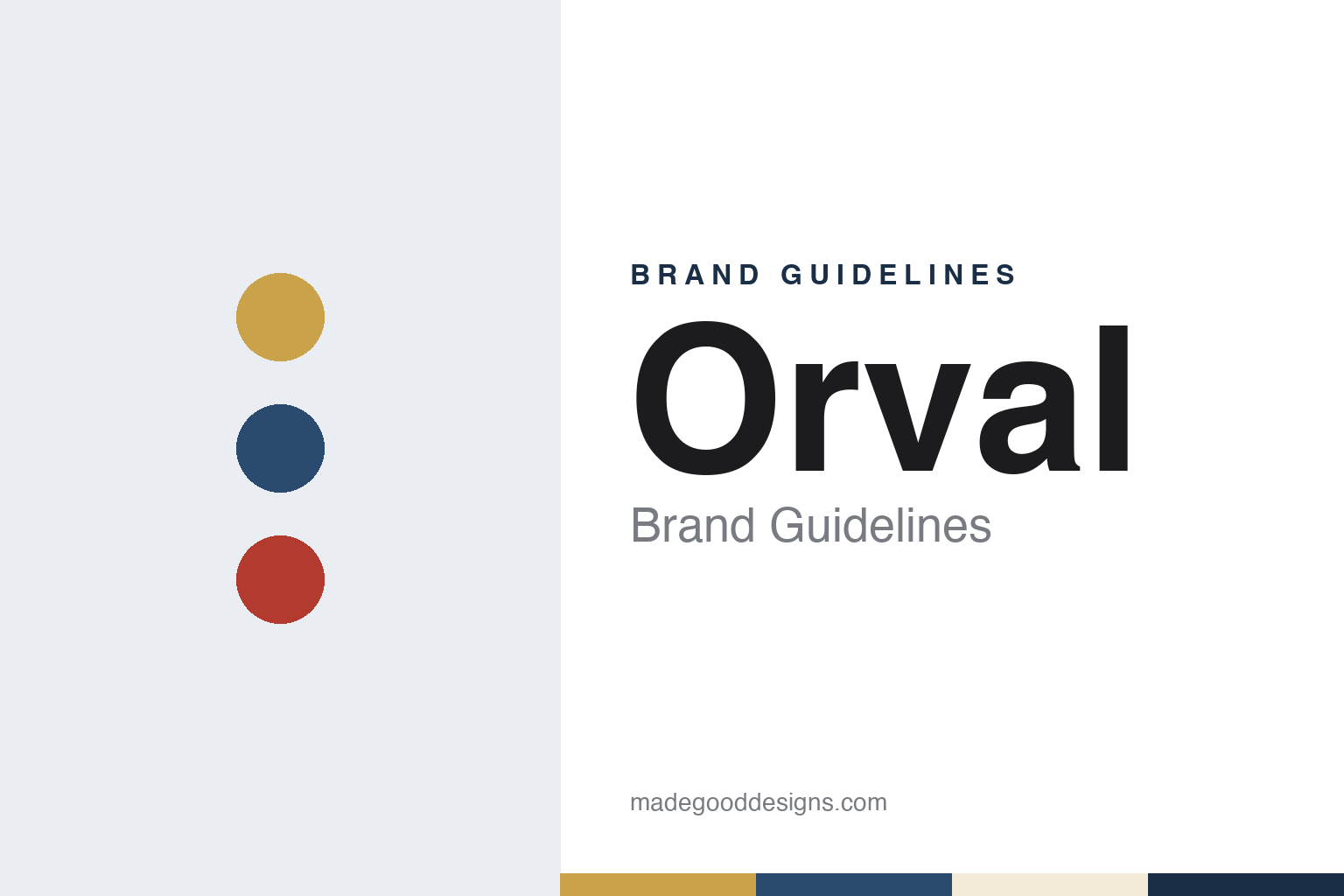
Orval Brand Guidelines
The abbey beer in the skittle bottle, brewed since 1931.
Aa
Two constants: an abbey stone gold, trout blue and label cream palette and an inscriptional serif register. Abstract homage — not an Orval product or mark; no label, logo or bottle is reproduced.
A brewery to rebuild an abbey
Lay brewers, a German master brewer and a ruin to raise.
Orval is brewed inside the walls of the Abbaye Notre-Dame d’Orval, a Trappist monastery at Villers-devant-Orval in the Gaume, the southern tip of Belgium’s province of Luxembourg. English Wikipedia says the brewery, known in French as the Brasserie d’Orval, makes two beers: Orval, sold commercially, and Orval Vert, also called Petit Orval, which is served on tap only at À l’Ange Gardien, the inn the abbey runs a short walk away.
The modern brewery exists because of a ruin. English Wikipedia’s article on the abbey says the medieval monastery was left in ruins after 1793, that the land was bought by the Harenne family in 1887, and that the family gave it to the Cistercian order in 1926 so that monks could return. The new monastery was built between 1926 and 1948 under the Trappist monk Marie-Albert van der Cruyssen, Orval regained the rank of abbey in 1936, and the new church was consecrated on 8 September 1948.
Paying for all that was the brewery’s job. The abbey says that in 1931 a brewery was established to take on the role an old foundry had once played, when Emperor Charles V allowed the monks to set one up in 1529 to pay for war damage. From the outset, the abbey says, the brewery employed lay people rather than monks. Its first master brewer was a German, Martin Pappenheimer, and the abbey attributes the beer’s character jointly to him and to two Belgians who worked there at the same time, Honoré Van Zande and John Vanhuele. It suggests that two of its methods, infusion brewing and dry hopping, are English and probably came with Vanhuele, who had lived in England for many years. English Wikipedia says the first beer left the brewery on 7 May 1932, in barrels rather than bottles.
The beer that resulted is unusual. The Oxford Companion to Beer (2012) records the use of Hallertau, Styrian Goldings and Strisselspalt hops, and English Wikipedia notes that the wild yeast Brettanomyces is added during maturation, so a bottle keeps changing as it ages. The beer writer Michael Jackson called it a “world classic.”
Colour
An architect’s bottle, his daughter’s glass and an old legend.
The architect of the new abbey also drew its beer. French Wikipedia, citing Orval. Histoire de la reconstruction de l’abbaye by Eric Hance and Danièle Hanky (2015), says Henri Vaes — a childhood friend of Dom Marie-Albert, whose name also appears as Henry — devoted himself to the project down to the smallest details, the door latches included, and drew the beer bottle, while the glass was drawn by his daughter. English Wikipedia likewise credits Vaes and his daughter with the Orval glass. The abbey itself says the glass, the bottle and the label that drinkers know today date from the early 1930s.
The bottle is the beer’s best-known shape. Orval is sold in a single skittle-shaped 33 cl bottle, English Wikipedia says, and French Wikipedia notes that in the Gaume a bottle of Orval is commonly called a quille, a skittle. A three-litre collector’s bottle appeared in 2008. French Wikipedia calls the glass a chalice.
The emblem is older than the brewery. The abbey tells a legend in which Mathilda of Tuscany lost her wedding ring in a spring on the site, and a trout rose to the surface with the ring in its mouth; she is said to have called the place a val d’or, a golden valley, which the story offers as the origin of the name “Orval.” English Wikipedia says the abbey’s arms show the trout and the ring and that the same spring still supplies water to the monastery and its brewery. Writing in Good Beer Hunting in August 2016, Breandán Kearney said Orval registered the symbol as a trademark as early as 1934.
The beer also carries a collective mark. French Wikipedia says Orval is one of the beers entitled to the Authentic Trappist Product label, which the International Trappist Association grants to goods made within a Trappist abbey, by or under the supervision of the monks, with part of the income going to charitable work.
Typography
Design and documentation.
The seven brands in this group are all beer names: Orval, Delirium Tremens, Kwak, Augustiner, Hofbräu, Schneider Weisse and Goose Island. Beer brands in general sit at many different points in the trade, from abbeys and family breweries that still carry an old name to labels that now belong to much larger brewing groups, and a single brand can be poured everywhere from a village café to a bar on another continent.
A beer brand’s identity is usually carried less by a single bottle than by a label, a name, a glass and the place it promises, because the company behind the name may have changed hands, moved its brewing or grown far beyond the town where it started. That makes the questions behind each name worth asking plainly: who started it, who owns it now, and where its beer is actually brewed and bottled.
Each guide separates what independent sources record from what the company says about itself — its founding story, its owners over time, where its beer is brewed and how its labels have changed — and marks plainly what rests only on the company’s own word.
Aa
An inscriptional serif for an abbey beer. (Specimen set in Cinzel, a serif STAND-IN; NOT the Orval logo or label lettering.)
Orval
One beer, one bottle and a monastery behind it.
Orval has stayed small by choice. English Wikipedia says the brewery is normally closed to the public and opens its doors on two days a year, and that it employs lay workers; French Wikipedia’s article on the abbey says that by 2024 the brewery and the cheese dairy were staffed entirely by lay people, with income going to the upkeep of the buildings and to social causes. The abbey also makes a cheese sold under the Orval name.
The abbey belongs to a wider Cistercian family. French Wikipedia says that in 1946 the abbot of Westmalle became Orval’s “father immediate,” the superior who oversees it under the Cistercian system of mutual support between communities. English Wikipedia notes that bottles sold in North America carry a different stated strength from those sold in Belgium, to meet local labelling rules.
Even the grammar of the name has a regional flavour. The Dictionnaire des belgicismes (2010), cited by French Wikipedia, notes that “Orval” is feminine across most of French-speaking Belgium but masculine in the region where it is brewed, where drinkers ask for “un Orval.” The name needs a little care online too: orval.be is the abbey’s own site, covering the monastery, its guesthouse, the brewery and the cheese together.
For a design guide, Orval shows how a single bottle shape, an architect’s hand and a medieval legend of a trout and a ring can carry a beer for more than nine decades. Compare Westmalle, the Trappist abbey that oversees Orval, and Leffe, the Belgian abbey beer revived in 1952. For this guide we use abbey stone gold, trout blue and label cream with a serif, an unofficial interpretation; no product or logo is reproduced.
Explore & save
Keep Orval’s identity on hand — save it to a board in the Made Good inspiration library.
Orval identity set
Pin the Orval abbey stone gold, trout blue and label cream palette and the inscriptional serif register to your own board.