Delirium Tremens Brand Guidelines
Huyghe’s pink elephant from Melle, brewed since 1988.
Aa
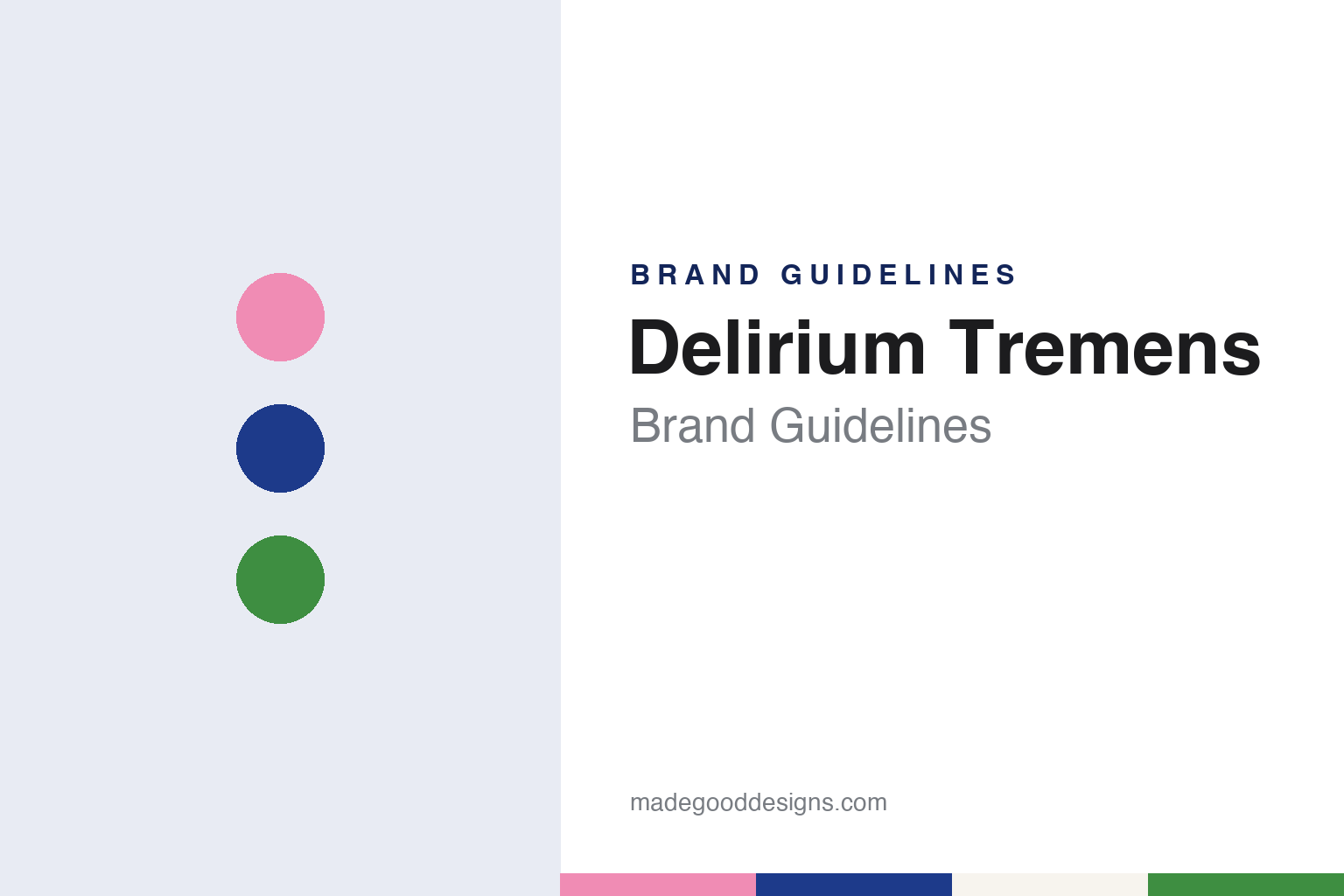
Two constants: an elephant pink, foil blue and stoneware white palette and a soft display serif register. Abstract homage — not a Delirium Tremens product or mark; no label, logo or bottle is reproduced.
A brewery at the Appelhoek
From a village pils brewery to a top-fermented export house.
Delirium Tremens is brewed by Brouwerij Huyghe, a family brewery in Melle, just outside Ghent in the Belgian province of East Flanders. The brewery says there has been brewing at the spot called the Appelhoek in Melle since at least 1654, a date also given in Tim Hampson’s World Beer (DK, 2013). It says Leon Huyghe came to Melle from Poperinge in 1902 to work at the local brewery, and English and French Wikipedia both say he took it over in 1906. It was then called Den Appel, after the place name.
For most of the twentieth century Huyghe was a regional brewery of pils and table beer. The company says Leon’s son Albert Huyghe and his son-in-law Louis Droesbeque joined the business around 1925, that work on a new brewhouse began in 1936, and that in 1938 the Den Appel name gave way to the Huyghe family name; French Wikipedia dates the renaming to 1936. In 1948, the company says, it began making soft drinks too, and in the 1970s, when sales fell, it turned to company canteens, schools and other institutions as customers.
The change of direction came in the 1980s with Jean De Laet, who French Wikipedia says married into the family. The company says that in 1985 the brewery was radically reorganised, switched from pils to top-fermented beers and began to think about export for the first time; its amber Artevelde reached the market on 5 July 1985, and a bottle-conditioned Artevelde Grand Cru followed in 1987.
Delirium Tremens was born the following year. The brewery dates its first brew to 26 December 1988, the date French Wikipedia also gives, citing Gilbert Delos’s 101 bières à découvrir (Dunod, 2013); the Belgian beer site Belgian Smaak gave 1989 in 2015. The company says the beer’s character comes from three different strains of yeast. A year later Huyghe launched La Guillotine for the bicentenary of the French Revolution.
Colour
A white bottle, a pink elephant and a procession of creatures.
The name is a Latin medical term; the label answers it with a cartoon. The brewery’s own history describes the packaging as resembling “cologne ceramics,” a stoneware look in glass, and says the colourful label helped the beer succeed. Belgian Smaak, in a February 2015 article by Breandán Kearney, described the ceramic-look bottle with a blue foil around its neck and on its cap. The Oxford Companion to Beer (2011) notes that the brewery’s Delirium beers feature pink elephants on their labels.
The elephant is not alone. In 2018, the brewery says, it rebranded Delirium Tremens and the whole Delirium range but kept every original feature of the bottle: the pink elephant, the green crocodile, the purple dragon, the birds it calls Hitchcock birds, and the white bottle. The change was one of emphasis: the pink elephant was moved to a more central position. The glass was refreshed at the same time, the company says, with the elephant’s trunk placed at its foot and a broader chalice shape.
In the 2015 Belgian Smaak article, the brewery guide Filip Devolder said it had been designed by a student working at the brewery on a summer job.
The company says a “Confrérie of the Pink Elephant” was founded in 1992 to promote Delirium Tremens and the brewery’s other beers. The name has also caused friction abroad: Belgian Smaak reported in 2015 that some foreign markets had removed the beer from sale, and that the brewery had offered to use “Delirium” alone on the label in certain places.
Typography
Design and documentation.
The seven brands in this group are all beer names: Orval, Delirium Tremens, Kwak, Augustiner, Hofbräu, Schneider Weisse and Goose Island. Beer brands in general sit at many different points in the trade, from abbeys and family breweries that still carry an old name to labels that now belong to much larger brewing groups, and a single brand can be poured everywhere from a village café to a bar on another continent.
A beer brand’s identity is usually carried less by a single bottle than by a label, a name, a glass and the place it promises, because the company behind the name may have changed hands, moved its brewing or grown far beyond the town where it started. That makes the questions behind each name worth asking plainly: who started it, who owns it now, and where its beer is actually brewed and bottled.
Each guide separates what independent sources record from what the company says about itself — its founding story, its owners over time, where its beer is brewed and how its labels have changed — and marks plainly what rests only on the company’s own word.
Aa
A soft, generous display serif for a playful label. (Specimen set in Fraunces, a serif STAND-IN; NOT the Delirium Tremens logo or label lettering.)
Delirium Tremens
One beer, a family of elephants and a bar in Brussels.
The beer built a range around itself. The company says Delirium Nocturnum, a dark beer, followed in 1999 for the beer’s tenth anniversary, a Christmas beer in 2000, and a barrel-aged Delirium Black, matured in bourbon barrels from the Buffalo Trace distillery, in 2019. Huyghe also grew by buying other breweries: the company lists Biertoren in Kampenhout in 1993, the Damy brewery of Olsene with its St Idesbald abbey beers in 1994, and Villers in 1999. In March 2011 it joined the Belgian Family Brewers association, the company says.
Recognition came early. Stuart A. Kallen placed Delirium Tremens first in The 50 Greatest Beers in the World (1999), English Wikipedia notes, and the brewery says the beer won a gold medal at the World Beer Championships in Chicago in 1998. Its name also went on a bar: English Wikipedia says the Delirium Café in Brussels, a short walk from the Grand-Place, was founded in December 2003 by Joël Pêcheur, Fabienne Charles and Jean De Laet, and Guinness World Records recorded it on 9 January 2004 as offering the most varieties of beer commercially available, with 2,004. The pink elephant decorates its entrance.
The business remains in family hands. Belgian Smaak named Alain De Laet as the brewery’s owner in 2015 and reported that more than 70 per cent of its output was exported, to more than 60 countries. Online, delirium.be is the beer’s site, brouwerijhuyghe.be the brewery’s, and the Delirium Café has its own.
For a design guide, Delirium Tremens shows how a white, stoneware-look bottle and a small cast of cartoon creatures led by a pink elephant can turn a regional pils brewery into an export house, and survive a redesign with every element kept. Compare Kwak, another Belgian ale in this group, and Hoegaarden, the revived Belgian witbier. For this guide we use elephant pink, foil blue and stoneware white with a serif, an unofficial interpretation; no product or logo is reproduced.
Explore & save
Keep Delirium Tremens’s identity on hand — save it to a board in the Made Good inspiration library.
Delirium Tremens identity set
Pin the Delirium Tremens elephant pink, foil blue and stoneware white palette and the soft display serif register to your own board.