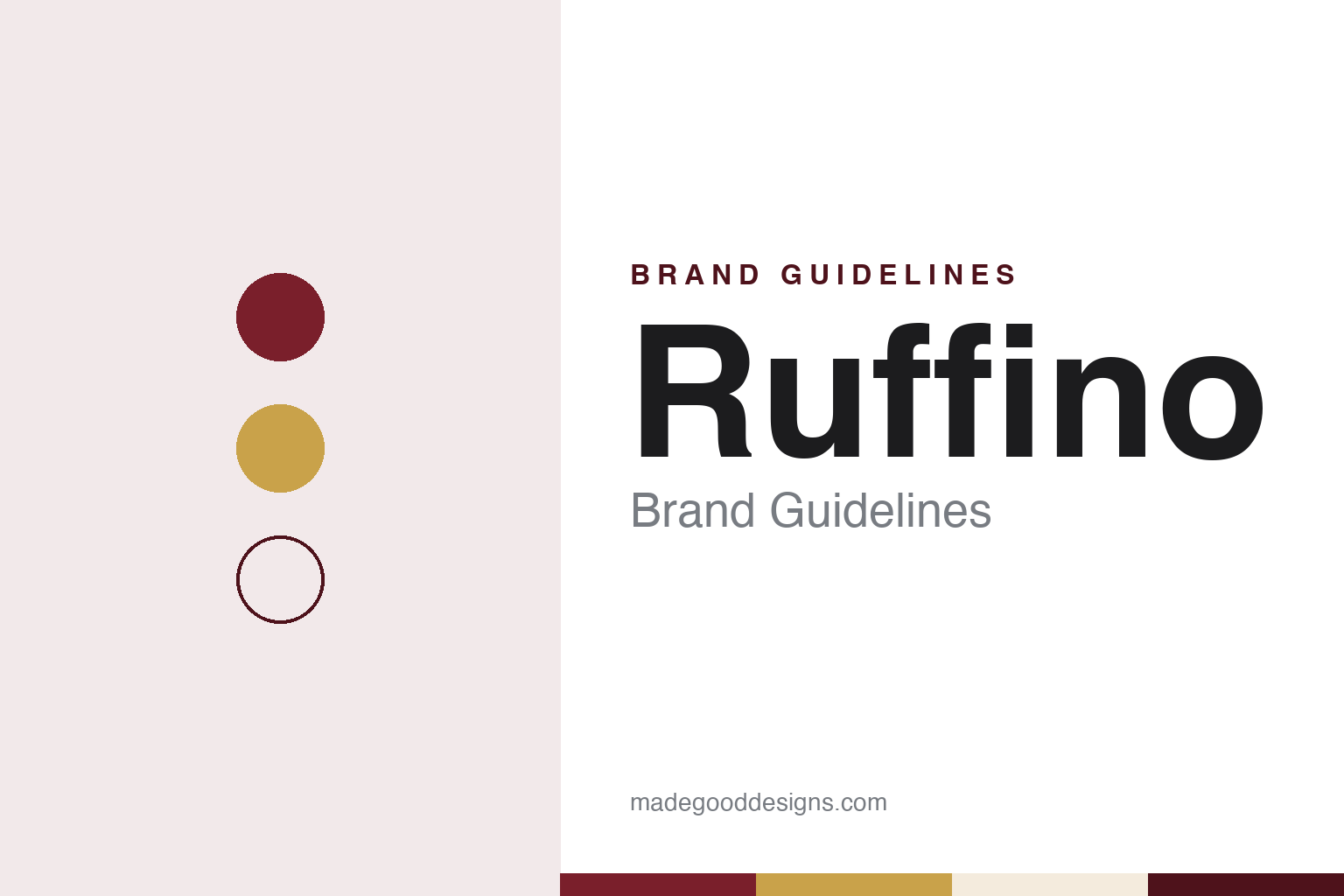
Ruffino Brand Guidelines
The Pontassieve Chianti house founded in 1877.
Aa
Two constants: a Chianti red, Ducale gold and parchment palette and a classical serif register. Abstract homage — not a Ruffino product or mark; no label, logo or bottle is reproduced.
Two cousins in Pontassieve
A railway town on the edge of the Chianti hills.
Ruffino was founded in 1877 in Pontassieve, a town on the Sieve river just east of Florence. The company says it was started by two cousins, Ilario and Leopoldo Ruffino, and English Wikipedia, citing Anthony Dias Blue’s Pocket Guide to Wine, gives the same founding year. The company’s own history explains the choice of town by what it offered a young wine business: vineyards in the Chianti area, a railway line and a glass factory nearby. Gambero Rosso, in a 2021 profile, also stressed that Pontassieve sat close to one of Italy’s first railways.
Royal favour arrived early, at least in the company’s telling. Ruffino says the Duke of Aosta visited Pontassieve in 1890, took a liking to the wine, and that Ruffino then became an official supplier to the Kingdom of Italy. Gambero Rosso reported that the house won a gold medal at Bordeaux in 1895, its first major recognition abroad.
The founding family did not keep the business for long. In 1913 the winery was bought by the Folonari family from Brescia, in Lombardy, according to English Wikipedia, which cites Nicholas Belfrage’s The Finest Wines of Tuscany and Central Italy, and Gambero Rosso. The Folonari name stayed attached to Ruffino for close to a century. When the wider Folonari wine business was divided in 1999, English Wikipedia says, the brothers Paolo and Marco Folonari kept the Ruffino name for their side of the family company.
The house’s best-known label took shape in the Folonari years. Ruffino says that in 1927 it obtained a licence for a select Chianti riserva, then called Chianti Stravecchio, named to honour the Duke of Aosta; this was the first Riserva Ducale, and Gambero Rosso gives the same year for the first bottling. After the Second World War, during which the company says its premises suffered damage, Ruffino bought its first Chianti Classico estate, Montemasso, in 1947, and from it came the first Riserva Ducale Oro, the gold-label selection.
Colour
A duke’s name, a gold label and a straw flask.
Ruffino’s visual history rests on two very different bottles. The first is the fiasco, the round Chianti bottle wrapped in straw. The company says that in the 1950s, as its Rosatello rosé made its debut, the fiasco became an icon of “Made in Italy” — a phrase the house still uses to tell its own story.
The second is the Riserva Ducale label. The name itself is the brand story: “Ducale” means “of the duke,” and the company ties it directly to the Duke of Aosta. The gold-label Oro was first produced in 1947, and Gambero Rosso reported in 2021 that Riserva Ducale had received Tre Bicchieri, the guide’s top award, that year.
Ruffino also points to a piece of regulatory paperwork as part of its heritage. When Chianti was raised to DOCG status in 1984, the company says it received the very first government seal strip, numbered AA00000001. The house added a modern flagship in 2000, when it released the first vintage of Modus, a Tuscan red of the kind often called a “Super Tuscan,” and the company says the 2010 vintage of Riserva Ducale Oro was its first release under Chianti Classico’s Gran Selezione tier.
Today the company lists a group of Tuscan estates under its name, among them Poggio Casciano, Santedame, Gretole, Greppone Mazzi and La Solatìa. Gambero Rosso reported in 2021 that Ruffino had bought properties in Chianti, Montepulciano and Montalcino and in the Veneto, the region its Prosecco comes from, and that a Prosecco DOC, a Chianti and a Pinot Grigio were among its organically certified wines. The company groups its sustainability work under the name Ruffino Cares.
Typography
Design and documentation.
The seven brands in this group are all Italian wine names: Antinori, Santa Margherita, Ruffino, Masi, Zonin, Bolla and Cavit. Wine brands in general sit at many different points in the trade, from family houses that still carry a founder’s name to cooperatives owned by their growers and labels that now belong to much larger drinks groups, and a single brand can be sold everywhere from a corner shop to a restaurant list.
A wine brand’s identity is usually carried less by a single bottle than by a label, a name and the place it promises, because the company behind the name may have changed hands, moved its production or grown far beyond the place where it started. That makes the questions behind each name worth asking plainly: who started it, who owns it now, and where its wine is actually made and bottled.
Each guide separates what independent sources record from what the company says about itself — its founding story, its owners over time, where its wine is made and how its labels have changed — and marks plainly what rests only on the company’s own word.
Aa
A classical serif for a house with a ducal name. (Specimen set in Cormorant Garamond, a serif STAND-IN; NOT the Ruffino logo.)
Ruffino
From a Brescian wine family to an American drinks group.
The current ownership was assembled in stages. English Wikipedia, citing Belfrage, says the American company Constellation Brands bought a 40 percent interest in Ruffino in 2004. Constellation’s annual report filed with the US Securities and Exchange Commission records that its stake rose to 49.9 percent in May 2010, and that on 5 October 2011 it bought the remaining 50.1 percent from MPF International, a company controlled by the Folonari family, making Ruffino wholly owned. The same filing says Constellation had begun arbitration against the majority shareholder and that all of the legal actions between them were settled as part of the purchase.
The filing says Ruffino was then consolidated into Constellation’s North American business, and the company’s website carries Constellation Brands in its footer. Ruffino is still based in Pontassieve, and the company describes its Poggio Casciano estate as a cultural centre for the house. Gambero Rosso reported in 2021 that the house worked about 550 hectares of vineyards, and that it launched a rosé, Aqua di Venus, in May 2020. The company says it set up a Winemaking Council of oenologists and agronomists in 2023.
For a design guide, Ruffino shows how a founding story, a duke’s name and a gold label can carry a Tuscan wine house through more than a century of changing owners. Compare Antinori, the Florentine wine family, and Laudemio Frescobaldi, the olive oil of another old Tuscan wine family. For this guide we use Chianti red, Ducale gold and parchment with a serif, an unofficial interpretation; no product or logo is reproduced.
Explore & save
Keep Ruffino’s identity on hand — save it to a board in the Made Good inspiration library.
Ruffino identity set
Pin the Ruffino Chianti red, Ducale gold and parchment palette and the classical serif register to your own board.