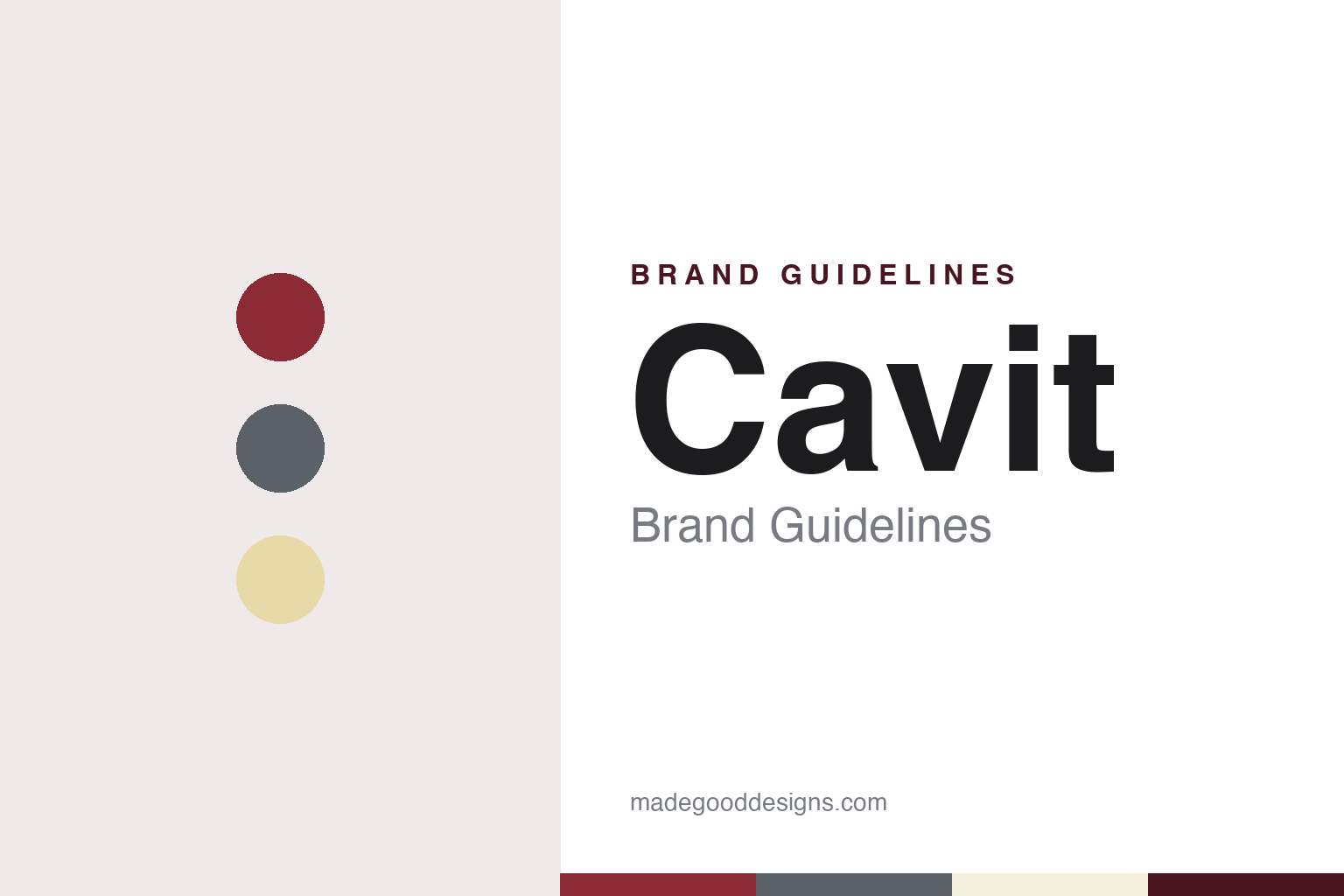
Cavit Brand Guidelines
The Trentino winegrowers’ cooperative from Ravina di Trento.
Aa
Two constants: a Teroldego red, Dolomite grey and Pinot straw palette and a sturdy serif register. Abstract homage — not a Cavit product or mark; no label, logo or bottle is reproduced.
A consortium of cellars in the Adige valley
From a growers’ consortium to a winery of its own.
The name is a contraction. Cavit stands for Cantina Viticoltori — the “winery of winegrowers” — of Trentino, the mountainous province in northern Italy around the city of Trento. Wine Spectator wrote in November 2012 that the shortened form was originally written Ca’Vit, and that its American importer changed it to Cavit on the label for the United States.
The company dates its story to 1950, when, it says, a group of winemakers formed a Consortium of Social Wineries — a consorzio of local cooperative cellars — which it calls “the embryo of Cavit.” According to the company’s history, the consortium added a commercial arm to its technical work in 1957, setting up a winery of its own to sell its members’ wine. The present site at Ravina di Trento was built in 1964, and the company says it has been expanded since 1977.
Cavit is still organised as a cooperative of cooperatives. The company describes itself as a “multi-consortia group” of 11 associated wineries and 5,250 winegrowers, whose members farm, it says, on average about 1.2 hectares each and together cultivate more than 60 per cent of the Trentino vineyard area. The cellars collect their members’ grapes; Cavit, in the company’s words, then “collects, examines and selects” what its member wineries produce and takes it through to bottling and sale. The trade site Beverfood repeated those membership figures in June 2026, when it reported that Cavit had been ranked first among Italian entries in the 2026 cooperative contest run by the German trade magazine Weinwirtschaft, which combines tasting scores with distribution and commercial strength.
The membership has not always been stable. L’Adige reported in December 2019 that the Cantina di Lavis and the Valle di Cembra cellars, which had left the consortium in 2006, were returning to it as part of a deal that followed La Vis’s agreement with its creditor banks.
Colour
A trident inside a C, and a name built for an American label.
Cavit’s biggest market story is American. The company says the first bottle of Cavit wine was exported to the United States in 1978; Wine Spectator, in 2012, dated the partnership with the importer Palm Bay International to 1977, when Palm Bay’s founder David Taub travelled to Trento and agreed terms with the cooperative. Palm Bay began operations that year by importing what the magazine called an obscure white wine from Trentino, and Wine Spectator credited Taub’s marketing with helping to put Pinot Grigio on the map in the United States. In May 2026 Palm Bay marked “50 Years of Cavit” with a campaign that dated the first vintage bound for the US to 1976 and the national launch to 1977. Palm Bay’s own page for the brand calls Cavit “America’s Original,” describes it as an early pioneer of the grape and, citing Circana sales data, calls it America’s leading Italian Pinot Grigio. Marc Taub, Palm Bay’s president and chief executive, was quoted in the release.
The mark itself is a crest. A case study published by the World Brand Design Society describes the Cavit emblem as a “C” enclosing the Trentino trident, and credits the Italian agency Break Design, which had already designed packaging for Cavit’s wines, with renewing the corporate identity. According to that case study, the crest was refined by removing superfluous elements, the trident itself was simplified, the word “Trento” was given more prominence and the words “cantina” and “viticoltori” were added beneath the name, so that the logo spells out the cooperative’s full title and its home city. The typography was updated at the same time, with the aim, the case study says, of keeping the mark legible at the small sizes it meets on websites, social media, video and sports sponsorship in skiing and basketball. Cavit’s own press kit of March 2026 carries the rebranding in its title.
Below the corporate mark, the range is divided into named lines. The company lists Altemasi, Il Maso, Bottega Vinai and Mastri Vernacoli among them, alongside Trentino wines, Charmat-method sparkling wines and sweet wines. Altemasi, the company says, takes its name from the “masi più alti” — the highest farms — of Trentino.
Typography
Design and documentation.
The seven brands in this group are all Italian wine names: Antinori, Santa Margherita, Ruffino, Masi, Zonin, Bolla and Cavit. Wine brands in general sit at many different points in the trade, from family houses that still carry a founder’s name to cooperatives owned by their growers and labels that now belong to much larger drinks groups, and a single brand can be sold everywhere from a corner shop to a restaurant list.
A wine brand’s identity is usually carried less by a single bottle than by a label, a name and the place it promises, because the company behind the name may have changed hands, moved its production or grown far beyond the place where it started. That makes the questions behind each name worth asking plainly: who started it, who owns it now, and where its wine is actually made and bottled.
Each guide separates what independent sources record from what the company says about itself — its founding story, its owners over time, where its wine is made and how its labels have changed — and marks plainly what rests only on the company’s own word.
Aa
A sturdy transitional serif for a crest-led cooperative mark. (Specimen set in Fraunces, a serif STAND-IN; NOT the Cavit logo.)
Cavit
Sparkling wine, a Sekt house and a group of its own.
Sparkling wine became a second pillar. The company says it opened a dedicated sparkling-wine cellar in 1993, where both its Charmat-method wines and Altemasi, made by the classic method of second fermentation in the bottle, are produced. Altemasi is sold as Trentodoc, the appellation for classic-method sparkling wine from Trentino grapes, and the company says its Trentodoc wines are made from Chardonnay and Pinot Nero grown in high vineyards and picked by hand. The company’s representative office is Maso Toresella, a sixteenth-century residence above Lake Toblino, whose vineyards supply the Il Maso wines, the company says.
The cooperative then began to buy. The Stuttgarter Zeitung reported in July 2013 that Kessler, the sparkling-wine house in Esslingen am Neckar, was to pass into the majority ownership of the Trento cooperative; Cavit dates its transformation into a group to 2014, the year it gives for the Kessler acquisition. In December 2019 L’Adige reported that Cavit had acquired the Trento sparkling-wine house Cesarini Sforza, along with a majority of the distribution company GLV. The company says Cesarini Sforza was founded in Trento in 1974 and now makes Trentodoc alongside Altemasi.
Technology is part of the story the company tells about its vineyards. Cavit says it developed PICA — an integrated mapping platform for its growers’ vineyards — in 2010 with two Trentino research institutes, the Fondazione Edmund Mach and the Fondazione Bruno Kessler, and that its agronomists use it to guide planting, monitoring and harvest across members’ plots.
The name needs a little care online. Cavit is also the name of a temporary dental filling material sold by 3M, and a Turkish given name; the wine cooperative’s own site is cavit.it.
For a design guide, Cavit shows how a cooperative of thousands of small growers can be carried by one crest — a C around a trident, with the city and the words “cantina viticoltori” spelled out beneath — from a valley in the Alps to shelves across the United States. Compare Santa Margherita and Zonin, two other Italian wine names. For this guide we use Teroldego red, Dolomite grey and Pinot straw with a serif, an unofficial interpretation; no product or logo is reproduced.
Explore & save
Keep Cavit’s identity on hand — save it to a board in the Made Good inspiration library.
Cavit identity set
Pin the Cavit Teroldego red, Dolomite grey and Pinot straw palette and the sturdy serif register to your own board.