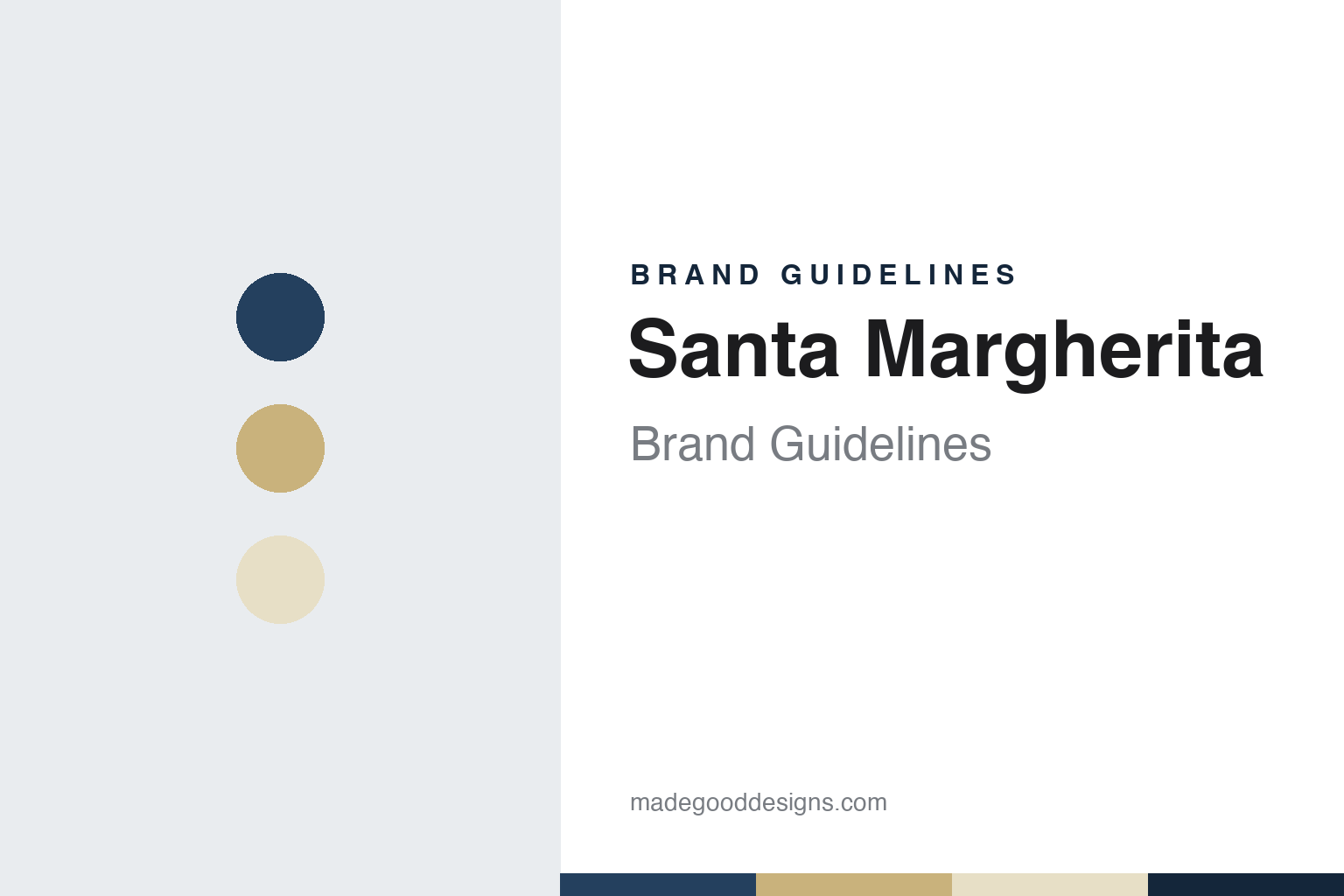
Santa Margherita Brand Guidelines
The Marzotto family’s Pinot Grigio house from the Veneto.
Aa
Two constants: a lagoon blue, straw gold and pale wheat palette and a high-contrast didone serif register. Abstract homage — not a Santa Margherita product or mark; no label, villa emblem or bottle is reproduced.
A wine estate on reclaimed land
A textile family, a drained marsh and a name taken from a wife.
Santa Margherita began as an agricultural project rather than a wine label. English Wikipedia’s article on the Marzotto Group, the textile company of the same family, says that in 1935 Gaetano Marzotto created an agricultural complex between Fossalta di Portogruaro and the Venetian Lagoon, and named it after his wife, Margherita Lampertico Marzotto. The company’s own history says the land there was largely abandoned and needed reclaiming, and that Marzotto set out to build an estate of about a thousand hectares, giving her name to the family’s table products and wines.
The wine business grew out of that estate over the following decades. The food and wine magazine Exploring Taste, in a 2016 article marking the company’s eightieth anniversary, said Santa Margherita made its first sparkling wine from the Prosecco grapes of Valdobbiadene in 1952, and that in 1979 the wine business became the company Santa Margherita SpA. Its logo, the same article said, was based on the Villa Marzotto, a country house built in 1540.
The name belongs to the family, not to a place. Santa Margherita Ligure is a resort town on the Ligurian coast with no link to the winery, which sits at the eastern edge of the Veneto, near the border with Friuli. The group remains in the hands of the Marzotto family.
The Marzottos are also remembered for motor racing. Exploring Taste recalled four brothers, Vittorio, Umberto, Giannino and Paolo Marzotto, who raced in the 1950s, with Giannino winning the Mille Miglia in 1950 and 1953, and a later member of the family driving in the historic edition of the race in 2015.
Colour
A copper-skinned grape, pressed as a white.
The wine that made the name is Santa Margherita Pinot Grigio. Pinot Grigio grapes have copper-coloured skins, and the company says its technical team, building on studies in Alto Adige, worked out a way of pressing them without letting the juice sit on the skins, so that the wine came out pale. Exploring Taste dated the development of the method to 1960, and the company describes the wine’s success as uninterrupted since 1961; it marked the fiftieth anniversary in 2011.
Advertising shaped the brand early. Exploring Taste said the first Pinot Grigio campaign, in 1981, was written by Emanuele Pirella, the Italian advertising writer, with a long line about the choice that distinguishes those who know how to choose.
The United States turned it into a household name. English Wikipedia says the Chicago importer Anthony Terlato introduced Santa Margherita Pinot Grigio to the US in 1979, and that over the following quarter-century it became one of the most successful wine imports in American history, topping Wine & Spirits magazine’s annual restaurant poll of imported wines from 1995 to 2008, citing the wine writer W. Blake Gray. The relationship ended in the mid-2010s: Exploring Taste reported that from 1 January 2016 the company managed its own US sales, and Shanken News Daily reported in 2018 that the family had set up its own American import arm, Santa Margherita USA, in 2016 after leaving the Terlato portfolio.
The winery itself was rebuilt for the brand’s second half-century. Exploring Taste said a new cellar, the Villanova winery at Fossalta, opened in 2011, and in 2012 the company marked sixty years of its Prosecco with a Prosecco Superiore named “52.”
Typography
Design and documentation.
The seven brands in this group are all Italian wine names: Antinori, Santa Margherita, Ruffino, Masi, Zonin, Bolla and Cavit. Wine brands in general sit at many different points in the trade, from family houses that still carry a founder’s name to cooperatives owned by their growers and labels that now belong to much larger drinks groups, and a single brand can be sold everywhere from a corner shop to a restaurant list.
A wine brand’s identity is usually carried less by a single bottle than by a label, a name and the place it promises, because the company behind the name may have changed hands, moved its production or grown far beyond the place where it started. That makes the questions behind each name worth asking plainly: who started it, who owns it now, and where its wine is actually made and bottled.
Each guide separates what independent sources record from what the company says about itself — its founding story, its owners over time, where its wine is made and how its labels have changed — and marks plainly what rests only on the company’s own word.
Aa
A high-contrast didone serif for a name taken from a person rather than a place. (Specimen set in Playfair Display, a serif STAND-IN; NOT the Santa Margherita logo.)
Santa Margherita
From one estate to a group of Italian wineries.
Santa Margherita has grown into a group of wineries across Italy, trading as Santa Margherita Gruppo Vinicolo. Exploring Taste listed the main steps up to 2016: the Alto Adige producer Kettmeir, founded in 1919, joined in 1986; Lamole di Lamole in Chianti Classico in 1993; the Franciacorta sparkling-wine house Ca’ del Bosco in 1994; and Sassoregale in the Maremma in 2000.
Two more followed in 2017. The Drinks Business reported in August 2017 that the group had taken a majority stake in Cantina Mesa in south-western Sardinia, whose founder, the advertising creative Gavino Sanna, stayed on as a shareholder, and a major stake in Cà Maiol, a producer founded in 1967 that took the group into the Lugana appellation for the first time. The magazine said Cantina Mesa had about 70 hectares of vineyards in the Sulcis-Iglesiente area, and that Cà Maiol, which started with 12 hectares and had grown to about 140, would continue to be run by its proprietor, Fabio Contato. Shanken News Daily reported in December 2018 that Santa Margherita USA had added both wineries to its American range early that year, alongside group estates such as Torresella, Kettmeir and Feudo Zirtari.
The group celebrated its eightieth anniversary in 2015, Exploring Taste noted, still under the name Gaetano Marzotto gave the estate in 1935.
For a design guide, Santa Margherita shows how a woman’s name, a sixteenth-century villa and one pale wine can carry a family company from a drained marsh near Venice to restaurant lists around the world. Compare Zonin, another family-owned wine group from the Veneto, and Masi, the Valpolicella house. For this guide we use lagoon blue, straw gold and pale wheat with a high-contrast serif, an unofficial interpretation; no product or logo is reproduced.
Explore & save
Keep Santa Margherita’s identity on hand — save it to a board in the Made Good inspiration library.
Santa Margherita identity set
Pin the Santa Margherita lagoon blue, straw gold and pale wheat palette and the high-contrast didone serif register to your own board.