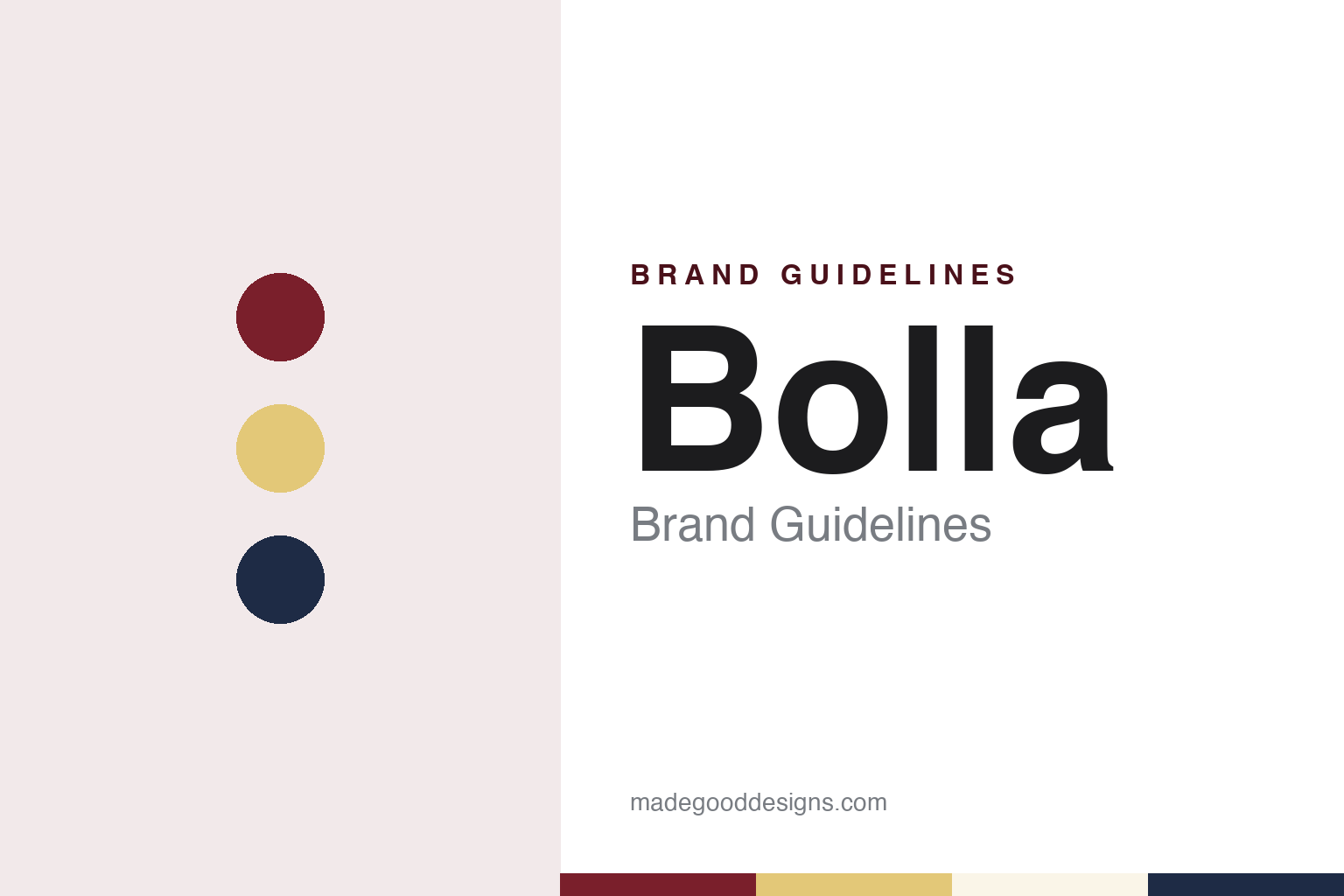
Bolla Brand Guidelines
The Soave wine house from 1883, now part of GIV.
Aa
Two constants: a Valpolicella red, Soave straw and Verona navy palette and a classic book serif register. Abstract homage — not a Bolla product or mark; no label, logo or bottle is reproduced.
An inn in Soave
A tavern’s white wine, a family and two wineries.
Bolla began in Soave, the walled town east of Verona that gives its name to the region’s best-known white wine, in 1883. The two main accounts agree on the year, the town and the family, and differ on the founder. Italian Wikipedia names Abele Bolla, who kept an inn called Al Gambero. The history published by Bolla’s owner, Gruppo Italiano Vini, credits his son Alberto Bolla: as a child, it says, Alberto spent much of his time in the cellar of his parents Abele and Giulia’s tavern, then began selling the local white wine to other taverns in Soave.
The trade spread along the roads out of town. The company says the business soon reached Verona and Venice, where Alberto and his brothers opened a restaurant in 1902 near the church of San Salvatore. Italian Wikipedia records a gold medal at a fair in Bologna in 1909 as the house’s first official recognition, and says that in 1939 it received a warrant from the royal House of Savoy allowing it to use the royal arms.
Red wine came next. According to the company, Alberto’s eldest son Giorgio, an oenologist, joined in the 1930s, and in 1931 Alberto opened a second winery at Pedemonte, in the heart of the Valpolicella Classico zone, to make Recioto and Valpolicella and later Amarone, while the Soave whites stayed at the original cellar. Italian Wikipedia credits the Bolla family with being the first to market an Amarone, dating the release of its Riserva del Nonno, from the 1950 vintage, to 13 April 1953. Italian Wikipedia adds that Bardolino, from Lake Garda, joined Soave and Valpolicella in the range.
Colour
A jingle at home and a famous name in America.
Bolla was an early user of mass media. Italian Wikipedia says the family set up Fratelli Bolla and expanded its advertising on radio and television from the 1960s, and that in 1963 the singer Giorgio Gaber performed a jingle for its commercials on RAI, the Italian state broadcaster.
The bigger story was in the United States. The American spirits company Brown-Forman, of Louisville, Kentucky, began handling Bolla in the late 1960s: Decanter reported in December 2008 that it had marketed the wines since 1968 and taken a minority stake in 1972, while Italian Wikipedia gives 1967 for the start of the import deal and a 40 per cent stake four years later. By 2000 Brown-Forman owned the Bolla business outright. The company’s own history repeats a story that Frank Sinatra would not sit down at a restaurant table unless Bolla Soave was on the wine list; it is told as a legend, not as a documented event.
The name was sold as Italian taste in a bottle. Italian Wikipedia records two slogans, “Bolla. Una storia italiana dal 1883” for Italy and “Bolla. The trusted taste in Italian Wine.” for the United States. Decanter reported that Bolla sales peaked at more than 1.5 million cases in 2001, before declining in the years that followed.
The labels still lean on the founding date. In 2024 Bolla presented new labels for its La Fondazione range, linked to the 140 years since the 1883 founding, Wine Industry Advisor reported from a company release.
Typography
Design and documentation.
The seven brands in this group are all Italian wine names: Antinori, Santa Margherita, Ruffino, Masi, Zonin, Bolla and Cavit. Wine brands in general sit at many different points in the trade, from family houses that still carry a founder’s name to cooperatives owned by their growers and labels that now belong to much larger drinks groups, and a single brand can be sold everywhere from a corner shop to a restaurant list.
A wine brand’s identity is usually carried less by a single bottle than by a label, a name and the place it promises, because the company behind the name may have changed hands, moved its production or grown far beyond the place where it started. That makes the questions behind each name worth asking plainly: who started it, who owns it now, and where its wine is actually made and bottled.
Each guide separates what independent sources record from what the company says about itself — its founding story, its owners over time, where its wine is made and how its labels have changed — and marks plainly what rests only on the company’s own word.
Aa
A classic book serif for a family name and a founding year. (Specimen set in Libre Baskerville, a serif STAND-IN; NOT the Bolla logo.)
Bolla
From an American spirits company back to an Italian wine group.
Bolla returned to Italian ownership in two steps. Gruppo Italiano Vini (GIV), a large Italian wine group, bought the Pedemonte winery in 2006 and began making Bolla wines for Brown-Forman, Decanter reported; GIV’s own history says it completed the acquisition of the company that year. In December 2008 Brown-Forman agreed to sell the Bolla brand to GIV, together with Fontana Candida, as part of what its chief executive described as a review of its portfolio. Decanter reported that GIV would take over Bolla outside the United States on 1 January 2009 and in the US by the end of April 2009.
Bolla is now part of a much larger group. Wine Spectator reported that the merged cooperative group Cantine Riunite & CIV, best known for Riunite Lambrusco, became the majority owner of GIV. Bolla’s base remains Pedemonte, in San Pietro in Cariano, in the Valpolicella hills.
In the United States the brand has changed hands among importers. Banfi Vintners became its US partner in 2009, Italian Wikipedia says. BevNews and Shanken News Daily reported in June 2019 that Frederick Wildman & Sons, an importer in which GIV holds a majority stake, was taking over the US import of Bolla, Riunite and Fontana Candida from Banfi. In April 2026 Frederick Wildman announced that Southern Glazer’s Wine & Spirits would distribute its GIV and Riunite brands in many US states from 1 May 2026.
The name needs a little care online. Bolla is also the Italian word for a bubble, and the brand’s pages sit within the GIV website.
For a design guide, Bolla shows how a family surname and a founding year can carry a Veronese wine across a century of owners, from a tavern in Soave to an American spirits company and back to an Italian group. Compare Masi, the Valpolicella house known for Amarone, and Zonin, the Gambellara wine family. For this guide we use Valpolicella red, Soave straw and Verona navy with a serif, an unofficial interpretation; no product or logo is reproduced.
Explore & save
Keep Bolla’s identity on hand — save it to a board in the Made Good inspiration library.
Bolla identity set
Pin the Bolla Valpolicella red, Soave straw and Verona navy palette and the classic book serif register to your own board.