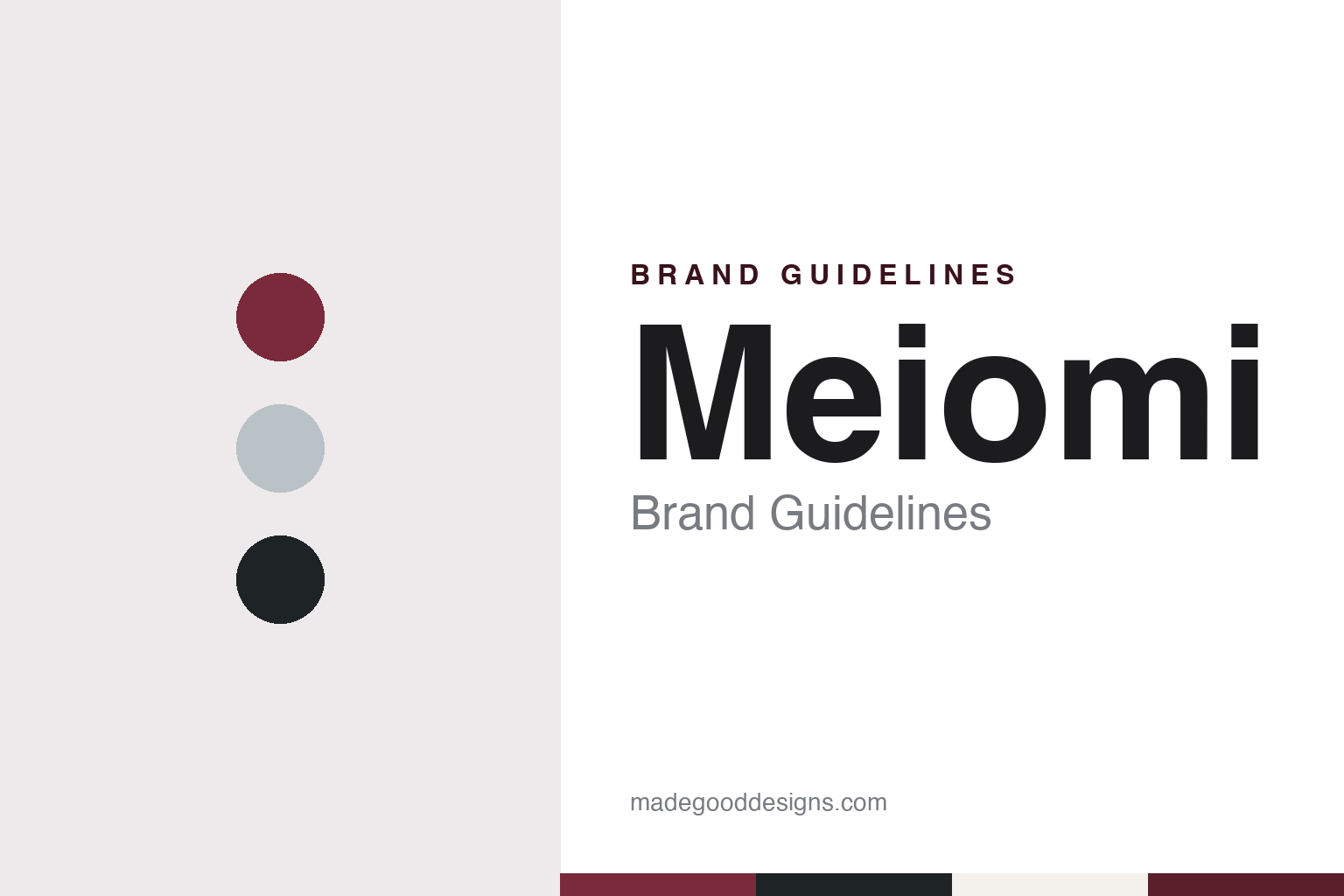
Meiomi Brand Guidelines
Joe Wagner’s three-county Pinot Noir, developed in 2006.
Aa
Two constants: a Pinot garnet, coastal fog and shell white palette and a geometric sans register. Abstract homage — not a Meiomi product or mark; no label, logo or bottle is reproduced.
A son of Caymus
A Pinot Noir side project that outgrew the family winery.
Meiomi is a California wine brand built around one grape, Pinot Noir, and one idea: blending fruit from several coastal counties rather than a single vineyard. It was developed in 2006 by Joe Wagner, Wine Spectator reported in July 2015, while he was a winemaker at Caymus Vineyards, the Napa Valley winery headed by his father, Chuck Wagner. VinePair, in a 2018 profile of the brand, described Joe Wagner as a fifth-generation winemaker and a Napa Valley native.
The brand grew out of another family label. VinePair wrote that Meiomi began as an offshoot of Belle Glos, a single-vineyard Pinot Noir label named after Joe Wagner’s grandmother, Lorna Belle Glos, and that Wagner wanted to widen the family’s Pinot Noir range at a more accessible level. The same profile placed the launch against a wider shift in taste: the 2004 film Sideways had made California Pinot Noir fashionable, and demand was rising as Meiomi took shape.
The first wine reached the market in 2009, according to Wine Spectator. Its recipe was the brand’s point of difference. Meiomi Pinot Noir is blended from grapes grown in Sonoma, Monterey and Santa Barbara counties counties on the California coast. In the 2015 Wine Spectator report Wagner was quoted on the role of each appellation in the blend, singling out Monterey as the region that gave the most for the money.
Growth was rapid. Wine Spectator reported that Meiomi sold about 90,000 cases in 2010 and grew to about 550,000 cases in 2014, when it was named a “Hot Brand” by the trade magazine Impact. A Chardonnay joined the Pinot Noir in 2014. By then Wagner had set up his own company, Copper Cane Wine & Provisions, formed in 2014 to handle Meiomi and several other labels, a move Wine Spectator described as a break from the Wagner Family of Wines led by his father.
Colour
A word for the coast, and a blend that matched it.
The name carries the brand’s idea. According to Joe Wagner, quoted by VinePair, “Meiomi” means “coastal” in Wappo, the language of an Indigenous people of Northern California. The word therefore points to the blend itself, which draws on vineyards near the Pacific rather than on one named site.
VinePair described Pinot Noir as the brand’s best seller, with the Chardonnay as the second pillar.
The range widened after the first decade. VinePair listed a rosé, a sparkling wine and a Cabernet Sauvignon, launched in 2020 and also blended from Sonoma, Monterey and Santa Barbara fruit, alongside the original Pinot Noir and Chardonnay. Across these line extensions the Meiomi name, rather than a vineyard or a grape, stayed the anchor of the label.
The brand also took on a sporting partner. VinePair reported that Meiomi began a partnership with the PGA in 2019 and became the official wine of the PGA Tour.
Meiomi’s success drew direct rivals. Shanken News Daily reported in August 2019 that Wagner’s Copper Cane was launching Böen, a Pinot Noir and Chardonnay blended from three counties, describing the new label as taking aim at Meiomi, the brand he had created.
Typography
Design and documentation.
The seven brands in this group are all American wine names: Woodbridge, Josh Cellars, Meiomi, La Crema, Duckhorn, Caymus and Stag’s Leap Wine Cellars. American wine brands in general sit at many different points in the trade, from family houses that still carry a founder’s name to labels that now belong to much larger drinks groups, and a single brand can be sold everywhere from a corner shop to a restaurant list.
A wine brand’s identity is usually carried less by a single bottle than by a label, a name and the place it promises, because the company behind the name may have changed hands, moved its production or grown far beyond the place where it started. That makes the questions behind each name worth asking plainly: who started it, who owns it now, and where its wine is actually made and bottled.
Each guide separates what independent sources record from what the company says about itself — its founding story, its owners over time, where its wine is made and how its labels have changed — and marks plainly what rests only on the company’s own word.
Aa
A clean geometric sans for a short, coastal brand name. (Specimen set in Josefin Sans, a sans-serif STAND-IN; NOT the Meiomi logo.)
Meiomi
Two owners in a decade.
The first sale came less than ten years after the brand was developed. Wine Spectator reported on 1 July 2015 that Constellation Brands, the drinks company based in Victor, New York, had agreed to buy Meiomi from Copper Cane. The deal covered the brand and its stocks of Pinot Noir and Chardonnay but included no vineyards, and Wagner agreed to stay on as a consulting winemaker for two years. The trade press reported that Belle Glos was not part of the sale. Decanter reported that Constellation completed the purchase on 4 August 2015. Wagner told Wine Spectator that Constellation would make Meiomi at several of its own production facilities in California.
Under Constellation the brand kept growing. VinePair reported that Meiomi was producing about 700,000 cases a year by 2016 and passed the million-case mark in 2017, and the Cabernet Sauvignon, rosé and sparkling wine were added in the years that followed.
A second change of owner followed a decade later. Wine Spectator reported on 9 April 2025 that Constellation had agreed to sell Meiomi to The Wine Group, together with Woodbridge, Robert Mondavi Private Selection, Cook’s, SIMI and J. Rogét, as Constellation narrowed its wine business to higher-end labels. The package included production facilities in Lodi and Monterey County and the SIMI winery in Healdsburg. The magazine described The Wine Group as the second-largest wine company in the United States by volume, and noted that Meiomi’s sales had dipped in the period before the deal. The Wine Group announced that it had completed the acquisition on 2 June 2025. For the brand’s lettering, see our note on the Meiomi font.
For a design guide, Meiomi shows how a single word, glossed by its founder as “coastal,” can stand for a multi-county blend and carry a Pinot Noir from a family side project to two of the largest wine companies in the United States. Compare Caymus, the Napa Valley winery of the Wagner family, and Woodbridge, which changed hands in the same 2025 deal. For this guide we use Pinot garnet, coastal fog and shell white with a geometric sans, an unofficial interpretation; no product or logo is reproduced.
Explore & save
Keep Meiomi’s identity on hand — save it to a board in the Made Good inspiration library.
Meiomi identity set
Pin the Meiomi Pinot garnet, coastal fog and shell white palette and the geometric sans register to your own board.