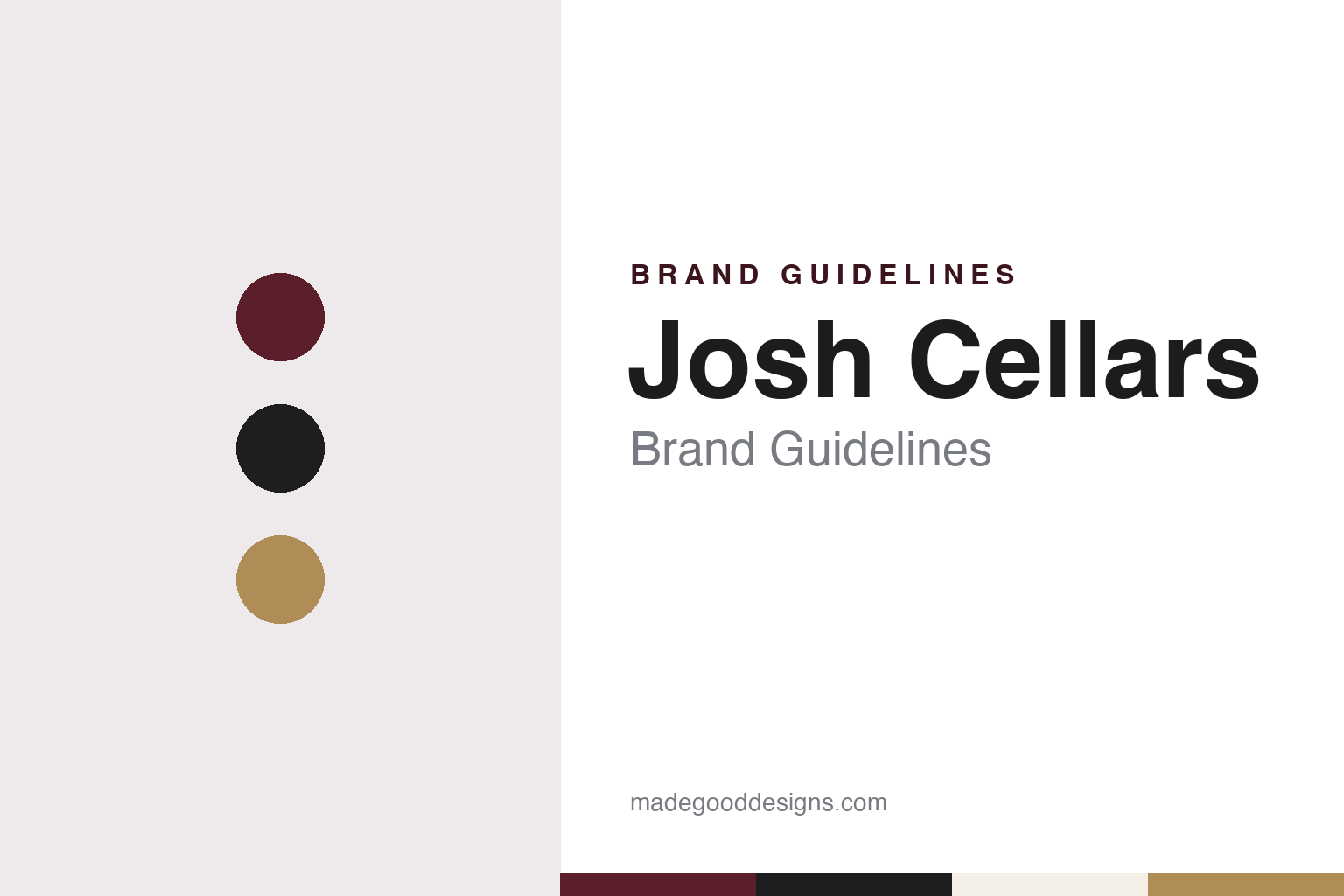
Josh Cellars Brand Guidelines
Joseph Carr’s tribute to his father, launched 2007.
Aa
Two constants: a cabernet, label black and antique gold palette and a high-contrast display serif register. Abstract homage — not a Josh Cellars product or mark; no label, logo or bottle is reproduced.
A wine named for a father
A Cabernet sold from the back of a truck.
Josh Cellars is the work of Joseph Carr, an American vintner who grew up in Upstate New York. English Wikipedia says he began developing the brand in 2005 with the Sonoma winemaker Tom Larson, and that the first wine, a Cabernet Sauvignon, was launched in 2007. Carr, it says, sold that first vintage out of the back of his truck with his wife, Dee. Shanken News Daily described Carr in 2016 as a former president of the Australian wine company Mildara Blass.
The name is a tribute. The brand is named for Carr’s father, Josh, who was not a winemaker: English Wikipedia, citing the company and a 2014 interview in Parade, describes him as a military veteran who worked as a lumberjack and a volunteer firefighter. It was Carr’s mother who suggested the name; Carr has said that although she was half joking when she said it, he loved the idea.
The wine itself has a long-serving maker. English Wikipedia says Wayne Donaldson joined as head winemaker in 2009 and oversees both the core range and the barrel-aged Josh Cellars Reserve wines, including North Coast and Paso Robles Cabernet Sauvignons. The range grew from that single Cabernet to 11 varieties by 2023, among them Chardonnay, rosé and Pinot Noir, and English Wikipedia, citing the Times Union of Albany in 2021, says the brand made wine at facilities in Paso Robles and Mendocino, in Oregon, and in Italy, where it produces Prosecco.
Colour
A plain first name in a formal script.
The label pairs a very ordinary name with a very formal hand. The brand’s wordmark sets “Josh” in a flowing cursive script, and in January 2024 that contrast made it an internet meme. After a viral post on X showed a bottle of Josh Cellars Merlot, users began joking about the irony of a simple human name rendered in sophisticated lettering, with lines such as “It’s Josh o’clock somewhere,” as English Wikipedia summarises from coverage in GQ, Bon Appétit, the San Francisco Chronicle and Business Insider that month. Some posts extended the joke to other wineries named like people. The company leaned in: its chief brand officer, Dan Kleinman, said in a statement that the team was delighted to see the brand join the conversation, ending “Let the memes flow!”
The name had been a gift to comedians before. In April 2021 a Saturday Night Live sketch had a character played by Kate McKinnon praise Josh as such a neat name for a wine and declare it “the official wine of Rummikub,” and Carr told the Times Union the exposure said something about how the brand was getting out there. In 2022 the brand’s “Joshgiving” campaign starred the singer Josh Groban and called on Joshes across the country to perform acts of thanks before Thanksgiving.
The first name in script is the brand’s fixed point. Our separate note on the Josh Cellars font looks at the lettering more closely.
Typography
Design and documentation.
The seven brands in this group are all American wine names: Woodbridge, Josh Cellars, Meiomi, La Crema, Duckhorn, Caymus and Stag’s Leap Wine Cellars. American wine brands in general sit at many different points in the trade, from family houses that still carry a founder’s name to labels that now belong to much larger drinks groups, and a single brand can be sold everywhere from a corner shop to a restaurant list.
A wine brand’s identity is usually carried less by a single bottle than by a label, a name and the place it promises, because the company behind the name may have changed hands, moved its production or grown far beyond the place where it started. That makes the questions behind each name worth asking plainly: who started it, who owns it now, and where its wine is actually made and bottled.
Each guide separates what independent sources record from what the company says about itself — its founding story, its owners over time, where its wine is made and how its labels have changed — and marks plainly what rests only on the company’s own word.
Aa
A high-contrast display serif beside a cursive first name. (Specimen set in Playfair Display, a serif STAND-IN; NOT the Josh Cellars logo.)
Josh Cellars
A small brand that a family importer made very large.
The brand’s growth came through Deutsch Family Wine & Spirits, then trading as W. J. Deutsch & Sons. Shanken News Daily reported on 30 June 2011 that Deutsch had signed an exclusive US marketing and sales agreement for Carr’s two brands, Josh Cellars and the Napa Valley label Joseph Carr, taking effect on 1 July. At the time, the article listed the Josh Cellars range as a North Coast Cabernet Sauvignon and a North Coast Chardonnay, and Deutsch expected to sell about 60,000 cases of the two brands combined over the following year. In December 2016 the same publication reported that Deutsch acquired full control of Josh Cellars a year after that deal, when it was selling about 25,000 cases; English Wikipedia dates the acquisition to 2011 and says Carr remained the face of the company.
The numbers then changed quickly. English Wikipedia says sales rose from about 130,000 cases in 2012 to about 980,000 cases in 2015, and, citing The Wall Street Journal in October 2024, that production reached about 7.5 million cases across 23 wines by 2024. VinePair reported in 2023 that Josh was the best-selling premium table wine brand in the United States.
Deutsch is a family company founded in 1981 by Bill Deutsch and now led by his son, Peter Deutsch. It moved its headquarters from White Plains, New York, to Stamford, Connecticut, after an announcement by the state’s governor in December 2015. Deutsch is also the American importer that introduced [yellow tail] to the United States in 2001.
For a design guide, Josh Cellars shows how a family story, a plain first name and a formal script can carry a wine brand from the back of a truck to national shelves — and how a brand can embrace the joke when the internet notices the contrast. Compare [yellow tail], the wallaby wine Deutsch brought to America, and Barefoot, the Californian brand named in the post that started the meme. For this guide we use cabernet, label black and antique gold with a serif, an unofficial interpretation; no product or logo is reproduced.
Explore & save
Keep Josh Cellars’s identity on hand — save it to a board in the Made Good inspiration library.
Josh Cellars identity set
Pin the Josh Cellars cabernet, label black and antique gold palette and the high-contrast display serif register to your own board.