Bacardi Breezer Brand Guidelines
The 1990 rum cooler that lost its bat.
Aa
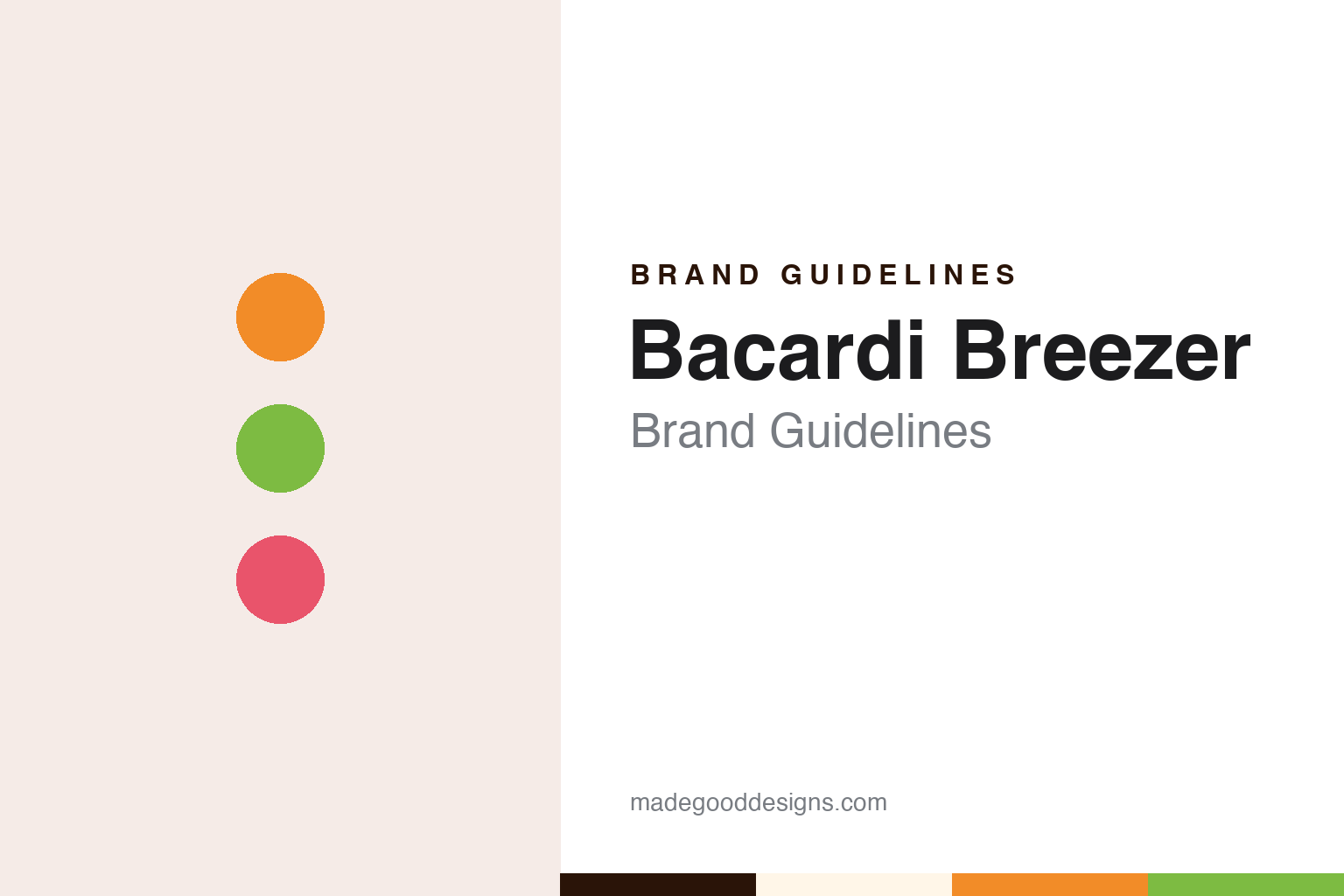
Two constants: a sunrise orange, lime zest and watermelon palette and a contemporary geometric sans register. Abstract homage — not a Breezer product or mark; no bottle, label, crown or bat is reproduced.
Bacardí Breezer
A rum company’s fruit cooler, born in America.
Breezer is the fruit-flavoured ready-to-drink line of Bacardi, the spirits company founded in Santiago de Cuba in 1862 by Facundo Bacardí Massó. English Wikipedia describes Bacardi today as a private, family-owned company with its headquarters in Hamilton, Bermuda, and lists the Breezer among its main brands. For most of its life the drink carried the parent company’s name and was sold as Bacardí Breezer. English Wikipedia describes the classic version as a premix of Bacardi rum, sparkling water and added sugar, sold in a long run of fruit flavours that stretches from lemon, lime and orange to watermelon, lychee and mango.
The brand started in the United States. A 2020 history of the drink in VICE, written by Andrea Strafile, says it was launched in the US in 1990, and The Spirits Business gave the same year and market in May 2025, describing Breezer as a flavoured alcoholic beverage brand first launched in the US under the name Bacardí Breezer. According to VICE, the drink reached Europe a few years later, arriving in the UK in 1993 and in Italy in 2001.
The British launch is unusually well documented, because it became an advertising case study. The Institute of Practitioners in Advertising (IPA) holds a 1998 paper from its Effectiveness Awards, credited to the agency McCann for the client Bacardi-Martini UK. It says the drink was first launched in the Tyne Tees television region in 1993, into a “cooler” market that did not yet exist in Britain, and that the regional launch went well enough for a national roll-out in spring 1994. The same paper says early consumer response was not positive, because the drink found itself competing with beer, and that television and radio advertising was used to position it as cutting-edge and innovative.
Colour
A bat on the label and a free spirit in the ads.
For three decades the Breezer wore its parent’s badge: until the 2023 redesign, Creative Review reports, it carried the classic Bacardi bat, the emblem of the rum brand, as well as the Bacardí name. VICE calls the original a “colourful drink” that was very much a product of its time.
The advertising leaned on attitude rather than ingredients. VICE says the brand’s line was built around a “free spirit in everyone” — in some versions a “Latin spirit” — and that its commercials set dull, responsibility-laden adult life against the breezy fun of young party-goers. Citing the textbook Principles of Marketing by Frances Brassington and Stephen Pettitt, the same article says Bacardi was among the early brands to tailor its advertising to different platforms, including online.
English Wikipedia says the Breezer became one of the best-known alcopops in Britain during the 1990s and 2000s. Its British life then ended: both VICE and The Spirits Business report that the traditional Bacardí Breezer was discontinued in the UK in 2015. VICE adds that a new generation of Breezers followed in 2019, with flavour pairings such as lemon and elderflower. Elsewhere the drink kept going: in 2023 the London design agency behind its next look described the Breezer as popular in markets including India, Scandinavia, South Africa and Canada, as reported by Creative Review.
Typography
Design and documentation.
The seven brands in this group are all ready-to-drink names: Vizzy, Smirnoff Ice, Bacardi Breezer, Cutwater, Kirin Hyoketsu, Mike’s Hard Lemonade and Twisted Tea. Several of them come from companies better known for beer or wine. The Boston Beer Company, maker of Samuel Adams, first sold its hard iced tea in 2000 as BoDean’s Twisted Tea and renamed it Twisted Tea in 2001, the company says; Molson Coors launched Vizzy nationally in the United States in April 2020. Kirin Brewery launched Hyoketsu in Japan in 2001, according to a Kirin release of April 2016. Mike’s Hard Lemonade comes from the family-owned Mark Anthony group founded by Anthony von Mandl, which says it began in 1972 as a one-person wine importer.
Others sit inside spirits houses or were bought by one. Smirnoff Ice belongs to Diageo, and English Wikipedia notes that in the United States it is a malt beverage, while in many other markets it is made with Smirnoff vodka. Bacardi Breezer, which English Wikipedia describes as a premix of Bacardi rum, was launched in Britain in 1993, the same article says, citing the BBC. Cutwater was founded in San Diego in 2016 by former Ballast Point executives, FoodBev reported, and in February 2019 The Whiskey Wash reported its purchase by Anheuser-Busch.
A ready-to-drink brand’s identity is carried largely by a can, a name and a flavour list, and the same name can cover different recipes in different countries. Each guide separates what independent sources record from what the company says about itself — who launched it, who owns it now and how its packs have changed — and marks plainly what rests only on the company’s own word.
Aa
A contemporary geometric sans for a fruit cooler that dropped its bat. (Specimen set in Outfit, a sans STAND-IN; NOT the Breezer wordmark or logo.)
Breezer
A crown, a sunrise and a return to Britain.
In 2023 the drink was given a new global identity by Knockout, a London agency that specialises in drinks and spirits. Creative Review, reporting the project on 31 May 2023, says the brand was now simply Breezer and that the classic Bacardi bat was gone. In its place Knockout drew a crown, made to look as if it had been splashed onto the packaging to suggest playful refreshment. The wordmark was redrawn in a more contemporary typeface, with rays of sunshine behind it that evoke the sun rising over the horizon and point to daytime drinking occasions. Colourful abstract patterns on the bottle neck and lower label stand for the range’s seventeen flavours; Creative Review says they were influenced by street art and combine dotted screenprinting with varnish texturing so that the label looks and feels like fruit skin. Dominic Burke, Knockout’s founder and creative director, said the rebrand gave Breezer “the iconic assets to demonstrate its authority in the RTD category.” The Spirits Business later described the 2023 look as an attempt to recruit “the next generation of drinkers.”
That new name carried the drink back to Britain. The Spirits Business reported on 22 May 2025 that Breezer would return to UK supermarket shelves in June 2025 with three flavours — Zesty Orange, Zingy Lime and Crisp Watermelon — in 275ml glass bottles at 3.4% ABV. Steve Young, business unit director for Bacardi UK & Ireland, said: “We know there is a lot of love for Breezer in the UK, and we are confident a new generation of consumers will fall in love with the new Breezer.” The company said it would aim the relaunch at two groups: Gen Z drinkers new to the brand, and older drinkers who remember the original and might enjoy the nostalgia of its return.
For a design guide, Breezer shows how a sub-brand can step out from under its parent’s emblem: three decades under the Bacardi bat, then a crown, a sunrise and a fruit-skin texture of its own. Compare Smirnoff Ice and the Turin vermouth house Martini. For this guide we use sunrise orange, lime zest and watermelon with a sans, an unofficial interpretation; no product or logo is reproduced.
Explore & save
Keep Bacardi Breezer’s identity on hand — save it to a board in the Made Good inspiration library.
Breezer identity set
Pin the Breezer sunrise orange, lime zest and watermelon palette and the contemporary geometric sans register to your own board.