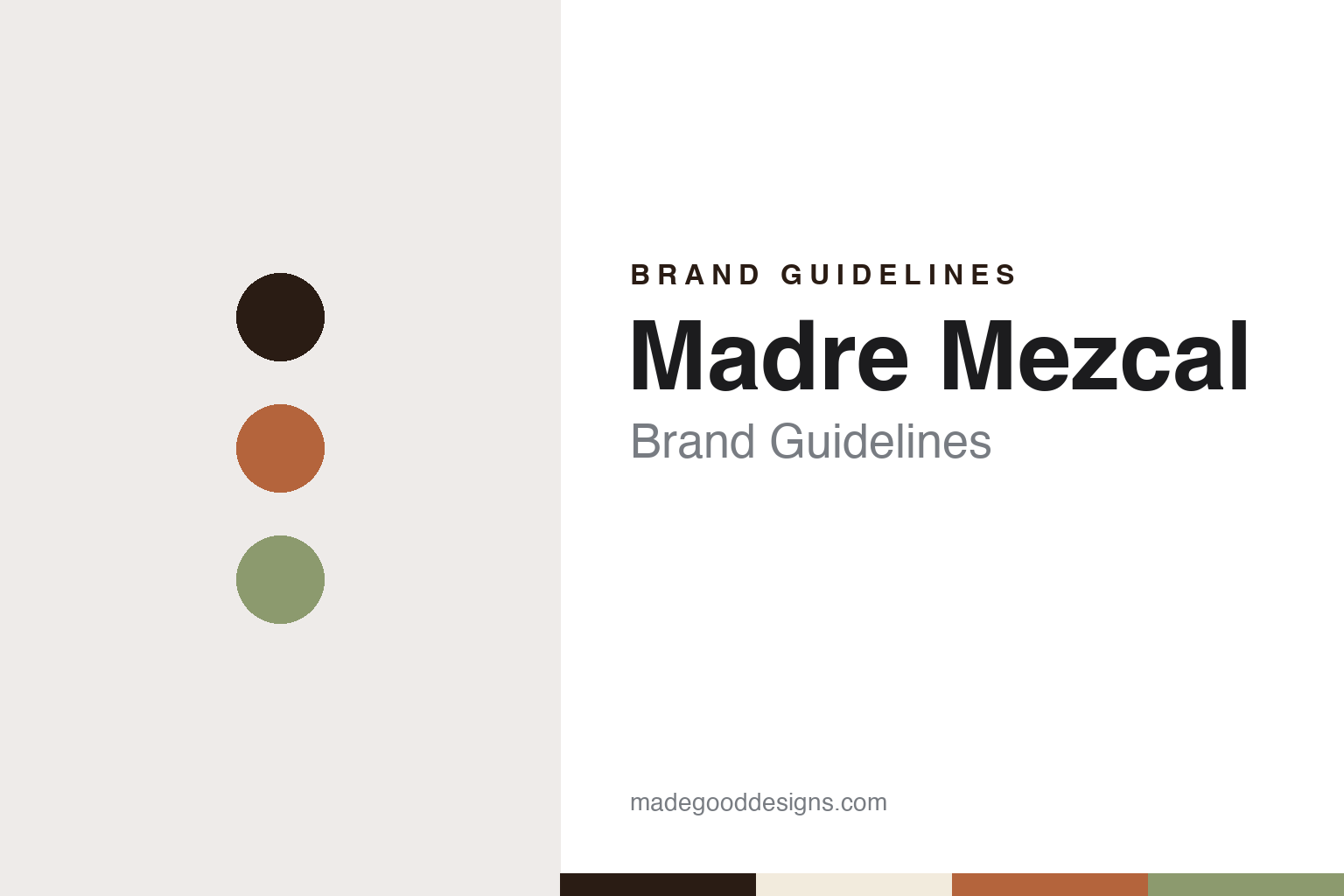
Madre Mezcal Brand Guidelines
A family palenque in San Dionisio Ocotepec and a mezcal named for the mother.
Aa
Two constants: an earth brown, clay terracotta and agave sage palette and an earthy soft serif register. Abstract homage — not a Madre Mezcal product or mark; no bottle, label or logo is reproduced.
Mezcal found us
Two childhood friends, a plastic bottle and a family in San Dionisio.
Madre Mezcal began with a bottle carried home from Oaxaca. According to the drinks site VinePair, which profiled the brand in August 2022, the artist Tony Farfalla and the photographer and brand specialist Stefan Wigand, friends since childhood, met up in Montauk, New York, in 2014 and shared a mezcal Farfalla had brought back from Mexico. Flaviar Times reported in 2020 that Farfalla had first come across mezcal while documenting witchcraft in Mexico, and quoted him summing up the start of the venture as “We didn’t find Mezcal — Mezcal found us.” Wigand told VinePair that when the two went back to Oaxaca together, they did not go down thinking it would become a business.
On that trip they met the García Morales family of San Dionisio Ocotepec, in the Oaxacan hills, whose recipe Gestalten said drew on generations of mezcal-making know-how. The Berlin publisher, writing in 2019, said every batch was distilled in a palenque built by José Inés García Morales, and that the brand came out of roughly three years of return visits, recipe work with the family and market research. VinePair likewise said the recipe took three years to settle. In the early days, the company says, the mezcal crossed the border in plastic bottles and was picked up by bartenders in Brooklyn, before the move to hand-poured glass.
The company itself, VinePair says, was founded in 2016, when Farfalla and Wigand joined forces with two partners: Davide Berruto, whom Flaviar Times described as Farfalla’s former mentor and the owner of a sustainable furniture business, and Chris Stephenson, a former chief marketing officer of MTV. The name means “mother”; VinePair says it was chosen to honour the land and the people who make the mezcal, and the brand’s own site calls it “a celebration of Mother Earth.”
Colour
Espadín, cuishe and five producing families.
The original Madre is an ensamble, a blend of two agaves. Flaviar Times reported that the espadín in it is cultivated while the cuishe is harvested wild, and that the founders described the result as a “gateway” mezcal, made a little less smoky to suit first-time drinkers. VinePair said the family plants, cuts and blesses the agave before cooking it in an earthen pit and fermenting it with wild yeast, and Gestalten wrote that the cooked agave is ground with a stone pulled by a horse. Flaviar Times placed the distillery on a hillside about half an hour outside Santiago Matatlán, between Matatlán and San Dionisio.
Madre has since widened the circle of producers. Its website now says its spirits are made by five families. José Inés García Morales and his family, whom the company calls its original and current mezcal producer, still supply espadín and cuishe. In Santiago Matatlán, the company says, Carlos Méndez Blas and his family, who began making mezcal in 1930, produce espadín and oversee bottling. The family of Isabel Martínez Ríos in Palmar, in the Miahuatlán district, makes cuishe, and in Santa Catarina Minas Moisés Martínez Álvarez makes Madre Ancestral from his own blend of tobasiche and espadín, crushing the agave by hand and distilling in clay pots.
The fifth family is in Jalisco. A February 2025 company announcement said Madre had launched an additive-free tequila in 2024, and the company names the family of Don Carlos Padilla in San Julián, in the Los Altos highlands of Jalisco, as its producer there. Alongside the ensamble, the range has included a single-agave Madre Espadín and Desert Water, a ready-to-drink mix of mezcal and sparkling water that VinePair listed in 2022.
Typography
Design and documentation.
The seven brands in this group are all mezcal names: Bozal, Alipús, Real Minero, Rey Campero, Mezcal Vago, Madre and Dos Hombres. Mezcal is distilled from cooked agave, and much of it is made in small production houses that Wikipedia notes are called fábricas or palenques, often in villages in the hills of Oaxaca. The traditional method roasts the agave hearts in pit ovens and crushes them with a stone wheel turned by a horse, and Wikipedia says mezcal has been recognised internationally as an appellation of origin since 1994.
A mezcal brand’s identity is usually carried less by a single bottle than by a label, a name and the village it points to, because the company that sells the mezcal is not always the family that makes it, and one brand can draw on several producers. That makes the questions behind each name worth asking plainly: who started it, who owns it now, and which families and palenques actually make the mezcal.
Each guide separates what independent sources record from what the company says about itself — its founding story, its owners over time, where its mezcal is made and how its labels have changed — and marks plainly what rests only on the company’s own word.
Madre
An earthy soft serif for a mezcal whose name means “mother.” (Specimen set in Fraunces, a serif STAND-IN; NOT the Madre Mezcal logo or its lettering.)
Madre Mezcal
A studio called LAND, a funded independent and a mezcal school.
Madre’s look was built by LAND, the design studio of Caleb Owen Everitt and Ryan Rhodes. Gestalten featured the work in July 2019, drawing on its book Upstart!, and quoted the designers: “The design hallmarks of the Madre Mezcal brand are simplicity and honesty mixed with mystery.” LAND’s own case study credits the studio with the branding, packaging, art direction, naming, signage and brand vocabulary. VinePair wrote in 2022 that Farfalla’s surrealist art also shapes the brand’s design. Around the bottles, the company publishes a journal, a radio series and films, and runs Mezcal Learning, an Instagram-based course it describes as an offering to the world.
Madre remains an independent company. A February 2025 company announcement named co-founder Chris Stephenson as chief executive and said Madre had raised a Series A round in 2021 led by Room9 and closed a further round in 2024; the investment and consulting firm No Sleep Beverage said in March 2025 that it had invested in Madre in the second half of 2024. The company says its mezcal is now sold across the United States and in parts of Europe, Asia and Australia. VinePair reported in 2022 that proceeds from a “Together Campaign” of pins, posters and T-shirts went to RAICES, a nonprofit offering legal services to immigrants, and that a share of proceeds supported three women-led nonprofits in Oaxaca.
For a design guide, Madre Mezcal shows how a one-word name — “mother” — and a studio’s plain, slightly mysterious identity can carry a family palenque in San Dionisio Ocotepec to bars in Brooklyn and beyond. Compare Del Maguey, Ron Cooper’s single-village mezcal, and Montelobos, the mezcal from Santiago Matatlán. For this guide we use an earth brown, a clay terracotta and an agave sage with a soft serif, an unofficial interpretation; no product or logo is reproduced.
Explore & save
Keep Madre Mezcal’s identity on hand — save it to a board in the Made Good inspiration library.
Madre Mezcal identity set
Pin the Madre Mezcal earth brown, clay terracotta and agave sage palette and the earthy soft serif register to your own board.


