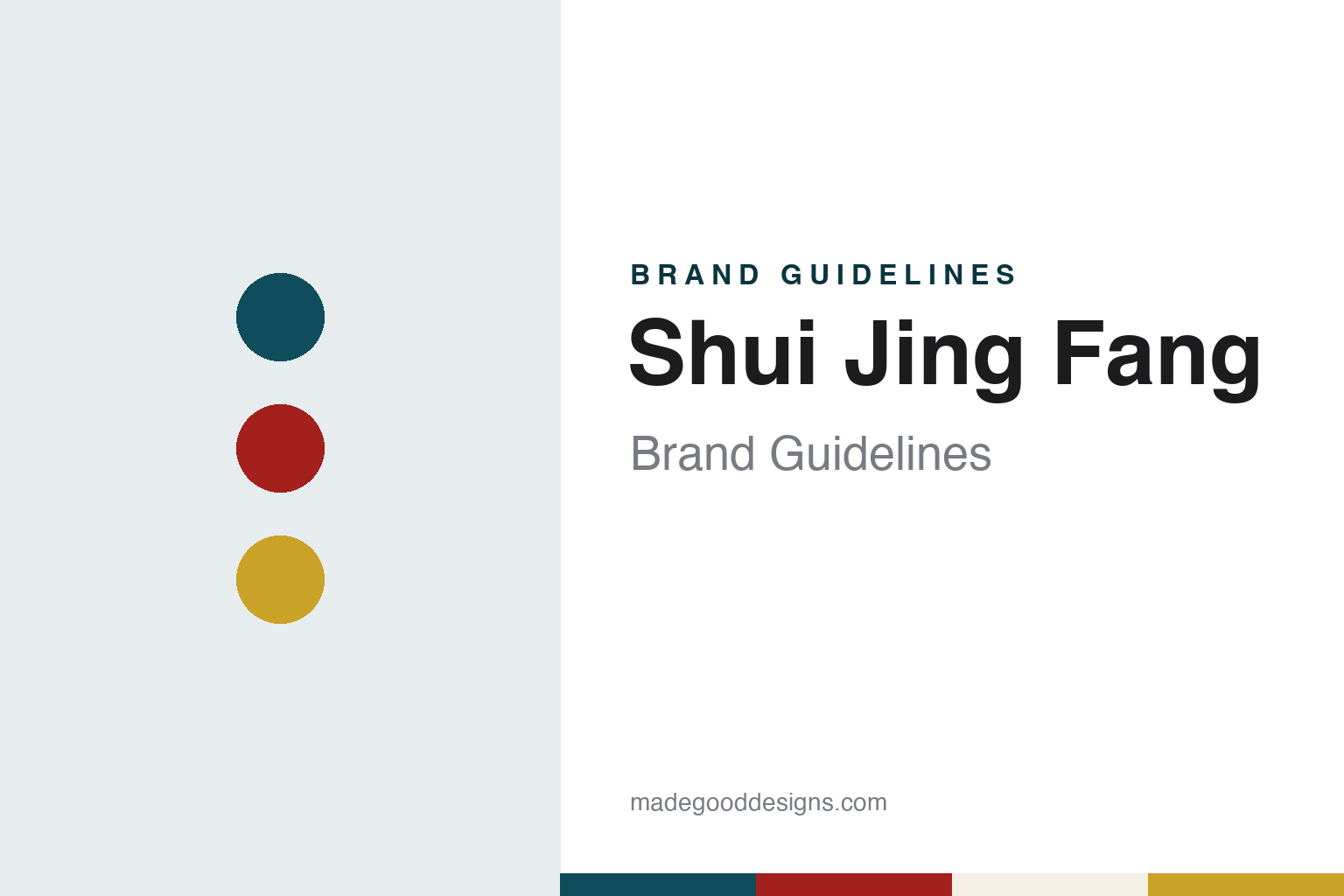
Shui Jing Fang Brand Guidelines
The Chengdu baijiu named after a street-side distillery ruin.
Aa
Two constants: a well-water teal, lacquer red and ginkgo gold palette and a classical serif register. Abstract homage — not a Shui Jing Fang product or mark; no bottle, label or logo is reproduced.
A ruin on Shuijing Street
An old distillery under a working one.
Shui Jing Fang takes its name from a place. The baijiu is named after Shuijing Street in Chengdu, the capital of Sichuan, and after the workshop found beneath it. Chinese Wikipedia’s article on the site says that in August 1998 workers at the Chengdu Quanxing distillery, rebuilding a factory building, came upon an ancient distillery underground. Derek Sandhaus, writing in The Oxford Companion to Spirits & Cocktails, describes the find as the ruins of a fifteenth-century distillery under Quanxing’s works on the street.
Archaeologists excavated part of the site in March and April 1999. According to the Chinese Wikipedia article, which cites a 2004 volume on China’s protected monuments, the dig uncovered three drying floors from the Ming, Qing and modern periods, eight fermentation pits and four stoves, with pottery drinking vessels the most common find. Sichuan listed the workshop as a provincial protected site in January 2000, and on 25 June 2001 the State Council named it a National Key Cultural Relics Protection Unit, in the fifth batch of such sites.
Quanxing turned the discovery into a brand. Sandhaus writes that the company released Shui Jing Fang in 2000 as a new premium baijiu; the business site TMTPost, in a 2022 history of the company, dates the launch to August 2000 and describes it as Quanxing’s high-end label. Chinese Wikipedia classes the spirit as a strong-aroma baijiu, the style associated with Sichuan, and notes that its traditional brewing technique was added to China’s national list of intangible cultural heritage in 2008. The company calls Shui Jing Fang “China’s first distillery,” World Baijiu Day reported in 2015.
Colour
From a pharmaceutical listing to a Diageo subsidiary.
The company that makes Shui Jing Fang has an unusual corporate past. Chinese Wikipedia says the listed business began as the Sichuan Pharmaceutical Factory, was restructured as a joint-stock company in 1993 and listed on the Shanghai Stock Exchange in December 1996. TMTPost reported that in 1999 the Quanxing group put its liquor business into the listed company, which was renamed Quanxing Shares, and that in October 2006 the company took the name Sichuan Shuijingfang Co., Ltd., after the brand it had launched six years earlier.
A foreign owner followed. In an announcement of 25 April 2012, Diageo set out its history with Quanxing, the group that held about 39.7% of the listed Shuijingfang company: Diageo bought 43% of Quanxing in February 2007, raised its holding to 49% in July 2008 and to 53% in July 2011, which gave it control. Chinese takeover rules then obliged it to offer to buy the remaining listed shares, and the April 2012 announcement reported that the offer had closed with only a nominal number of shares tendered. Sandhaus likewise dates Diageo’s first agreement to 2007 and its majority to 2011.
In July 2013 Chinese authorities approved Diageo’s purchase of the remaining 47% of the holding company, Xinhua and Ta Kung Pao reported, as cited by Chinese Wikipedia; the older mid-priced Quanxing Daqu brand had passed to a group led by Bright Food, CCTV reported in March 2012. Diageo later went to the market again. A Diageo press release of 4 April 2019 said a partial tender offer had closed, and that on completion its stake in Shuijingfang would rise from 60% to about 63.14%.
That holding came under scrutiny in 2026. Vino Joy News, relaying a Bloomberg report, wrote on 16 January 2026 that Diageo was reviewing its China operations, including a possible sale of its stake of more than 63%, that talks were at an early stage and that no decision had been made; Shuijingfang said it had received no information about a sale. On 10 August 2026 Blue Whale News reported that Diageo’s chief executive, Dave Lewis, would not comment on market rumours, and the report described no agreed sale.
Diageo took the brand abroad. Luxart Asia reported in July 2011 that Diageo had launched Shui Jing Fang in Singapore as part of an international roll-out, in four variants: Wellbay, Classic, Scholar’s Edition and Forest Green.
Typography
Design and documentation.
The seven brands in this group are all Chinese baijiu names: Jiannanchun, Xifeng, Langjiu, Gujing Gongjiu, Shui Jing Fang, Jiugui and Hongxing Erguotou. Four come from western China — Jiannanchun from Mianzhu and Shui Jing Fang from Chengdu, both in Sichuan; Langjiu from Erlang in Gulin County, also in Sichuan; and Xifeng from Fengxiang, near Baoji in Shaanxi. Gujing Gongjiu is made at Gujing, near Bozhou in Anhui; Jiugui comes from Jishou in western Hunan; and Hongxing Erguotou is a Beijing brand.
Baijiu is sorted into aroma styles, and the group spans several of them. Chinese Wikipedia classes Jiannanchun and Gujing Gongjiu as strong-aroma baijiu, Langjiu as sauce-aroma, Xifeng as the phoenix-aroma style, and Jiugui as a mixed-aroma spirit of its own fuyu type; Beijing Red Star describes its erguotou as light-aroma. Ownership varies just as widely. Shui Jing Fang’s Shanghai-listed company is controlled by Diageo; Jiugui’s Shenzhen-listed company sits within the state food group COFCO; Gujing’s company has been listed in Shenzhen since 1996; and Hongxing Erguotou’s maker is owned by Beijing state investors.
A baijiu brand’s identity is usually carried by a name, a place and a bottle rather than by a single logo, and the company behind the name may have been merged, listed or sold many times since the brand began. Each guide separates what independent sources record from what the company says about itself — its founding story, its owners over time, where its baijiu is distilled and bottled, and how its labels have changed — and marks plainly what rests only on the company’s own word.
Aa
A classical serif for a brand built on an excavated past. (Specimen set in Noto Serif, a serif STAND-IN; NOT the Shui Jing Fang logo.)
Shui Jing Fang
A brand that tells its story through a place.
The brand’s visual language leans on Chengdu. In December 2013 The Moodie Davitt Report, the travel-retail trade title, described a Red Fortune edition released for the Chinese New Year: a red bottle painted with a gold design of the ginkgo, which the report said was chosen to symbolise Chengdu. English Wikipedia lists the ginkgo as Chengdu’s city tree.
The excavated workshop is the brand’s anchor. The company’s description of Shui Jing Fang as “China’s first distillery” points back to the site on Shuijing Street, a protected national monument since 2001. The name needs care online: “Shui Jing Fang” is also the name of a real-estate development in Chengdu, so the spirit is best searched together with the word baijiu or the company name.
For a design guide, Shui Jing Fang shows how an archaeological find, a street name and a city emblem can carry a young brand with an old story. Compare Wuliangye and Luzhou Laojiao, two other Sichuan baijiu makers. For this guide we use well-water teal, lacquer red and ginkgo gold with a serif, an unofficial interpretation; no product or logo is reproduced.
Explore & save
Keep Shui Jing Fang’s identity on hand — save it to a board in the Made Good inspiration library.
Shui Jing Fang identity set
Pin the Shui Jing Fang well-water teal, lacquer red and ginkgo gold palette and the classical serif register to your own board.


