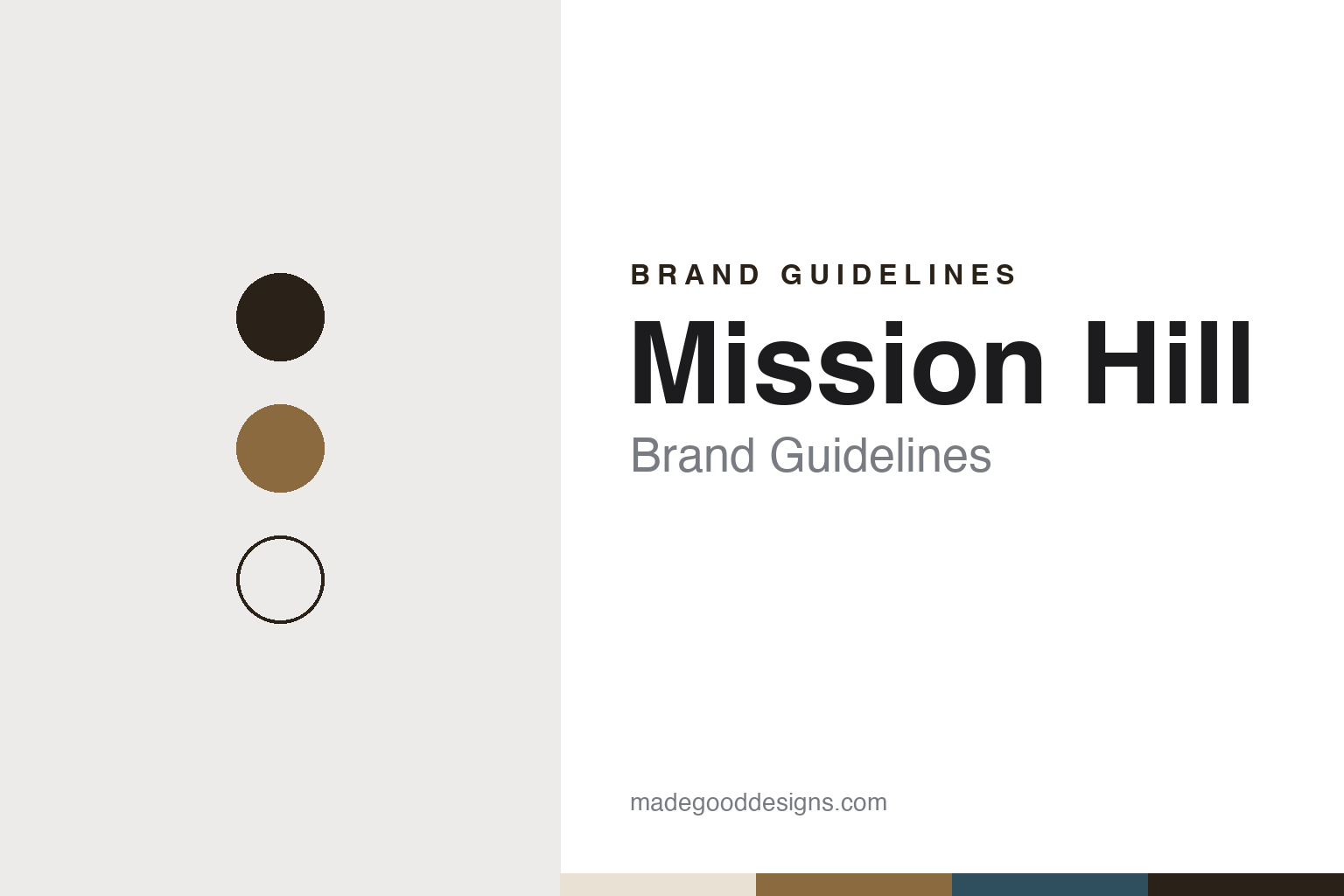
Mission Hill Brand Guidelines
Anthony von Mandl’s bell-tower winery in West Kelowna.
Aa
Two constants: a limestone, bell bronze and lake slate palette and a classical serif register. Abstract homage — not a Mission Hill product or mark; no label, logo or bottle is reproduced.
A hilltop winery, bought in 1981
From a struggling 1960s venture to the flagship of a wine and drinks entrepreneur.
Mission Hill Family Estate sits on a hilltop in West Kelowna, British Columbia, looking out over Okanagan Lake. The winery is older than the name its owner made famous. The Encyclopedia of British Columbia says it was established in 1966 by a Kelowna business syndicate, and English Wikipedia gives the same year, citing a 1966 report in The Sun. The British wine writer Jamie Goode, writing on his site Wine Anorak after a 2014 visit, dates the start to 1965, when a consortium led by the Okanagan businessman Tiny Walrod began a winery called Mission Hills on the hill.
The early years were unsettled. The Encyclopedia of British Columbia says the original owners sold in 1970 to Ben Ginter, who ran the business until 1981. Goode describes it trading for a time as Uncle Ben’s Gourmet Wines and then as Golden Valley Wines.
In 1981 the Vancouver wine seller Anthony von Mandl bought the winery, which English Wikipedia describes as abandoned by then; Goode says it was trading as Golden Valley Wines. The winery dates its own story from that year and calls it the founding of Mission Hill Winery. On 2 October 1981, it says, von Mandl told the Kelowna Chamber of Commerce that he saw the valley as a future “Napa Valley of Canada,” with vineyards, estate wineries and inns running down its length. Goode notes that von Mandl had already founded the drinks company that became the Mark Anthony group in 1972, after studying economics at the University of British Columbia.
The first years under von Mandl leaned on something other than wine. Goode writes that the winery was also making a cider, Golden Valley Cider, and that von Mandl added fruit-flavoured versions and renamed the line Okanagan Premium Cider; von Mandl told him the cider “kept the winery alive.” The same entrepreneurial streak shows in the rest of his business. According to Goode, von Mandl imported Corona beer into Canada from 1986 to 2007 and launched Mike’s Hard Lemonade in Canada in 1996 and in the United States in 1999, and English Wikipedia, citing The New York Times in 2010, also credits him with founding Mike’s Hard Lemonade Co.
Colour
A bell tower, an oculus and a label made of metal.
Mission Hill’s most recognisable design asset is a building. English Wikipedia, citing The Seattle Times in 2003, says the Seattle firm Olson Kundig was commissioned in 1996 to rebuild the winery, its first winery project, and that the work was completed in 2002; the winery itself says the architect Tom Kundig began a six-year transformation of the estate in 1997. Von Mandl told Goode he “didn’t want a North American feel” and wanted something closer to a transition between North America and Europe.
The centrepiece is a twelve-storey bell tower. Goode and English Wikipedia both record that it holds four bells cast by the foundry Fonderie Paccard in Annecy, France. Around it the winery added a courtyard and the Terrace restaurant overlooking the lake, which English Wikipedia says opened in 2002, and Goode noted works of art in the winery and cellars.
The architecture also names the flagship wine. Oculus is a Bordeaux-style red blending Merlot, Cabernet Sauvignon, Cabernet Franc and Petit Verdot, and English Wikipedia, citing The New York Times, says the name refers to the round window of classical architecture. Goode writes that Oculus was first made in 1997, with help from the French consultant Michel Rolland.
Packaging has occasionally gone further. Goode noted that the Perpetua Chardonnay carried a metal label. And in the cider years, he writes, von Mandl travelled to Switzerland to find the four-colour printing process he wanted for the label.
The range is organised as a ladder of collections. English Wikipedia lists Reserve as the entry tier, then the Terroir Collection and the Legacy collection at the top, and the winery’s own shop today groups its wines as Reserve, Terroir, Legacy and Oculus.
Typography
Design and documentation.
The seven brands in this group are all Canadian wineries: Inniskillin, Jackson-Triggs, Peller Estates and Cave Spring from Ontario’s Niagara Peninsula, and Mission Hill, Quails’ Gate and Burrowing Owl from British Columbia’s Okanagan Valley. Some still carry a founding family’s name or are run by that family; others now sit inside much larger wine companies, and two of the Niagara names reach into the Okanagan as well.
Ownership is the clearest dividing line. Inniskillin, founded by Donald Ziraldo and Karl Kaiser with a first planting in 1974, and Jackson-Triggs, launched in 1993 by the company Donald Triggs and Allan Jackson built from the old Cartier wines, both passed through Vincor and Constellation Brands and today trade under Arterra Wines Canada, the name the business took in 2017 after Constellation sold its Canadian wine arm, English Wikipedia says. Peller Estates belongs to Andrew Peller Ltd of Grimsby, Ontario, which agreed in June 2026 to be taken private by Fairfax Financial Holdings, Canadian Grocer reported. In the Okanagan, Anthony von Mandl bought the Mission Hill estate in West Kelowna in 1981; Quails’ Gate grew from land the Stewart family began planting in 1956 and relaunched as a winery in 1989; and Burrowing Owl, near Oliver, began when Jim Wyse bought vineyard land in 1993, with the winery itself built in 1998, the company says. Cave Spring’s first vintage came in 1986, from vines the Pennachetti family planted in 1978.
A Canadian wine brand’s identity is usually carried by a label, a place name and a story about the land, because the company behind the name may have merged, been sold or grown far beyond its first vineyard. Each guide separates what independent sources record from what the winery says about itself — its founding story, its owners over time, where its wine is grown and made, and how its labels and buildings present it — and marks plainly what rests only on the company’s own word.
Aa
A classical serif for an estate that names its wines after architecture. (Specimen set in Cormorant Garamond, a serif STAND-IN; NOT the Mission Hill logo.)
Mission Hill
Vineyards to the south, and a family of wineries around the flagship.
For its first years under von Mandl, Mission Hill bought most of its grapes. English Wikipedia says it began buying its own vineyards in 1996, and the winery says it started planting in the early 1990s, including in Osoyoos near the US border, where at the time there were only fruit orchards. It names among its estate sites the Naramata Ranch Vineyard on the Naramata Bench, the Jagged Rock Vineyard on the Black Sage Bench near Oliver, and the Border Vista Vineyard in Osoyoos, and says the grapes for its Legacy wines come from its southern vineyards. Its chief winemaker is Taylor Whelan, who the winery says joined von Mandl’s CedarCreek Estate Winery in 2011.
Mission Hill is no longer von Mandl’s only winery. Goode reported in 2014 that the family had recently bought CedarCreek in Kelowna and was building a winery there for its Martin’s Lane wines. English Wikipedia names von Mandl as the proprietor of Mission Hill, and the winery describes him as its founder and itself as a family estate. Visiting has also changed: the winery says that from May 2026 guests need a reservation to enter.
The full name is Mission Hill Family Estate, and the winery’s own site is missionhillwinery.com.
For a design guide, Mission Hill shows how a building can carry a wine brand: a bell tower, a courtyard and a classical window give the estate its silhouette and its flagship wine its name. Compare Quails’ Gate, another Okanagan Valley winery, and Burrowing Owl, the South Okanagan estate. For this guide we use limestone, bell bronze and lake slate with a serif, an unofficial interpretation; no product or logo is reproduced.
Explore & save
Keep Mission Hill’s identity on hand — save it to a board in the Made Good inspiration library.
Mission Hill identity set
Pin the Mission Hill limestone, bell bronze and lake slate palette and the classical serif register to your own board.