Quails’ Gate Brand Guidelines
The Stewart family’s lakeside winery in West Kelowna.
Aa
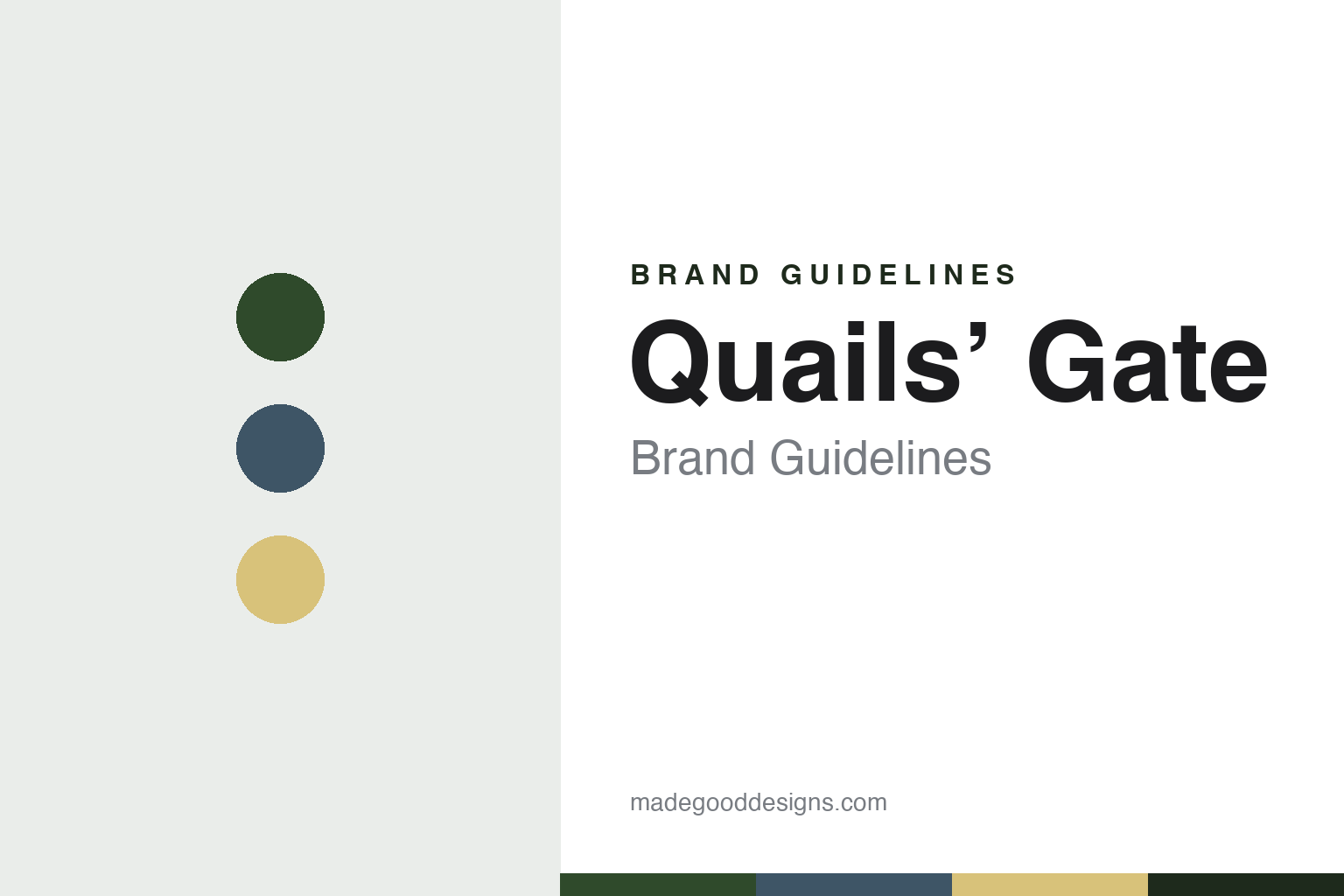
Two constants: a Quails’ Gate green, slate and gold palette and an estate serif register. Abstract homage — not a Quails’ Gate product or mark; no label, logo or bottle is reproduced.
Boucherie Road
A nursery family that planted grapes by mistake.
Quails’ Gate is a family winery on Boucherie Road in West Kelowna, on the west shore of Okanagan Lake in British Columbia. The company says its roots in the valley go back to 1908, when Richard Stewart Sr., a horticulturist from Ireland, settled in the area; English Wikipedia, citing the wine writer John Schreiner, says he came from County Kildare. An article by the writer Tim Pawsey on the company’s website says he and his brother started Stewart Brothers Nursery in 1911.
The vineyard came a generation later. Pawsey’s article says Richard “Dick” Stewart sold his share in the nursery and bought the lower part of the Boucherie Road property in 1956, later adding the upper part; English Wikipedia describes the 1956 purchase as the Allison Ranch. The company says it planted its first vines in 1961. According to the same article, the order was for seedless Diamond table grapes, but a mix-up at the nursery put Chasselas in the ground instead; Verdelet and Maréchal Foch followed. For years the Stewarts sold grapes rather than wine — first to Calona Wines, the company says, and later to wineries including Jordan & Ste-Michelle, Gray Monk and Mission Hill.
The family opened its own farm-gate winery in 1989, with Dick’s eldest son Ben Stewart and his wife Ruth at the helm, the company says. Its first few wines were made at Mission Hill, just up Mount Boucherie, by the winemaker Daniel Lagnaze, and the first commercial release followed in 1990. The first winery was a converted farm building; Tony Stewart recalls in the article that the rules of the day meant a winery that fermented on site also had to bottle on site, so the family had to buy a bottling line. English Wikipedia, citing Schreiner, says Ben’s brother Tony Stewart left a career as a stockbroker to join the business in 1992.
Colour
Pinot Noir, Chasselas and Old Vines Foch.
The company dates its Pinot Noir to 1975, when, it says, Dick Stewart planted the variety on the property — the start of what it now calls its flagship red. English Wikipedia names the winery’s signature wines as its Stewart Family Reserve Pinot Noir and Chardonnay, and lists an Old Vines Foch, from the Maréchal Foch hybrid the family planted in its early years.
A Founders’ Series names wines after the family: Richard’s Block Pinot Noir and Rosemary’s Block Chardonnay, the second named for Rowan Stewart’s grandmother, the company’s article says. Rowan, Tony Stewart’s son, began working in the vineyards in 2004, studied viticulture and winemaking in New Zealand and returned to the family business in 2020, according to the company, which lists Jeff Del Nin as its senior winemaker. Ben Stewart’s daughter, Llane Dobbener, is also part of the next generation, working in human resources, the company article says; it describes her picking grapes, labelling wines and fitting foil caps to bottles as a child on the farm.
The site grew around the wine. The company says the winery moved into a more suitable building in 1993, was substantially remodelled in 1998, opened its Old Vines Patio in 1999 and expanded it into the Old Vines Restaurant in 2005. Its website now also offers guest accommodation, the Lake House and the Nest, and says the family farms 160 acres of vineyards. In June 2022 the law firm Farris said it had advised on a lease under which the Stewart family took over the running of 30 acres of Black Sage Road vineyards in the South Okanagan from Julie and Lanny Martiniuk, who remain the owners of the land.
Typography
Design and documentation.
The seven brands in this group are all Canadian wineries: Inniskillin, Jackson-Triggs, Peller Estates and Cave Spring from Ontario’s Niagara Peninsula, and Mission Hill, Quails’ Gate and Burrowing Owl from British Columbia’s Okanagan Valley. Some still carry a founding family’s name or are run by that family; others now sit inside much larger wine companies, and two of the Niagara names reach into the Okanagan as well.
Ownership is the clearest dividing line. Inniskillin, founded by Donald Ziraldo and Karl Kaiser with a first planting in 1974, and Jackson-Triggs, launched in 1993 by the company Donald Triggs and Allan Jackson built from the old Cartier wines, both passed through Vincor and Constellation Brands and today trade under Arterra Wines Canada, the name the business took in 2017 after Constellation sold its Canadian wine arm, English Wikipedia says. Peller Estates belongs to Andrew Peller Ltd of Grimsby, Ontario, which agreed in June 2026 to be taken private by Fairfax Financial Holdings, Canadian Grocer reported. In the Okanagan, Anthony von Mandl bought the Mission Hill estate in West Kelowna in 1981; Quails’ Gate grew from land the Stewart family began planting in 1956 and relaunched as a winery in 1989; and Burrowing Owl, near Oliver, began when Jim Wyse bought vineyard land in 1993, with the winery itself built in 1998, the company says. Cave Spring’s first vintage came in 1986, from vines the Pennachetti family planted in 1978.
A Canadian wine brand’s identity is usually carried by a label, a place name and a story about the land, because the company behind the name may have merged, been sold or grown far beyond its first vineyard. Each guide separates what independent sources record from what the winery says about itself — its founding story, its owners over time, where its wine is grown and made, and how its labels and buildings present it — and marks plainly what rests only on the company’s own word.
Aa
An estate serif for a family vineyard. (Specimen set in Cormorant Garamond, a serif STAND-IN; NOT the Quails’ Gate logo.)
Quails’ Gate
A family winery with an agency and a Sonoma arm.
The Stewarts have built a business beyond their own label. In July 2009, John Schreiner reported, Quails’ Gate and Burrowing Owl launched their own Vancouver sales agency, Appellation Wine Marketing. Quails’ Gate had been a partner in an earlier agency, Medallion Wine Marketing, until Constellation Brands bought Medallion and folded it into Vincor Canada, which became the winery’s agency in April 2008 — an arrangement Schreiner described as awkward, since Vincor was also a competitor. Tony Stewart, then president, said in a news release that a smaller “boutique-style” agency would serve the winery’s customers better.
The family’s interests also reach California. In January 2016 the Sonoma Index-Tribune reported that the Stewart family, owners of Lake Sonoma Winery and other brands in its Bacas Family Estates line, had bought Envolve Winery in Sonoma from the siblings Mike, Kate and Chris Benziger. At home, the Stewart family has owned Quails’ Gate since it opened in 1989; the company describes itself as a fourth-generation Okanagan farming family, and its website signs off “Authentically Okanagan Since 1989.”
For a design guide, Quails’ Gate shows how a family winery can build its identity from one piece of land and the people who farmed it, naming its top wines after family members and blocks of the vineyard. Compare Mission Hill, the winery up the hill that made Quails’ Gate’s first wines, and Burrowing Owl, its partner in Appellation. For this guide we use vineyard green, lake slate and Chasselas gold with a serif, an unofficial interpretation; no product or logo is reproduced.
Explore & save
Keep Quails’ Gate’s identity on hand — save it to a board in the Made Good inspiration library.
Quails’ Gate identity set
Pin the Quails’ Gate green, slate and gold palette and the estate serif register to your own board.