Cave Spring Brand Guidelines
A family vineyard under the escarpment, and a first vintage in 1986.
Aa
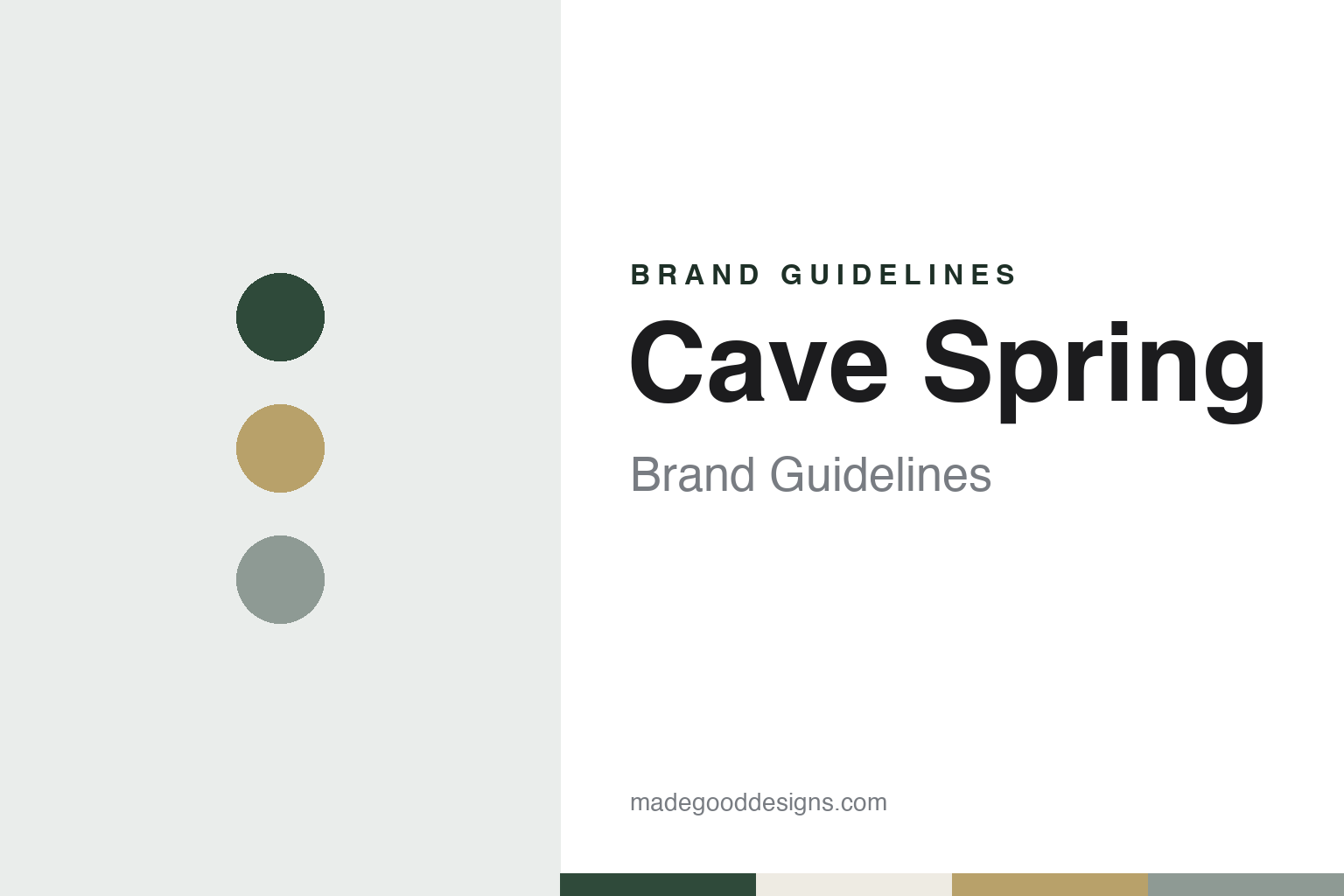
Two constants: an escarpment green, Riesling gold and limestone grey palette and an old-style book serif register. Abstract homage — not a Cave Spring product or mark; no label, logo or bottle is reproduced.
A family vineyard under the escarpment
An Italian grandfather, an old orchard and the vines planted in 1978.
The family behind Cave Spring came to Niagara from Italy. Lake Erie Living reported in 2013 that Giuseppe Pennachetti, the grandfather of the winery’s co-founder, emigrated from Fermo, in Italy, in the early 1920s. The winery tells the next part of the story itself: it says that John Pennachetti Senior, recalling how his father and son had revived a small vineyard in the 1960s, saw more potential in an abandoned orchard set against the limestone cliffs of the Niagara Escarpment.
That orchard became the Cave Spring vineyard. The company says that in 1978, “against the advice of experts at the time,” the Pennachetti family planted some of Niagara’s first European vinifera vines there, beginning with Riesling and Chardonnay, at a time when, the winery says, mass-produced labrusca and hybrid blends dominated Niagara wine. Gamay, Pinot Noir and Cabernet Franc followed later, the winery says, all varieties it describes as suited to Niagara’s cool climate.
The way the vines were planted is part of the house story too. Cave Spring says the family chose a planting density of 3,600 vines per hectare, unusual for the region in 1978, and trained the vines with vertical shoot positioning, a method it says was new to Niagara then and has only become standard more recently. Lake Erie Living placed the estate vineyard in Beamsville, a few miles from the village of Jordan, where the winery itself is based.
Colour
A first vintage in 1986, a quality standard and a new name.
The winery came almost a decade after the first vines. Lake Erie Living reported that Len Pennachetti and Angelo Pavan founded the business in 1986, and that Len’s brother Tom Pennachetti joined soon after. The company says the Pennachetti family and winemaker Pavan made the inaugural Cave Spring vintage in 1986. For decades the winery traded as Cave Spring Cellars; in 2019 its website still carried that name under the line “Benchmark Wines Since 1986.”
The first vintage fed straight into an argument about quality. Cave Spring says its early wines made the founders want to set them apart from the mass-produced Niagara wines of the day, and that two years later Len Pennachetti co-founded the Vintners Quality Alliance, or VQA, the system that guarantees the origin of wines made from Ontario-grown grapes. The company says he studied Europe’s appellation systems, wrote the first set of regulations, and went on to shape Niagara’s sub-appellations, among them the Beamsville Bench. Those are the winery’s own accounts of its founder’s role.
An independent honour followed decades later. The Grimsby–Lincoln newspaper NewsNow reported in January 2021 that Len Pennachetti had been appointed a Member of the Order of Canada, announced at the end of December 2020, with a citation “for his key role in developing the Ontario wine industry and for fostering tourism in the Niagara Peninsula region.” The paper credited him with building Main Street Jordan into a tourism destination, and recorded that the family’s Inn on the Twenty in Jordan had been sold to Vintage Hotels in 2017.
The name has shifted since. Internet Archive captures of the winery’s website show it using both names in January 2021 and, from later that year, presenting itself as Cave Spring Vineyard, the name of the estate vineyard the family planted in 1978. Cave Spring Cellars remains the name used in many older articles and listings, so both appear when searching for the wines.
Typography
Design and documentation.
The seven brands in this group are all Canadian wineries: Inniskillin, Jackson-Triggs, Peller Estates and Cave Spring from Ontario’s Niagara Peninsula, and Mission Hill, Quails’ Gate and Burrowing Owl from British Columbia’s Okanagan Valley. Some still carry a founding family’s name or are run by that family; others now sit inside much larger wine companies, and two of the Niagara names reach into the Okanagan as well.
Ownership is the clearest dividing line. Inniskillin, founded by Donald Ziraldo and Karl Kaiser with a first planting in 1974, and Jackson-Triggs, launched in 1993 by the company Donald Triggs and Allan Jackson built from the old Cartier wines, both passed through Vincor and Constellation Brands and today trade under Arterra Wines Canada, the name the business took in 2017 after Constellation sold its Canadian wine arm, English Wikipedia says. Peller Estates belongs to Andrew Peller Ltd of Grimsby, Ontario, which agreed in June 2026 to be taken private by Fairfax Financial Holdings, Canadian Grocer reported. In the Okanagan, Anthony von Mandl bought the Mission Hill estate in West Kelowna in 1981; Quails’ Gate grew from land the Stewart family began planting in 1956 and relaunched as a winery in 1989; and Burrowing Owl, near Oliver, began when Jim Wyse bought vineyard land in 1993, with the winery itself built in 1998, the company says. Cave Spring’s first vintage came in 1986, from vines the Pennachetti family planted in 1978.
A Canadian wine brand’s identity is usually carried by a label, a place name and a story about the land, because the company behind the name may have merged, been sold or grown far beyond its first vineyard. Each guide separates what independent sources record from what the winery says about itself — its founding story, its owners over time, where its wine is grown and made, and how its labels and buildings present it — and marks plainly what rests only on the company’s own word.
Aa
An old-style book serif for a Niagara estate built on one vineyard. (Specimen set in Libre Caslon Text, a serif STAND-IN; NOT the Cave Spring logo.)
Cave Spring
A family winery, a Riesling focus and a vineyard name on the label.
Cave Spring presents itself as a family business. The company describes its vision as the Pennachetti family’s, and in 2021 NewsNow called Len Pennachetti “the force behind” the winery. The company’s winery and its winery tasting room are on Main Street in Jordan, and it runs a second tasting room at the vineyard.
The winery’s account of its own methods centres on the vineyard. Cave Spring says every decision is measured against whether it helps its wines express the terroir of its vineyards, and that this has led to a narrow set of cool-climate varieties, a commitment to sustainability, the use of indigenous yeasts only and neutral oak in the cellar. Riesling runs through the range: the company’s own events pages list a Riesling Brut, a Rosé Brut, a Riesling Select Late Harvest and a Riesling Icewine among its wines, and the initials CSV, for Cave Spring Vineyard, are used across its membership and rewards programmes.
Packaging is described in environmental terms rather than as a design story. Cave Spring says it has stopped using shrink-wrap to transport its wines and that its labels are made with energy-efficient technology that avoids substances such as polymers, metals and volatile compounds.
For a design guide, Cave Spring shows how a winery can move its public name from the cellar to the vineyard, making a single planting from 1978 the centre of the brand. Compare Inniskillin, another Niagara winery whose founder helped build the VQA, and Dr. Loosen, a family Riesling estate on the Mosel. For this guide we use escarpment green, Riesling gold and limestone grey with a book serif, an unofficial interpretation; no product or logo is reproduced.
Explore & save
Keep Cave Spring’s identity on hand — save it to a board in the Made Good inspiration library.
Cave Spring identity set
Pin the Cave Spring escarpment green, Riesling gold and limestone grey palette and the old-style book serif register to your own board.