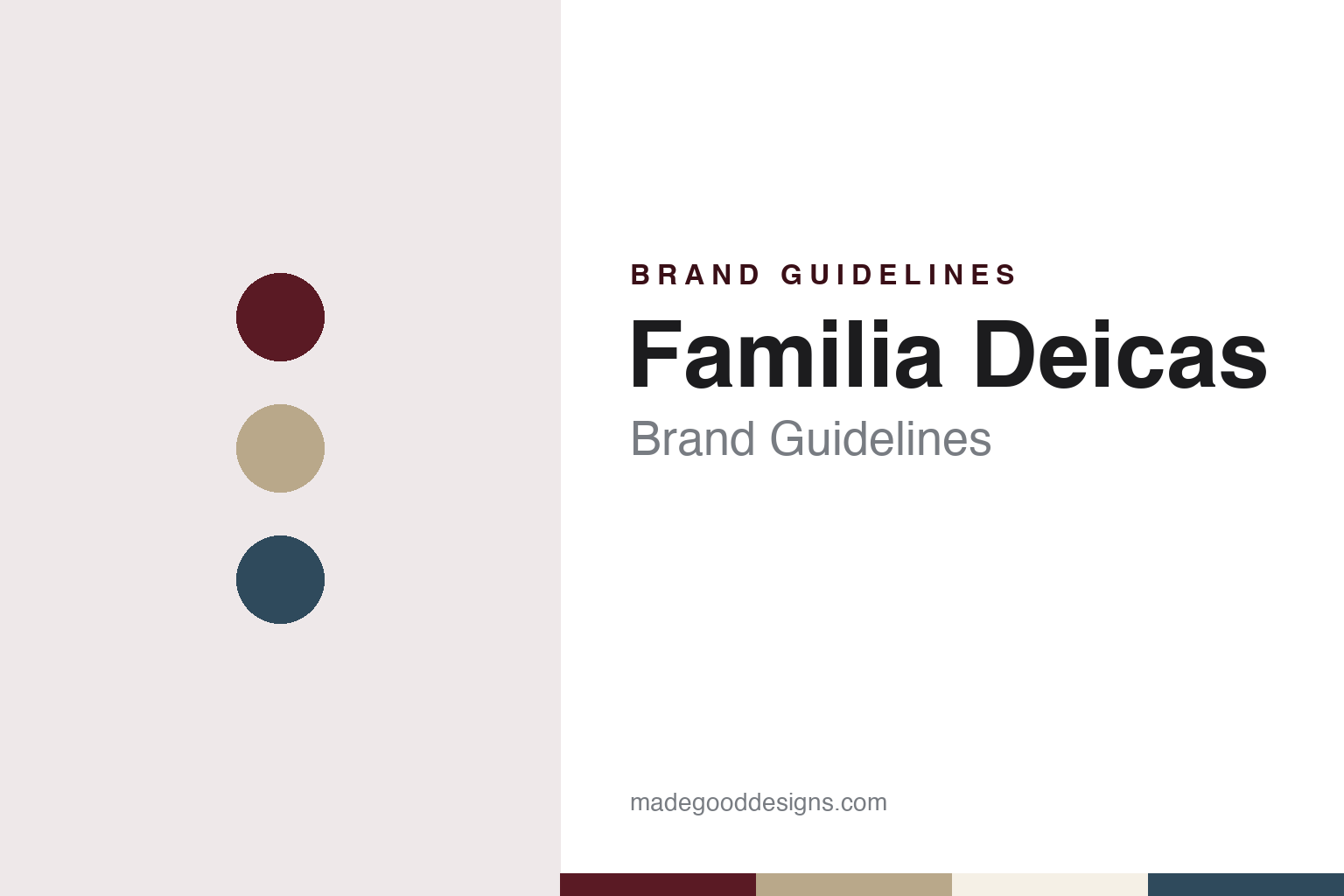
Familia Deicas Brand Guidelines
The Juanicó wine family behind Preludio, since 1979.
Aa
Two constants: a Tannat garnet, Jesuit stone and Atlantic blue palette and a high-contrast serif register. Abstract homage — not a Familia Deicas product or mark; no label, logo or bottle is reproduced.
A Jesuit estate in Canelones
Two centuries of owners before the Deicas family arrived.
Familia Deicas is the fine-wine house of the Deicas family, and its story begins on an old estate at Juanicó, in the department of Canelones north of Montevideo. Establecimiento Juanicó, the family’s larger wine company, gives the estate a long history: the company says the land was worked by the Jesuits in the 18th century, until the order was expelled from Spanish territories in 1767, and that in 1830 it passed to Francisco Juanicó, an immigrant from Mahón on Menorca, whose name the estate and the town still carry. In the early 20th century, the company says, the property was in the hands of pioneering Uruguayan families.
The state came next. According to Establecimiento Juanicó, in 1945 and 1946 the state fuel and alcohol company ANCAP acquired the estate to plant grapes for a Uruguayan cognac, made from vine stock the French government had given to Uruguay, and sold as Juanicó Cognac.
The family era began in 1979. Writing on Wine Anorak in July 2020, the British wine writer Jamie Goode reported that Juanicó, “once state owned,” was bought by the Deicas family that year, and that the winery in its current form was started by the banker Juan Carlos Deicas. Familia Deicas calls Juan Carlos its founder and says he bought the estate intending to continue the cognac project; it says the French specialists he hired saw in the soils a likeness to parts of Bordeaux. His son Fernando Deicas, the company says, then turned the winery towards fine wines from noble French grape varieties, and Goode reported in 2020 that Fernando runs the business.
Colour
Preludio, a stone cellar and a long Bordeaux thread.
The wine at the centre of the Familia Deicas identity is Preludio. The company says Fernando Deicas launched it in 1992 as a Bordeaux-inspired blend made to age, and that it rests for more than two years in a stone cellar the Jesuits built in the 18th century; the cellar, the Cava de Preludio, has its own page on the company site. Goode reported in 2020 that the American consultant Paul Hobbs had worked with the family since 2012 and described changes in how Preludio is made since 2015.
The family says that in 2000 its fine-wine project was separated from Establecimiento Juanicó as a distinct winery, Familia Deicas, with both remaining in the family. That split explains the two names a buyer meets. Goode reported that the Juanicó side makes Don Pascual, sold in Uruguay and around the Americas, as well as Bodegones del Sur and a natural-wine project called Bizarra, while Familia Deicas carries the estate’s top wines.
France runs through the range. The company says its Castelar sparkling wine was made in 2001 with the Champagne winemaker Pierre Yves Harang by the traditional method; that its Massimo Deicas Tannat borrowed small-scale “garage” techniques from Bordeaux; and that in 2011 a partnership with Château Franc La Rose in Saint-Émilion led to a Familia Deicas Saint-Émilion Grand Cru. The company also lists a sweet botrytised wine, Botrytis Noble, from 1996, and a Tannat liqueur.
Its labels are named for places as much as grapes. The company says Fernando created and registered the Atlántico Sur line in 2010 for wines shaped by the Atlantic, and its Extreme Vineyards and Single Vineyard lines grew out of a search for sites across the country that it dates to 1999 and 2004.
Typography
Design and documentation.
The seven brands in this group are wine names from two neighbours on South America’s Atlantic side: Bodega Garzón, Familia Deicas, Bouza and Pisano from Uruguay, and Miolo, Salton and Casa Valduga from Brazil. In Uruguay, Garzón stands in Maldonado, near the Atlantic coast, where Alejandro and Bettina Bulgheroni founded it in 2007, the International Wine Challenge reported in 2026; Familia Deicas took over the Juanicó estate in Canelones in 1979, the estate says; the Pisano family, from Liguria, planted its first vines at Progreso, also in Canelones, in 1919, La Capital reported in 2019; and the Bouza family began making wine in the late 1990s, with its winery at Melilla, on the rural edge of Montevideo.
The three Brazilian houses all belong to the Serra Gaúcha in Rio Grande do Sul, and to families of Italian descent. Salton was founded in Bento Gonçalves in 1910, Portuguese Wikipedia says; Miolo traces its land in the Vale dos Vinhedos to Giuseppe Miolo’s arrival in 1897 and set up its winery in 1989, the family says; and Casa Valduga, in the same valley, dates the family’s arrival to 1875, while its winery was begun in 1973. Portuguese Wikipedia says the Vale dos Vinhedos has carried an Indication of Provenance since 2002 and a Denomination of Origin since 2012.
A wine brand’s identity is usually carried less by a single bottle than by a label, a family name and the place it promises. Each guide separates what independent sources record from what the company says about itself — its founding story, its owners over time, where its wine is made and how its labels have changed — and marks plainly what rests only on the company’s own word.
Aa
A high-contrast serif for a family house that leans on Bordeaux and on an 18th-century cellar. (Specimen set in Playfair Display, a serif STAND-IN; NOT the Familia Deicas logo.)
Familia Deicas
A third generation and a map of new vineyards.
Familia Deicas has spread well beyond Juanicó. The company says it bought Valle de los Manantiales in the Sierras de Garzón in Maldonado in 2007; Goode reported in 2020 that the family began planting at Garzón in 2006. The company lists further vineyards bought or planted from 2010 in San José, Durazno and Lavalleja, near the Atlantic coast and in Mendoza in Argentina, and the Subsuelo project at Garzón with the Varela family in 2016. Wine Enthusiast, in a December 2020 report by Michael Schachner, named the Deicas family, “from Canelones,” among the established names planting new vineyards in Maldonado, and named Familia Deicas among the Uruguayan wineries whose Tannat it expected to win over American drinkers.
The third generation is now in charge of the cellar. The company says Santiago Deicas, Fernando’s son, made his first harvest at Château Franc La Rose in 2008 and led the Saint-Émilion launch in 2011, and it describes him as the winery’s winemaker; Goode reported in 2020 that Santiago had joined his father in the business as winemaker.
The names need a little care. Familia Deicas is the fine-wine label, with its own site at familiadeicas.com; Establecimiento Juanicó, at juanico.com, is the family’s broader wine company and the maker of Don Pascual. Juanicó is also the name of the town, of the estate and of the old ANCAP cognac.
For a design guide, Familia Deicas shows how a family winery can borrow authority from an old stone cellar, a Bordeaux vocabulary and a growing map of named vineyards, keeping its fine wines visibly apart from the larger brand made on the same estate. Compare Bodega Garzón, the newer winery in Maldonado, and Pisano, another Uruguayan wine family. For this guide we use Tannat garnet, Jesuit stone and Atlantic blue with a serif, an unofficial interpretation; no product or logo is reproduced.
Explore & save
Keep Familia Deicas’s identity on hand — save it to a board in the Made Good inspiration library.
Familia Deicas identity set
Pin the Familia Deicas Tannat garnet, Jesuit stone and Atlantic blue palette and the high-contrast serif register to your own board.


