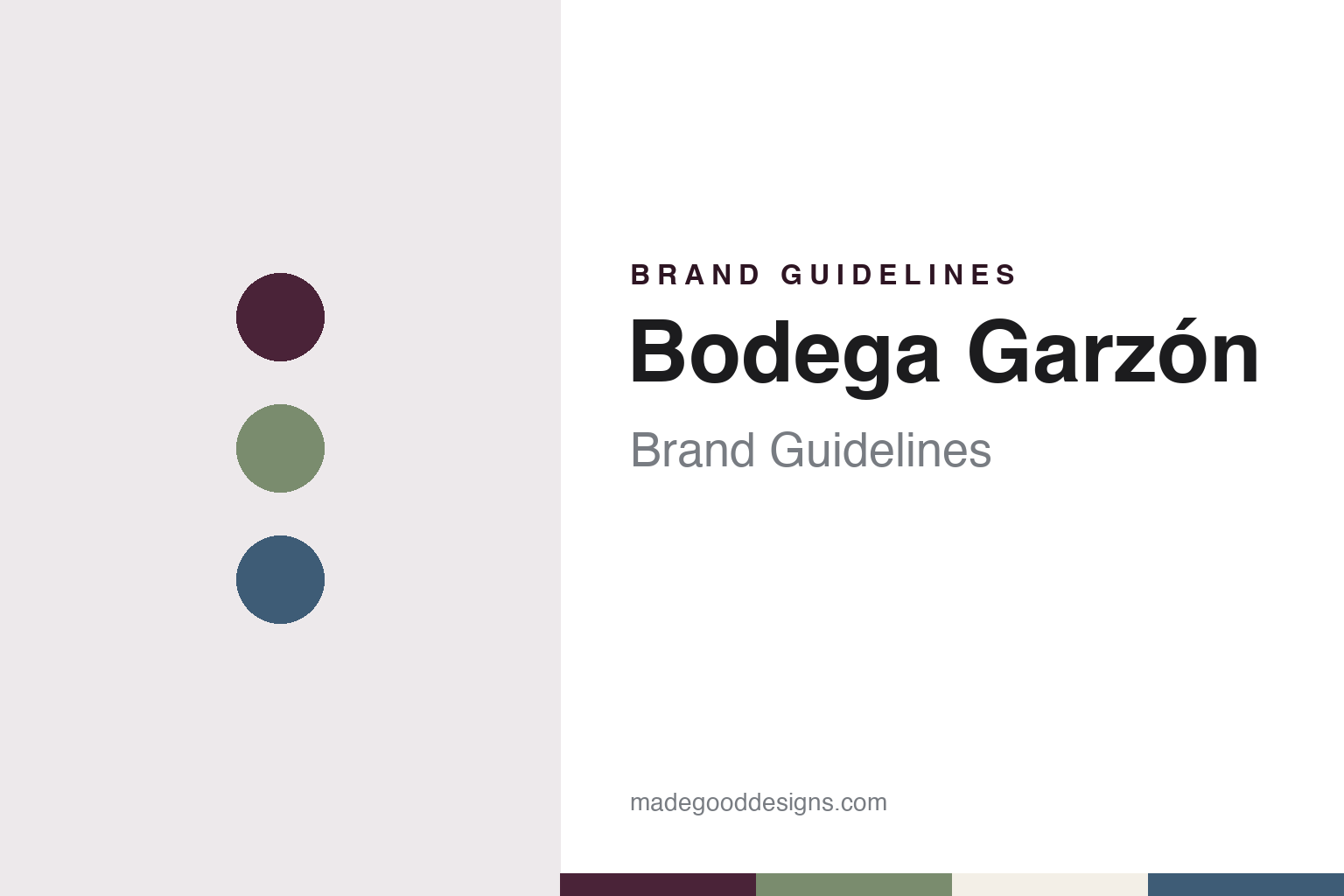
Bodega Garzón Brand Guidelines
Alejandro Bulgheroni’s hillside winery in Maldonado.
Aa
Two constants: a Tannat plum, olive leaf and Atlantic slate palette and a classical serif register. Abstract homage — not a Bodega Garzón product or mark; no label, logo or bottle is reproduced.
A little Tuscany in Maldonado
An Argentine businessman, an olive estate and a hillside of granite.
Bodega Garzón takes its name from Garzón, a small village in the department of Maldonado in south-eastern Uruguay, inland from the beach towns of Punta del Este and José Ignacio. Its founder is Alejandro P. Bulgheroni, the Argentine businessman whose fortune came mainly from the oil business, and the company says it was he and his wife Bettina who discovered the place. Speaking to PEAK Singapore in 2016, Bulgheroni dated that discovery to 1999 and called the hills he found there his “little Tuscany”; PEAK described Garzón itself as a former railway settlement.
Wine was not the first plan. Writing on Wine Anorak in February 2020, the British wine writer Jamie Goode reported that Bulgheroni first bought land in the area and planted olives, and that he had bought the hilly property with a wind farm in mind before turning to vines instead. PEAK reported in 2016 that the olive estate, Colinas de Garzón, is run as a separate property. Wine Enthusiast, in a December 2020 report by Michael Schachner, described the vineyard land as former cattle grazing land and eucalyptus forest.
For the vines, Bulgheroni turned to the Italian consultant Alberto Antonini, whom the company still lists as its winemaker. Goode reported that Bulgheroni chose to start on a large scale rather than with a trial plot: 240 hectares were planted in 2008, the first small vintage came in 2010 and the first large one in 2011. The leading grapes are Tannat, Uruguay’s signature red, and Albariño, the white grape of Galicia, alongside Cabernet Franc, Marselan and Pinot Noir. Goode noted that the vineyard is divided into some 1,200 separate plots.
Colour
A winery built into the hill, and wines named by tier.
The most visible part of the Garzón identity is the building. The winery was designed by the Mendoza firm Bórmida & Yanzón, led by Eliana Bórmida and Mario Yanzón; ArchDaily, publishing the project in October 2019, dated it to 2016 and credited the interiors to Backen, Gillam & Kroeger. ArchDaily’s project text says the architecture adapts to the topography and subordinates its scale to the landscape. The company says the winery is laid out on natural terraces in the hills so that wine can be moved by gravity, and that it uses stainless-steel tanks, concrete tanks and tapered oak vats.
PEAK reported that the winery held its grand opening in March 2016. Sustainability is part of how the company presents the building: a Business Wire release from the winery, republished by Greenroofs.com in May 2019, said the whole facility had been awarded LEED Silver certification under the US Green Building Council’s system, and the company says the site generates wind and solar power.
The wines are presented as a ladder of tiers. The company’s range runs from Estate and Reserva through Single Vineyard and Petit Clos to Balasto, which it calls its iconic wine, an assemblage of its best grapes. Shanken News Daily reported in November 2019 that Balasto, a blend of Tannat, Cabernet Franc, Petit Verdot and Marselan, was being sold through the Place de Bordeaux, the négociant system usually associated with Bordeaux’s classed growths.
The estate also works as a destination. The company names the Argentine chef Francis Mallmann as the ambassador and culinary director of its restaurant, and offers tours, cooking classes and a wine bar, while Shanken News Daily mentioned a members’ club with a golf course nearby.
Typography
Design and documentation.
The seven brands in this group are wine names from two neighbours on South America’s Atlantic side: Bodega Garzón, Familia Deicas, Bouza and Pisano from Uruguay, and Miolo, Salton and Casa Valduga from Brazil. In Uruguay, Garzón stands in Maldonado, near the Atlantic coast, where Alejandro and Bettina Bulgheroni founded it in 2007, the International Wine Challenge reported in 2026; Familia Deicas took over the Juanicó estate in Canelones in 1979, the estate says; the Pisano family, from Liguria, planted its first vines at Progreso, also in Canelones, in 1919, La Capital reported in 2019; and the Bouza family began making wine in the late 1990s, with its winery at Melilla, on the rural edge of Montevideo.
The three Brazilian houses all belong to the Serra Gaúcha in Rio Grande do Sul, and to families of Italian descent. Salton was founded in Bento Gonçalves in 1910, Portuguese Wikipedia says; Miolo traces its land in the Vale dos Vinhedos to Giuseppe Miolo’s arrival in 1897 and set up its winery in 1989, the family says; and Casa Valduga, in the same valley, dates the family’s arrival to 1875, while its winery was begun in 1973. Portuguese Wikipedia says the Vale dos Vinhedos has carried an Indication of Provenance since 2002 and a Denomination of Origin since 2012.
A wine brand’s identity is usually carried less by a single bottle than by a label, a family name and the place it promises. Each guide separates what independent sources record from what the company says about itself — its founding story, its owners over time, where its wine is made and how its labels have changed — and marks plainly what rests only on the company’s own word.
Aa
A classical serif for a winery that presents itself through architecture and landscape. (Specimen set in Cormorant Garamond, a serif STAND-IN; NOT the Bodega Garzón logo.)
Bodega Garzón
Recognition, reach and a family of wineries.
Recognition followed the opening. Wine Enthusiast, which runs the Wine Star Awards, noted in its December 2020 report that Bodega Garzón had won the magazine’s Wine Star Award as New World Winery of the Year for 2018. The same report named Garzón and the nearby Altos de José Ignacio, both in Maldonado where the Atlantic’s influence is strongest, as new growing areas that had helped push Uruguay forward, and said other wine families were following Garzón into the area.
Exports matter to the business. Shanken News Daily reported in 2019 that about two-thirds of Garzón’s production was sold abroad, with the United States as its main market, where the importer was Pacific Highway Wines & Spirits. Goode named the winery’s managing director as Christian Wylie and its winemaker as Germán Bruzzone, and the company lists both today.
Garzón is one part of a wider set of wine holdings. PEAK reported in 2016 that Bulgheroni also owned three wineries in Argentina and had wine interests in Tuscany, Bordeaux and the Napa Valley, and that Garzón was his first vineyard in Uruguay.
The name needs a little care. Garzón is the village, the area of the vineyards and the winery all at once, and the olive oil from the Bulgheroni olive estate is sold under the separate Colinas de Garzón name. The winery’s own site is bodegagarzon.com.
For a design guide, Bodega Garzón shows how a young winery can build an identity out of a place, a building set into a granite hillside and a clear ladder of wine tiers, rather than out of a long history. Compare Familia Deicas, the Uruguayan family winery that has also planted in Garzón, and Catena Zapata, the Mendoza family winery. For this guide we use Tannat plum, olive leaf and Atlantic slate with a classical serif, an unofficial interpretation; no product or logo is reproduced.
Explore & save
Keep Bodega Garzón’s identity on hand — save it to a board in the Made Good inspiration library.
Bodega Garzón identity set
Pin the Bodega Garzón Tannat plum, olive leaf and Atlantic slate palette and the classical serif register to your own board.