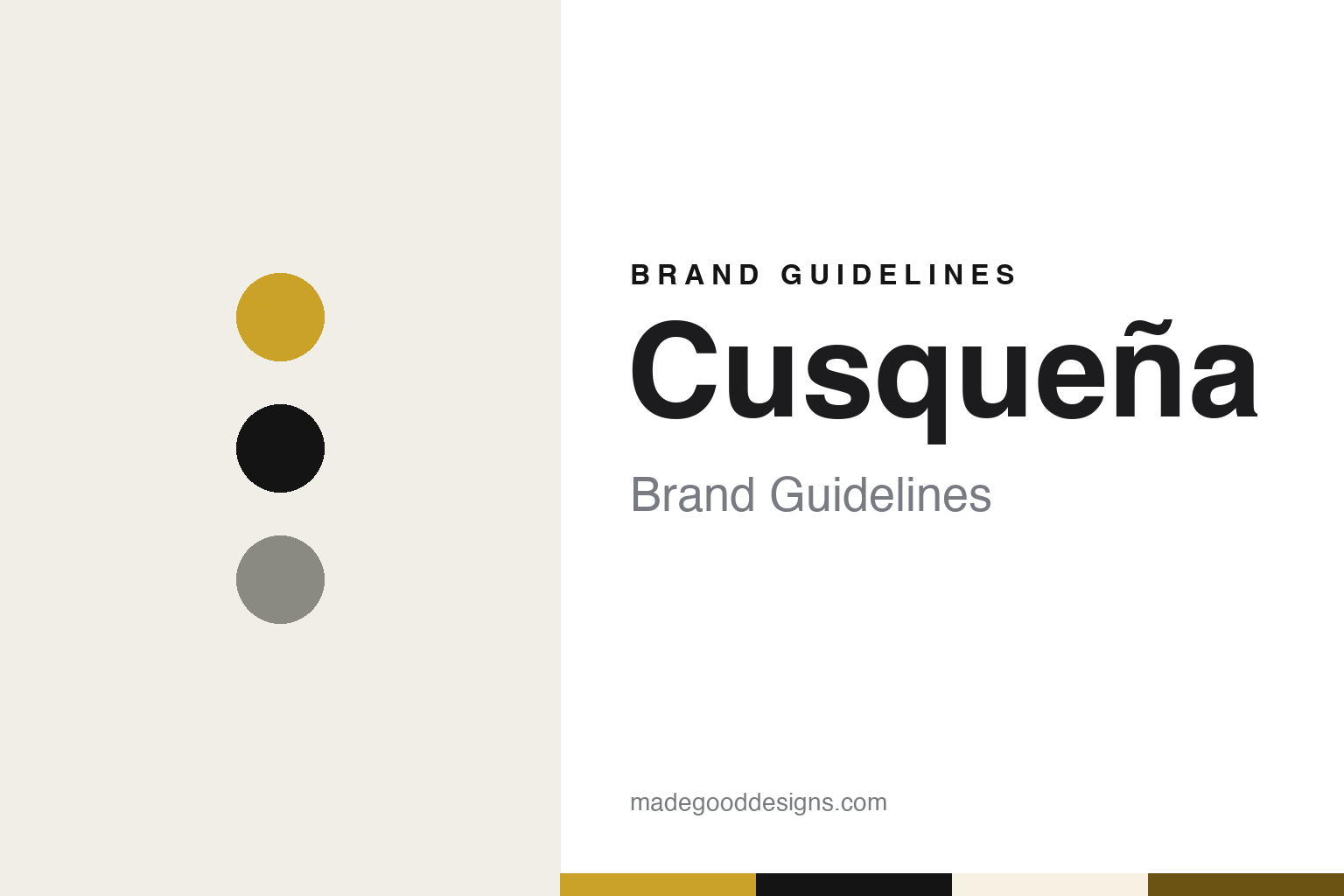
Cusqueña Brand Guidelines
The 1908 Cusco lager of Inca stone and gold.
Aa
Two constants: an Inca gold, andesite grey and basalt black palette and a classical capital serif register. Abstract homage — not a Cusqueña product or mark; no label, logo, badge or bottle is reproduced.
A German brewery in Cusco
From Pilsener Bier Cuzco to a city’s name.
Cusqueña’s story begins in Cusco, the former Inca capital in Peru’s southern Andes. On 1 October 1908, Spanish Wikipedia says, Ernesto Günther and a group of businessmen founded a Cusco branch of the Cervecería Alemana Günther & Tidow, a brewery that had been working in Arequipa for about ten years; the first brew at the new plant followed on 27 October 1909. Gestión, the Lima business daily, gave the same founding year and the same founders in a 2024 history of the brand.
The early beers did not carry today’s name. Spanish Wikipedia says the Cusco range included Pilsener Bier Cuzco, popularly called “the Pilsen,” and a malt extract; the beer began to be sold as Cerveza Cuzqueña, spelled with a “z,” in the mid-1950s, and took the spelling Cusqueña in the 1970s, when the malt drink likewise became Malta Cusqueña. The company changed its own name in 1939 to the Compañía Cervecera del Sur del Perú, known as Cervesur, according to the same article; Gestión dates Cervesur’s management of the brewery, and the start of the Cusqueña name, to 1955.
For most of the century Cusqueña was a beer of the south. In 1995, Spanish Wikipedia says, it was launched in Lima as Cusqueña Premium, with a redesigned label that kept the main features of the old one, plus a back label and a neck foil meant to make the bottle look more elegant. Gestión says the move to Lima introduced a premium beer category that Peru had not had outside imported brands.
Colour
Backus, SABMiller and AB InBev.
Cusqueña’s ownership followed the consolidation of Peruvian brewing. Backus y Johnston, the Lima brewery founded in the Rímac district by the Americans Jacob Backus and John Howard Johnston, took over Cervesur, with its Arequipa and Cusco breweries, in 2000, Spanish Wikipedia and Gestión both say. Backus then came under foreign control: by October 2005, the Mail & Guardian reported, SABMiller held a majority of Backus as a result of buying the Colombian brewer Bavaria, and was bidding for the remaining shares. On 10 October 2016 Anheuser-Busch InBev announced the completion of its combination with SABMiller. Backus has owned Cusqueña since 2000, and AB InBev has owned Backus since 2016; the brand’s website carries an Anheuser-Busch InBev copyright and names Unión de Cervecerías Peruanas Backus y Johnston as the company behind it.
Where the beer is brewed depends on where it is sold. Spanish Wikipedia lists Cusqueña among the beers made at the Backus breweries in Cusco and Arequipa, and English Wikipedia adds the brewery at Ate, in Lima. The Cusco plant itself was expanded in 2008 with two new cylindro-conical fermentation tanks, Spanish Wikipedia and Gestión both say. In 2020, Gestión reported, AB InBev began brewing Cusqueña Dorada at its plant in Quilicura, Santiago de Chile, while the other varieties sold in Chile continued to come from Peru.
The range has grown well beyond the original lager. The brand’s site lists five varieties — Dorada, Negra, Trigo, Roja and Doble Malta — and says all are made with 100% malt. Gestión dates Doble Malta to 2021 and mentions limited editions including a quinoa beer created with the chef Gastón Acurio. Its export slogan, Spanish Wikipedia says, has been “the gold of the Incas.”
Typography
Beer, bottles and national identity.
The seven beers in this group come from Latin America and the Caribbean: Polar, Cusqueña, Pilsen Callao, Brahma, Medalla, Kalik and Banks. Several have long histories. Pilsen Callao was first brewed in 1863 at a brewery that Federico Bindels founded in the Peruvian port of Callao, Spanish Wikipedia says, and Brahma was first made by a Rio de Janeiro brewery founded in 1888, according to English Wikipedia. Cusqueña goes back to a branch of the Arequipa brewer Günther & Tidow opened in Cusco on 1 October 1908, Spanish Wikipedia says. Cervecería Polar began brewing at Antímano, west of Caracas, on 14 March 1941; Cervecería India, now the Compañía Cervecera de Puerto Rico, was founded in Mayagüez in 1937 by the Valdés Cobián brothers; and Banks (Barbados) Breweries opened at Wildey in September 1961, all according to English Wikipedia. Kalik is the newcomer: English Wikipedia dates the Bahamian lager to 1988.
Their ownership has gone in very different directions. Two are still made by companies based in their home markets: Polar belongs to Empresas Polar, the privately held Venezuelan group whose president is Lorenzo Mendoza, and Medalla Light, which English Wikipedia dates to 1980, is made by the Compañía Cervecera de Puerto Rico, run since 2017 by Grace Marie Valdés. Brahma has been part of Ambev since the company was created in 1999 from the merger of Brahma and Antarctica, and Ambev is now a subsidiary of Anheuser-Busch InBev, English Wikipedia says. In Peru, Backus and Johnston bought 62 per cent of the Compañía Nacional de Cerveza, the maker of Pilsen Callao, in 1994, and Cervesur, the maker of Cusqueña, joined the Backus group in 2000, Spanish Wikipedia says; Backus was part of SABMiller from 2005 and has belonged to AB InBev since AB InBev’s takeover of SABMiller in 2016, according to English Wikipedia. Kalik is brewed in Nassau by Commonwealth Brewery, which its 2011 financial statements describe as a subsidiary of Heineken; they record that Heineken’s purchase of the shares held by its Bahamian partner took effect on 17 May 2010, and that the company was listed on the Bahamas International Securities Exchange on 24 May 2011. Banks passed from Barbadian ownership to an Ambev subsidiary in December 2015, according to Ambev’s filing with the US Securities and Exchange Commission, and since 31 July 2025 KOSCAB Holdings, a Coca-Cola bottler, has held the majority of SLU Beverages, which controls Banks Holdings, Nation News reported.
A beer brand’s identity is usually carried less by a single bottle than by a label, a name and the place it promises, because the company behind the name may have changed hands or moved its brewing. Each guide separates what independent sources record from what the brewer says about itself — its founding story, its owners over time, where its beer is brewed and how its labels, cans and advertising have changed — and marks plainly what rests only on the company’s own word.
Aa
A classical capital serif — the register of a premium lager that looks to Inca stonework. (Specimen set in Cinzel, a serif STAND-IN; NOT the Cusqueña logo.)
Cusqueña
Inca stonework on a beer bottle.
The brand’s look leans on the Inca past. In a redesign credited to the Buenos Aires packaging agency Tridimage, with images dated 2015, the designers say the polygonal stones of Inca masonry, and in particular the famous twelve-angled stone in Cusco, are referenced in the brand badge and worked into the shape of the bottle; that the label graphics show the Machu Picchu skyline; and that the can carries a raised gloss texture meant to feel like stone. The A’ Design Award lists the work as a winner in its packaging design category for 2015–2016. In October 2022 Cusqueña launched a rebrand campaign called “Imperio de creadores” (“empire of creators”), the Peruvian trade site Mercado Negro reported, featuring the Cusco musician Kayfex, the chef Javier Valdés and the Arequipa designer Cjuno.
That heritage has also brought trouble. On 8 September 2000 a crane being used to film a beer commercial at Machu Picchu toppled and chipped the Intihuatana, the carved granite “hitching post of the sun,” the Associated Press reported; the shoot was by J. Walter Thompson for Cervesur, and Archaeology magazine identified the agency as the one representing Cusqueña. A Cervesur manager said the company did not feel responsible but would help clear up what happened, and the company promised to help repair the damage.
For a design guide, Cusqueña shows how a regional lager can turn the stonework and gold of its home city into a premium identity that travels. Compare Pilsen Callao, its stablemate at Backus, and Inca Kola, the golden Peruvian soda launched in Lima in 1935. For this guide we use Inca gold, andesite grey and basalt black with a classical serif, an unofficial interpretation; no product or logo is reproduced.
Explore & save
Keep Cusqueña’s identity on hand — save it to a board in the Made Good inspiration library.
Cusqueña identity set
Pin the Cusqueña Inca gold, andesite grey & basalt black palette and the classical capital serif register to your own board.