Camel Valley Brand Guidelines
The Cornish vineyard the Lindos planted in 1989.
Aa
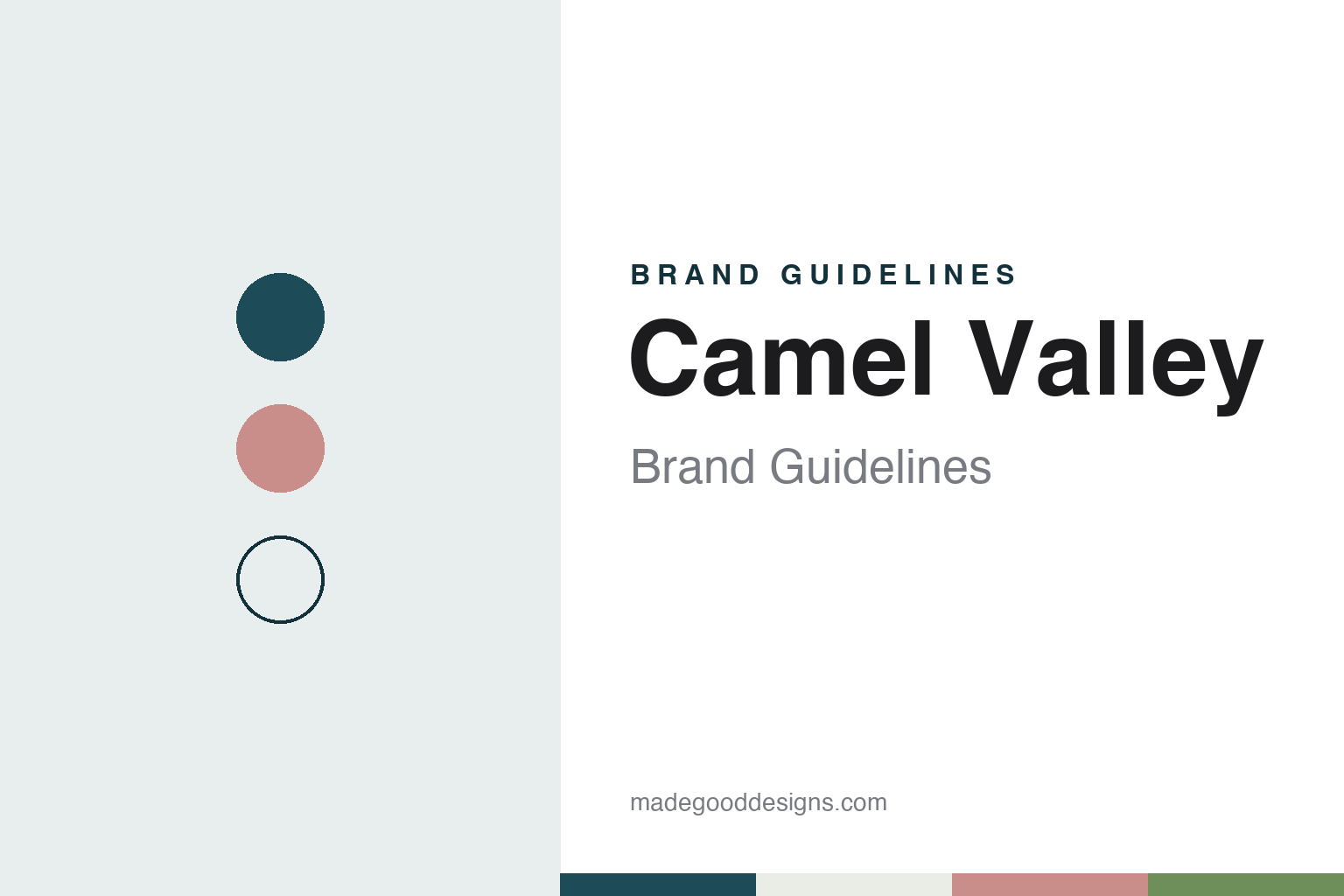
Two constants: an estuary teal, valley green and rosé blush palette and a contemporary text serif register. Abstract homage — not a Camel Valley product or mark; no label, logo or bottle is reproduced.
A pilot, a farm and a south-facing slope
Bob and Annie Lindo swap sheep for vines.
Camel Valley sits on the slopes above the River Camel at Nanstallon, near Bodmin in Cornwall. Its founders, Bob Lindo, a former RAF pilot, and his wife Annie, had bought the farm several years before they planted vines, looking for a change from service life and somewhere to bring up a young family, the company says. At first they farmed sheep and cattle. Each summer, it says, they watched the grass turn brown on the sun-baked, south-facing slopes and wondered whether vines would like the aspect.
In 1989 they planted their first 8,000 vines. Bob Lindo told Vineyard Magazine the same date in 2018, and the regional farming paper Fruit & Vine repeated it in 2024. The company says Bob worked a vintage in Germany, that both of them took viticulture courses, and that they built and equipped a winery themselves. “We practically lived in the vineyard, doing all the work by hand,” Annie Lindo is quoted as saying on the company’s site; at harvest it was the two of them and a few friends picking, with Bob crushing grapes through the night.
Cornish food helped spread the name. The restaurateur Rick Stein’s company says it has listed Camel Valley’s sparkling wines in its restaurants for more than 20 years, that Stein opened the second version of the winery in 1999, and that the vineyard appeared in his Food Heroes television series in 2002. Camel Valley describes itself as the maker of Cornwall’s first traditional-method sparkling wine, made, like Champagne, with a second fermentation in the bottle.
Colour
The second generation and a single-vineyard designation.
The business passed to a second generation without leaving the family. Sam Lindo, a mathematics graduate who had seemed headed for a career in the City, returned to the farm in 2002, the company says, and has since taken over as winemaker, with occasional help from his father. He worked a vintage at a New Zealand winery in 2006, it adds, and brought back ideas such as cool fermentation temperatures. Bob Lindo, quoted on the company’s site, says the two of them work as a team.
The vineyard’s best-known legal distinction is Darnibole. Harpers Wine & Spirit reported in 2017 that the European Union had given the Darnibole vineyard Protected Designation of Origin status after a meeting on 25 April 2017, making it the first UK single vineyard with a PDO; Darnibole had received national protection from the UK government in 2012. The rules require 100% Bacchus grown at Darnibole, hand-picked, with no acidification, de-acidification or sweetening, made at the adjoining Camel Valley winery and compared with previous vintages for typicity. During the process, Harpers reported, the area grew from seven to 28 acres of south-facing land. “There is something that we consider to be special about that small area,” Sam Lindo told the magazine.
The range is led by sparkling wines — the “Cornwall” Brut and the Pinot Noir Rosé Brut among them — alongside a white Pinot Noir, a sparkling red and still wines including Bacchus Dry, according to the company’s shop. One sparkling rosé, Cuvée Raymond, is sold only at the vineyard and at Raymond Blanc’s Le Manoir aux Quat’Saisons, the company says.
Typography
Design and documentation.
The seven brands in this group are all English sparkling-wine producers: Nyetimber, Chapel Down, Ridgeview, Gusbourne, Hambledon, Camel Valley and Rathfinny. They span several decades of planting. Hambledon, in Hampshire, says Major-General Sir Guy Salisbury-Jones planted its first vines in 1952; English Wikipedia says Stuart and Sandy Moss planted Nyetimber’s first vines in West Sussex in 1988, and that Eric Heerema took the estate over in 2006; Camel Valley says Bob and Annie Lindo planted their first vines in Cornwall in 1989; Ridgeview says Mike and Christine Roberts planted at Ditchling Common, in East Sussex, in 1995; Gusbourne says its first vines went into the ground at Appledore, in Kent, in 2004; and Rathfinny says Mark and Sarah Driver founded their estate near Alfriston, East Sussex, in 2010.
Their ownership varies as widely. Chapel Down, based at Tenterden in Kent, said in October 2024 that it would remain a standalone company listed on London’s AIM market after a strategic review, Just Drinks reported. In November 2023 Hambledon was acquired by Berry Bros & Rudd and Symington Family Estates as a 50:50 joint venture, Food Manufacture reported.
Place is part of the label. In June 2022 Decanter reported that Sussex had been recognised as a Protected Designation of Origin for still and sparkling wine, a campaign begun in 2015 by producers including Rathfinny and Ridgeview. Each guide separates what independent sources record from what the company says about itself — who planted the vines, who owns the estate now and how its labels have been designed — and marks plainly what rests only on the company’s own word.
Aa
A contemporary text serif for a family vineyard by a Cornish river. (Specimen set in Lora, a serif STAND-IN; NOT the Camel Valley logo.)
Camel Valley
Royal warrants, state banquets and a family label.
Camel Valley’s most visible mark is not its own. In April 2018 Vineyard Magazine reported that it had been awarded a Royal Warrant of Appointment, granted by the then Prince of Wales for its sparkling wines in recognition of supply to royal occasions over many years. The magazine noted that the bottles would now carry the Prince of Wales’s arms, displayed in a similar way to a medal sticker. “We are very proud to be the first ‘By Royal Appointment’ English sparkling wine,” Bob Lindo told it.
The magazine also listed the occasions behind it: the 2013 Commonwealth meeting in Sri Lanka chaired by the Prince of Wales; a 2013 Pinot Noir Rosé served at the Buckingham Palace state banquet for the King and Queen of Spain on 12 July 2017; and the 2013 “Cornwall” Brut poured at a reception for the Duchess of Cornwall’s birthday at Clarence House the next day.
The warrant survived the change of reign. Fruit & Vine reported on 17 May 2024 that, when King Charles III and Queen Camilla granted the first Royal Warrants of the new reign that month, 145 former Prince of Wales warrant holders received one from the King and seven of them also received one from the Queen — Camel Valley among the seven. The company announced both warrants on 14 May 2024.
The ownership story is short. Camel Valley remains a Lindo family business, trading as Camel Valley Ltd, with the vineyard, winery and visitor business all on the farm near Bodmin; the company runs tours and sells wine on site. The company names Sam Lindo as its winemaker.
For a design guide, Camel Valley shows how a small family estate can borrow authority from a place, a river valley and a royal coat of arms rather than from age. Compare St Austell, the Cornish family brewery, and Ridgeview, another English sparkling estate, in Sussex. For this guide we use estuary teal, valley green and rosé blush with a serif, an unofficial interpretation; no product or logo is reproduced.
Explore & save
Keep Camel Valley’s identity on hand — save it to a board in the Made Good inspiration library.
Camel Valley identity set
Pin the Camel Valley estuary teal, valley green and rosé blush palette and the contemporary text serif register to your own board.