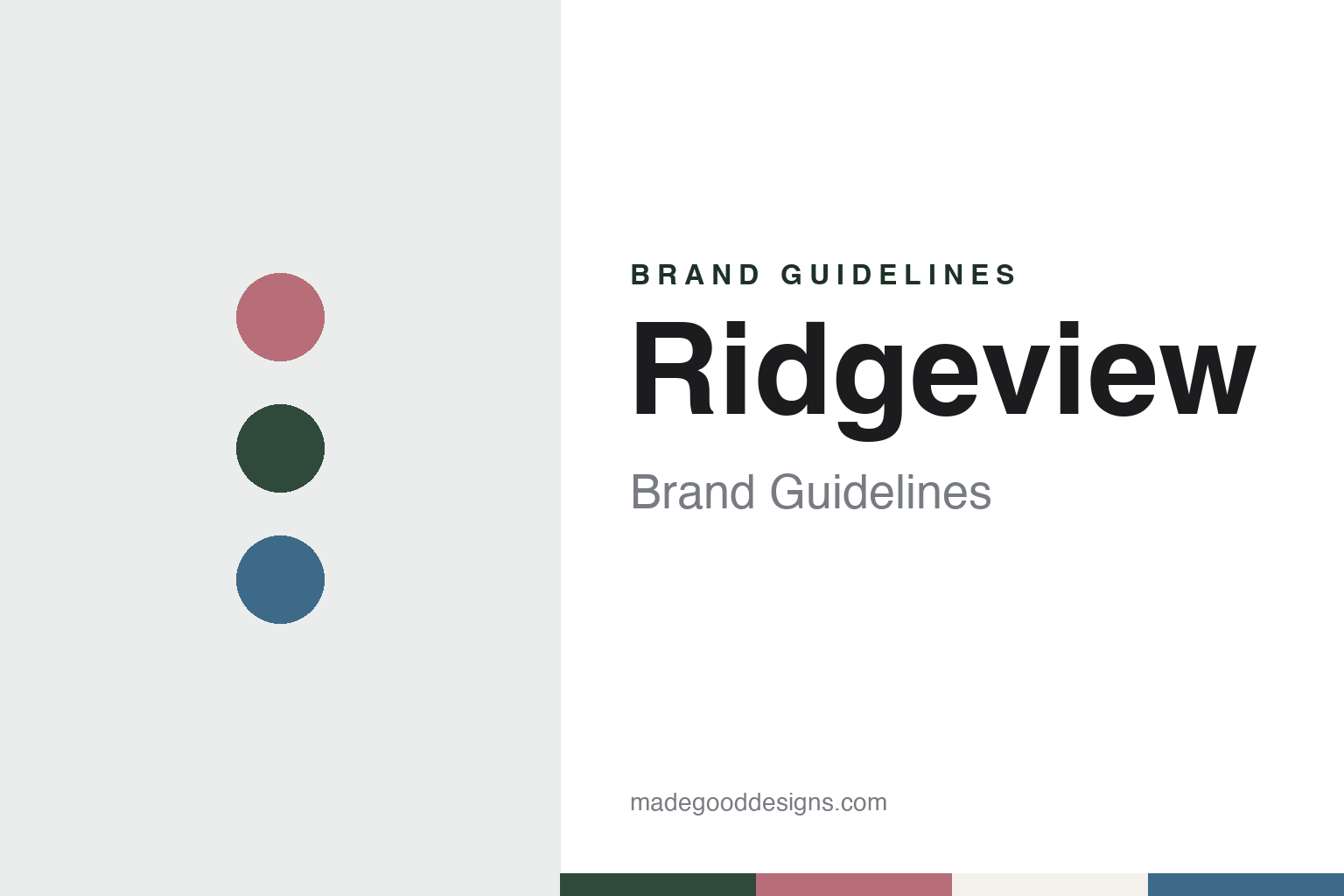
Ridgeview Brand Guidelines
The Ditchling sparkling wine estate begun in 1995.
Aa
Two constants: a Downs green, rose gold and Sussex sky palette and a clean geometric sans register. Abstract homage — not a Ridgeview product or mark; no label, logo or bottle is reproduced.
A vineyard under the South Downs
From first vines at Ditchling Common to a new owner in 2026.
Ridgeview is a sparkling wine estate at Ditchling Common in Sussex, at the foot of the South Downs. The company dates its story to 1995, when Mike and Christine Roberts planted their first vines there; Decanter, reporting in November 2014, gave 1994 as the year the couple co-founded the estate, and Companies House records the incorporation of Ridgeview Estate Winery Limited in July 1995. Ridgeview describes Mike Roberts as an accountant turned software entrepreneur who went back to college to learn winemaking, and says the couple chose the classic Champagne grapes, Chardonnay, Pinot Noir and Pinot Meunier, and the traditional method of a second fermentation in bottle.
The company says its winery became operational in 1999 and that its first bottling was released in 2000. It also says its wines have been poured at state banquets at Buckingham Palace and that Mike Roberts was appointed MBE in 2011 for services to the English wine industry. Beyond his own estate, Roberts was chairman of the trade body English Wine Producers, Decanter noted in November 2014, when it reported that his family had announced his death. In the same report, Decanter recorded that Ridgeview’s Grosvenor Blanc de Blancs 2006 had won an International Trophy for sparkling wine at the 2010 Decanter World Wine Awards.
The business then passed to the second generation. Ridgeview says Tamara Roberts joined in 2004 and became chief executive in 2013, and that her brother Simon Roberts became head winemaker in 2014. The company says it opened a new winery in 2020, and that it was a founder member of Sustainable Wines of Great Britain. Ridgeview also says it combines hand-picked fruit from its home estate with grapes from partner vineyards across southern England.
Ownership changed in 2025 and 2026. A notice in The London Gazette records that Ridgeview Estate Winery Limited went into administration on 22 September 2025, with administrators from FRP Advisory; on 12 February 2026, Drinks Intel reported that Ridgeview had announced the sale of the business to an investor consortium led by The Quantum Beverage Co, with financial details not disclosed. That consortium has owned Ridgeview since February 2026. Drinks Intel reported that Quantum Beverage co-founder Gregg Ainsworth became chief executive and that the Roberts family would continue to be involved; Ridgeview’s own history now says Tamara Roberts stepped down as chief executive in 2026, and that Simon Roberts still leads the winemaking.
Colour
London names, a ridge in the logo and rose gold on the label.
The most distinctive thing in Ridgeview’s naming is London. Its core range carries the names of London districts: Bloomsbury, Cavendish and Fitzrovia. When the estate redesigned its whole range for its 20th anniversary, the drinks business reported in March 2015, those three London-themed Signature Collection names were kept “as a dedication to” Christopher Merret, who first documented the traditional method of making sparkling wine in England in 1662. That 2015 redesign brought a completely new logo, the vintage on the neck label and special anniversary wirehoods, and moved the Fitzrovia Rosé into a green bottle. Three wines previously called Knightsbridge, Grosvenor and Victoria were renamed Ridgeview Blanc de Noirs, Blanc de Blancs and Rosé de Noirs, the magazine reported.
The current look arrived three years later. The trade title Vineyard reported in June 2018 that Ridgeview had unveiled new branding at The Savoy in London on 25 May 2018, designed by the Brighton studio CookChick. According to that report, the new logo draws on the inspiration behind the estate’s name, the view of the South Downs ridge from the vineyard and tasting room. The colours of the neck label were taken from the bottle caps that seal the wines while they rest in the cellar, and Bloomsbury gained a blue and green wrap meant to evoke the point where the vineyard and the Downs meet the sky. The labels carry rose gold detailing and were printed by the label specialist Multi-Color, and the line “life is for celebrating”, which Vineyard attributed to the founders, continues as a “peel to reveal” message inside the foils.
Tamara Roberts told Vineyard that the new look was “a deliberate move away from the more traditional sparkling wine design cues”. Lee Cook, co-founder and director of CookChick, said in the same report that the founder’s phrase “life is for celebrating” had been the centre of the brief and was carried into both the big idea and the details of the identity and packaging.
Typography
Design and documentation.
The seven brands in this group are all English sparkling-wine producers: Nyetimber, Chapel Down, Ridgeview, Gusbourne, Hambledon, Camel Valley and Rathfinny. They span several decades of planting. Hambledon, in Hampshire, says Major-General Sir Guy Salisbury-Jones planted its first vines in 1952; English Wikipedia says Stuart and Sandy Moss planted Nyetimber’s first vines in West Sussex in 1988, and that Eric Heerema took the estate over in 2006; Camel Valley says Bob and Annie Lindo planted their first vines in Cornwall in 1989; Ridgeview says Mike and Christine Roberts planted at Ditchling Common, in East Sussex, in 1995; Gusbourne says its first vines went into the ground at Appledore, in Kent, in 2004; and Rathfinny says Mark and Sarah Driver founded their estate near Alfriston, East Sussex, in 2010.
Their ownership varies as widely. Chapel Down, based at Tenterden in Kent, said in October 2024 that it would remain a standalone company listed on London’s AIM market after a strategic review, Just Drinks reported. In November 2023 Hambledon was acquired by Berry Bros & Rudd and Symington Family Estates as a 50:50 joint venture, Food Manufacture reported.
Place is part of the label. In June 2022 Decanter reported that Sussex had been recognised as a Protected Designation of Origin for still and sparkling wine, a campaign begun in 2015 by producers including Rathfinny and Ridgeview. Each guide separates what independent sources record from what the company says about itself — who planted the vines, who owns the estate now and how its labels have been designed — and marks plainly what rests only on the company’s own word.
Aa
A clean geometric sans for a modern sparkling wine label. (Specimen set in Jost, a sans-serif STAND-IN; NOT the Ridgeview logo.)
Ridgeview
A family estate, a modern label and a new chapter.
Ridgeview’s history ties it closely to the rise of English sparkling wine. When Decanter reported Mike Roberts’ death in 2014, it quoted tributes from across the trade, among them Bob Lindo, who set up Camel Valley in Cornwall in 1989. The estate’s own timeline adds that its wines were first exported in 2008, to Norway, Finland and Japan, and that it became the official sparkling wine of Downing Street in 2016; both are the company’s own account.
Its visual story is well documented. Two redesigns, in 2015 and 2018, were both reported in the trade press, with the reasoning set out on the record: London names kept as a nod to Christopher Merret, and a ridge, bottle caps and the Sussex sky used as the sources of the logo and the colours. Under the new owners, the estate’s website still tells the Roberts family story and sells the London-named wines.
For a design guide, Ridgeview shows how a young wine estate can borrow history through names while dressing its bottles in a deliberately modern way, and how a logo can be drawn from the view outside the tasting room. Compare it with the Sussex neighbour Nyetimber and with Camel Valley in Cornwall. For this guide we use Downs green, rose gold and Sussex sky with a clean geometric sans, an unofficial interpretation; no product or logo is reproduced.
Explore & save
Keep Ridgeview’s identity on hand — save it to a board in the Made Good inspiration library.
Ridgeview identity set
Pin the Ridgeview Downs green, rose gold and Sussex sky palette and the clean geometric sans register to your own board.


