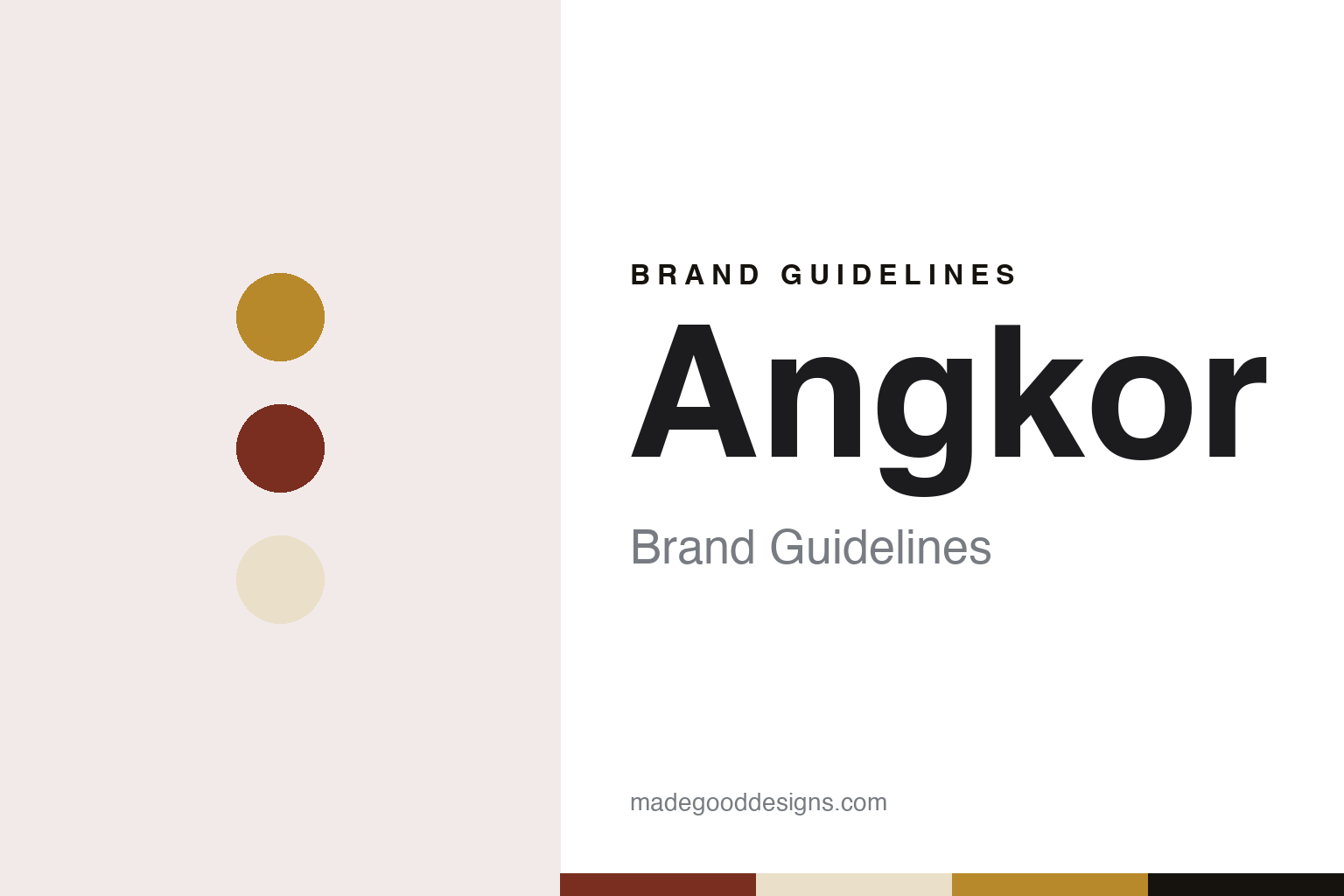
Angkor Brand Guidelines
Cambrew’s Sihanoukville lager, wholly Carlsberg-owned since 2019.
Aa
Two constants: an Angkor gold, red and sandstone palette and an inscriptional serif register. Abstract homage — not an Angkor or Cambrew product or mark; no label, can or logo is reproduced.
The SKD Brewery
A government brewery on the southern coast.
Angkor is a Cambodian lager named after the Angkor temples near Siem Reap, English Wikipedia says; when Carlsberg bought into its brewer in 2005, the Nordic business news site ScandAsia described the brand as named after Angkor Wat. It is brewed by Cambrew Ltd at a brewery in Sihanoukville, on Cambodia’s southern coast, and the Danish Carlsberg Group has owned all of Cambrew since 2019.
The brewery is older than the company that runs it. English Wikipedia says it began as the SKD Brewery — the initials stand for Société des Khmère Distilleries — commissioned by the Cambodian government in the early 1960s and built by a French contractor with French technical assistance. Carlsberg’s history of the site says it was fully operational by 1965, when it was inaugurated by Prince Norodom Sihanouk, and that Bayon was the first beer brand it produced. Carlsberg also says Sihanoukville was chosen for the quality of its spring water.
Sources differ on when the Angkor name itself first appeared. English Wikipedia dates the first Angkor Beer to 1963 and says the original brewery sold lager under both the Angkor and Bayon names. Carlsberg, and a 2019 report in ScandAsia, date Angkor Premium Beer in its present form to 1992.
The building has its own place in architectural history. English Wikipedia attributes it to the Cambodian architect Vann Molyvann, a central figure of the movement known as New Khmer Architecture, and describes an office block whose upper floor overhangs the ground floor on a row of triangular supports. The Hong Kong museum M+ holds a series of elevation and section drawings of the “Société des Khmère Distilleries Brewery (1965)” among its Vann Molyvann Drawings, created by the Vann Molyvann Project between 2010 and 2015.
The first chapter ended in war. English Wikipedia says the brewery’s operations were disrupted when civil war broke out in the early 1970s, and that it closed in 1975.
Colour
Cambrew, then Carlsberg.
The brand’s modern life began in the early 1990s. English Wikipedia says Cambrew Ltd, which it describes as a Malaysian company, took control of the brewery in 1991 and restarted production in 1992 after nine months of refurbishment; Carlsberg’s own timeline also gives nine months of rebuilding and the year 1992. Carlsberg says Cambrew then built a portfolio of Klang Beer, Black Panther Stout, Angkor Extra Stout and what became Angkor Premium Beer, and that since 1992 it has held an exclusive licence to make and distribute PepsiCo drinks in Cambodia.
Ownership moved to Copenhagen in stages. In August 2005 ScandAsia reported that Carlsberg had acquired a 50% interest in Cambrew, which it said owned the Angkor Beer brand. Carlsberg says its holding rose to 75% in 2018. In November 2019 ScandAsia reported that Carlsberg had agreed to buy the shares it did not already own, with the stated aim of rejuvenating Angkor Premium Beer, and Carlsberg’s timeline lists 2019 as the year Cambrew became wholly owned by the group. Between those steps, Carlsberg says, Cambrew added a third brewhouse at Sihanoukville in 2012 and marked the brewery’s 50th anniversary in 2015.
The beer is still made on the coast. A ScandAsia photo caption in 2019 described Angkor as produced at the company’s factory in Sihanoukville province. The same report listed Klang, Black Panther, Carlsberg, Tuborg, Kronenbourg 1664 and Somersby among Cambrew’s products, and said Guinness, Asahi and PepsiCo drinks were also made at the Sihanoukville plant. The business itself is run from Phnom Penh, where Carlsberg says Cambrew opened a new head office in 2015.
Typography
Lager and national identity.
The seven brands in this group are all lagers and beers from South and Southeast Asia: Angkor from Cambodia, 333, Huda and Larue from Vietnam, Bira 91 from India, Lion Lager from Sri Lanka and Myanmar Beer from Myanmar. Beer brands in general sit at many different points in the trade, from names that grew up inside a single national brewery to labels that now belong to much larger international brewing groups, and a single brand can be poured everywhere from a street-side stall to a hotel bar.
A beer brand’s identity is usually carried less by the liquid than by a name, a label, a can and the place it promises, because the company behind the name may have changed hands, taken on foreign partners or moved its brewing far beyond the city where it started. That makes the questions behind each name worth asking plainly: who started it, who owns it now, and where its beer is actually brewed and packed.
Each guide separates what independent sources record from what the company says about itself — its founding story, its shareholders over time, where its beer is brewed and how its labels and advertising have changed — and marks plainly what rests only on the company’s own word.
Aa
An inscriptional serif — a nod to carved temple lettering. (Specimen set in Cinzel, a serif STAND-IN; NOT the Angkor logo.)
Angkor
“My Country, My Beer.”
Angkor’s identity is built on national pride. Carlsberg gives the brand’s slogan as “My Country, My Beer,” and its packaging has been reworked several times under Cambrew. Carlsberg says the Angkor Premium bottle was redesigned in 2013 with a slimmer shape and a ring-tab closure, and that a “Sleek Can” followed in 2017.
The bigger change came with the 2019 relaunch. Cambrew’s managing director, Michael Norgaard Jensen, told the Khmer Times, as quoted by ScandAsia, that the changes included “several improvements to the packaging and recipe,” aiming for a beer that “stays true to its original Khmer taste.” Carlsberg says the new Angkor Premium Beer kept the original recipe from 1992 while being made to look more modern.
In 2023 the brand went further back into Cambodian art. Asia Brewers Network reported in March 2023 that Angkor had a new look showcasing the decorative Khmer Kbach style, launched through a “Shine Like Gold” campaign and presented as “the Gold of Angkor.” Campaign Brief Asia, reporting the same launch on 24 March 2023, described Kbach as sculpted Khmer ornament and said the new packaging put it in the spotlight. Neither report named a design agency.
For a design guide, Angkor shows how a lager can make a national landmark and a traditional ornament the centre of its identity while passing to a foreign owner. Compare Beerlao, the Laotian lager in which Carlsberg also holds a stake, and Tuborg, one of the Carlsberg brands sold by Cambrew. For this guide we use gold, a laterite red and sandstone with a serif, an unofficial interpretation; no product or logo is reproduced.
Explore & save
Keep Angkor’s identity on hand — save it to a board in the Made Good inspiration library.
Angkor identity set
Pin the Angkor gold, red and sandstone palette and the inscriptional serif register to your own board.