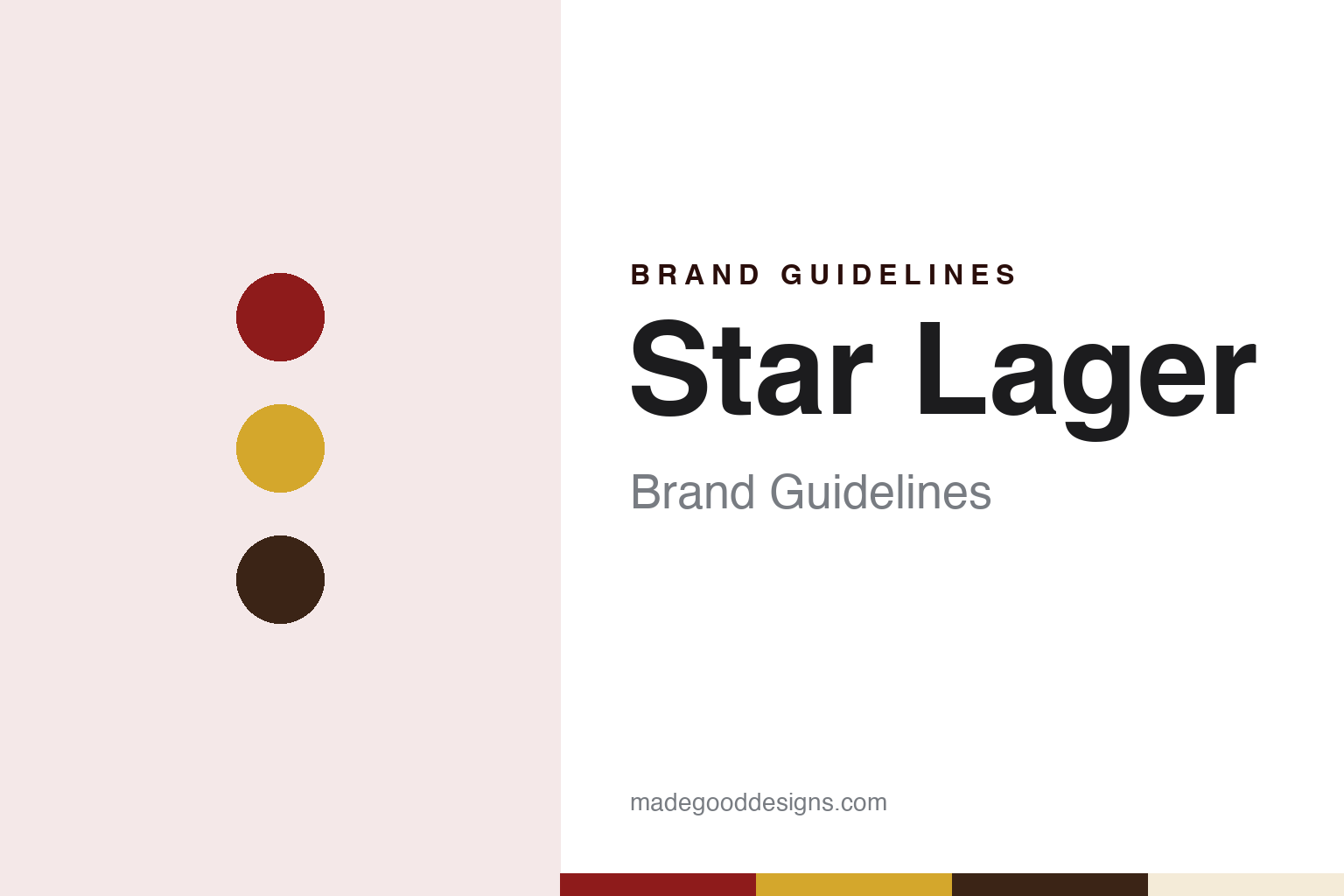
Star Lager Brand Guidelines
The Lagos lager that has carried one emblem since 1949.
Aa
Two constants: a red, gold and brown palette and a condensed sans register. Abstract homage — not a Star Lager product or mark; no bottle, label or logo is reproduced.
Iganmu, 1949
A trading company, a Dutch brewer and a Lagos brewhouse.
Star Lager is brewed by Nigerian Breweries Plc, the Lagos company whose story begins in November 1946, when, the company says, the United Africa Company (UAC) and Heineken signed a contract to incorporate Nigerian Brewery Limited in Lagos. English Wikipedia says the idea of a brewery in Lagos had been promoted by Frank Samuel of UAC before the Second World War. Because UAC had no history in brewing, it entered a technical agreement with Heineken, and other trading firms in Nigeria — among them John Holt, CFAO, SCOA and UTC — took equity in the new company.
Construction of the brewery at Iganmu, Lagos, began in 1947 and was finished in 1949, English Wikipedia says. The first bottle of Star rolled off the Lagos bottling line in June 1949; a 2017 Nigerian Breweries release gives the launch date as 2 June 1949. The company describes Star as the first beer brewed in Nigeria, introduced into a market that had been supplied by imported brands.
The company grew around the brand. Its own timeline records work starting on a brewery at Aba in May 1955; a change of name in May 1957, from Nigerian Brewery Limited to Nigerian Breweries Limited; a brewery at Kaduna commissioned in 1964, which English Wikipedia dates to 1963; Ibadan in 1982; Enugu in 1993; and Ama Brewery, commissioned in October 2003. The same timeline gives 2000 as the year Heineken “takes over control” of the company.
Colour
Modern beer, music and football.
From the start Star was a marketing project as well as a brewing one. English Wikipedia says Nigerian Breweries used consumer research to understand its market, built Star’s advertising around a link between drinking beer and modernity, and was one of the early companies to advertise a Nigerian brand heavily.
In recent years the brand has spoken mostly through music and sport. Nigerian Breweries lists Star Mega Jam, Star Quest and Star Music – The Trek among the music properties the brand has run, and in October 2019 it announced Access The Stars, a talent show with Access Bank whose discovered artists were to tour on The Trek alongside acts including Tiwa Savage, Flavour and Olamide, with Dare Art Alade as host and the choreographer Kaffy, the producer Tee-Y Mix and the singer Seyi Shay as judges. In January 2019 it named the singer Burna Boy as Star’s brand ambassador; the company said the brand had sponsored a series of December concerts beforehand, one of them the Burna Live Concert. In February 2018 Star sponsored Nigeria’s bobsled team — Seun Adigun, Akuoma Omeoga and Ngozi Onwumere — and the skeleton athlete Simidele Adeagbo at the Winter Olympics in Pyeongchang, the company announced. Its marketing director, Franco Maria Maggi, tied the sponsorship to the brand’s own story, saying Star identified with the athletes’ “pioneering spirit.”
Football produced the brand’s most visible pack graphics. On 31 August 2016 Star announced partnerships with Arsenal, Juventus, Real Madrid, Paris Saint-Germain and Manchester City, and Nigerian Breweries said the deals gave the brand the opportunity to put the clubs’ logos on its bottles. FC Barcelona followed in 2017 and, in September 2017, Chelsea, which the company announced as Star’s official beer partner in Nigeria, with a promise that fans would travel each year to watch Chelsea play in London. Tokunbo Adodo, then the company’s portfolio manager for national premium brands, said the deals were part of an intent “to be seen as the beer brand of football.”
Typography
Brewing in West Africa.
The seven brands in this group are all African beers: Star, Hansa Pilsener, Windhoek, St. George, Nile Special, Primus and Kilimanjaro. Each carries a national or local name — a city, a river, a mountain, a saint — yet almost all of them now sit inside one of a handful of international brewing groups, and the questions behind each label are the same: who brewed it first, who owns it now, and since when.
Three belong to AB InBev, through its takeover of SABMiller, which closed on 10 October 2016, BeverageDaily reported. Hansa Pilsener is a beer of South African Breweries, founded in 1895 as Castle Brewery, English Wikipedia says. Nile Special comes from Nile Breweries, which started in 1951 as a single brewery in Jinja, Uganda; South African Breweries took a stake in 1997 and full ownership in 2001, according to English Wikipedia. Kilimanjaro is made by Tanzania Breweries, half of which the Tanzanian government sold to South African Breweries’ international arm in 1993.
Two are Heineken names. Star is the beer of Nigerian Breweries, whose first bottle came off its Lagos line in June 1949 and whose leading shareholder is Heineken, English Wikipedia says. Windhoek is brewed by Namibia Breweries, where Heineken took over the shareholding of the Namibian group Ohlthaver & List in 2023, the Namibian Sun reported. Primus has a more recent twist: Bralima, its Congolese brewer since 1926, had been majority-owned by Heineken since 1986, but on 10 April 2026 Heineken announced it had sold its shareholding to ELNA Holdings of Mauritius, while keeping ownership of Primus and licensing it in the Democratic Republic of Congo.
The seventh, St. George, belongs to the French Castel group through BGI Ethiopia, which English Wikipedia says was established in 1998.
Each guide separates what independent sources record from what the company says about itself — its founding story, its owners over time, where its beer is brewed and how its labels have changed — and marks plainly what rests only on the company’s own word.
Aa
A condensed sans for a bottle-neck register. (Specimen set in Oswald, a sans STAND-IN; NOT the Star Lager logo.)
Star Lager
One emblem, several packs.
The family has widened around the core lager. English Wikipedia dates Star Lite to February 2014 and Star Radler to July 2015, now in citrus and red-fruit versions, and Nigerian Breweries announced a new sleek can for Star Radler in December 2021. On its brand page the company describes Star as “Cold Filtered for that crisp, truly refreshing taste” and lists its ingredients as water, sorghum, malted barley, malted sorghum and hop extract. English Wikipedia connects the local grain to 1988, when the Nigerian government banned barley imports and the company, with Heineken’s technical assistance, converted its breweries and set up a grain farm in Niger State.
The latest pack change came in December 2024, when Marketing Edge reported a refreshed, retro-styled design for the 60cl bottle, the 45cl bottle and the 33cl can, drawing on the brand’s long history and keeping the star emblem as a prominent feature.
Heineken has been part of the business since its incorporation in 1946. English Wikipedia calls it Nigerian Breweries’ leading shareholder and says it led the company’s 2014 merger with Consolidated Breweries, the maker of 33 Export, three years after Nigerian Breweries bought the Sona Breweries plants at Ota and Kaduna and Life Breweries at Onitsha.
For a design guide, Star Lager shows how one emblem can carry a beer through decades of music, football and pack changes. Compare Windhoek, the Namibian lager whose brewer Heineken bought in 2023, and Primus, from Central Africa. For this guide we use a red, a gold and a bottle brown with a condensed sans, an unofficial interpretation; no product or logo is reproduced.
Explore & save
Keep Star Lager’s identity on hand — save it to a board in the Made Good inspiration library.
Star Lager identity set
Pin the Star Lager red, gold and brown palette and the condensed sans register to your own board.


