Windhoek Brand Guidelines
Namibia’s 1920 brewery merger, a purity-law promise and a W drawn from the dunes.
Aa
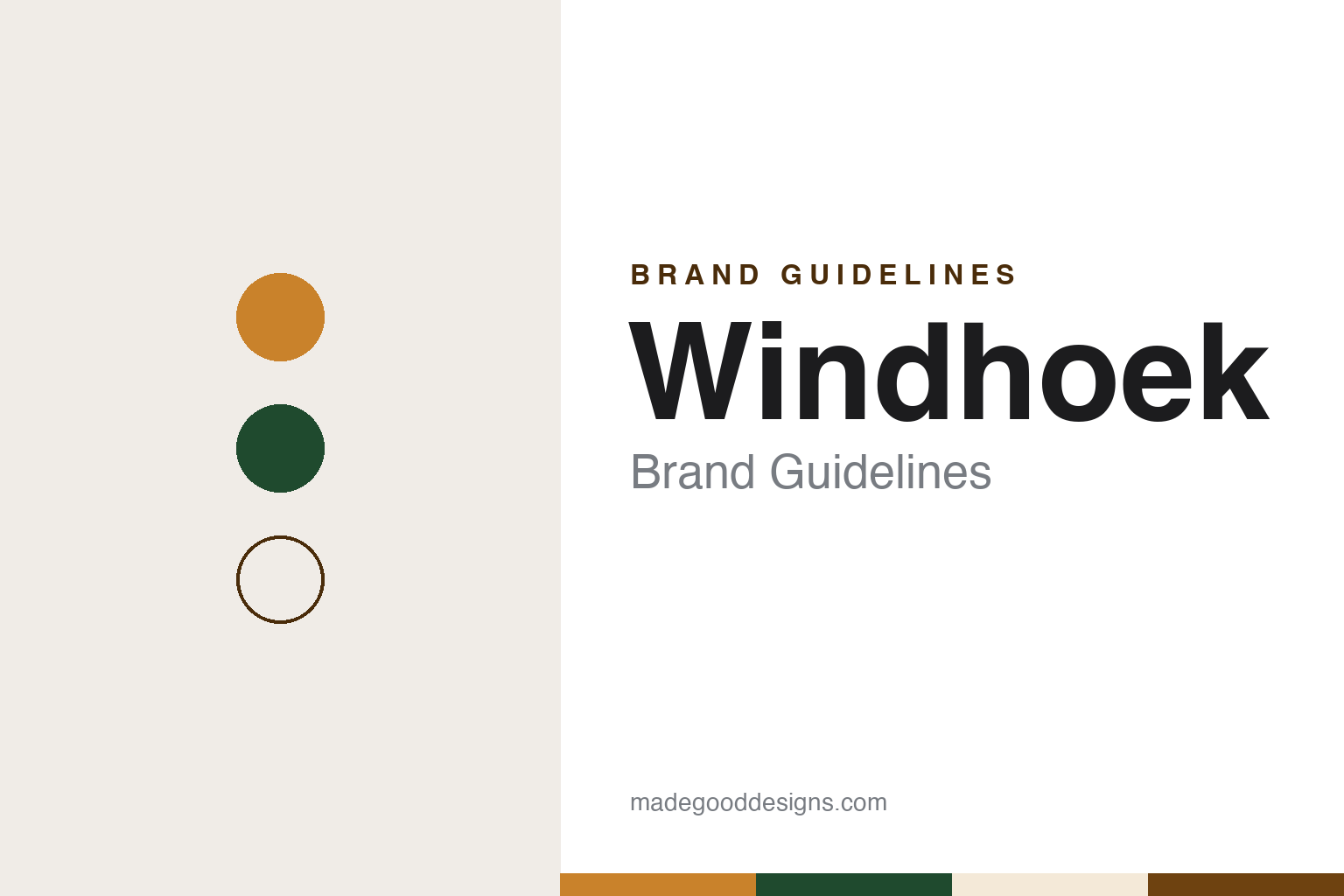
Two constants: a dune ochre, burnt sand and bottle green palette and a condensed sans register. Abstract homage — not a Windhoek product or mark; no label, logo, can or bottle is reproduced.
Four breweries become one
A 1920 merger in a territory that had just changed hands.
Windhoek is the beer brand of Namibia Breweries Limited (NBL), the brewer based in the Namibian capital whose name the beer carries. Its story begins in the years after the First World War. The historian Tycho van der Hoog, author of Breweries, Politics and Identity: The History Behind Namibian Beer, wrote in The Namibian in September 2020 that South African soldiers had invaded German South West Africa in 1914, and that in 1920 “two young German bankers,” Hermann Ohlthaver and Carl List, bought four of the territory’s breweries.
NBL’s own company history names them: the Kronen Brauerei in Swakopmund, the Omaruru Brewery, and the Klein Windhoek and Felsenkeller breweries in Windhoek. The company says the pair consolidated the four as South West Breweries Limited in 1920, which is the year NBL gives as its founding and the year it marked with a centenary in 2020. Van der Hoog wrote that the main brewery stood on Tal Street in Windhoek, in the building that now houses The Brewers Market.
The company’s milestones trace the decades that followed. South West Breweries bought the Hansa Brauerei in Swakopmund in 1967 and moved into a new brewery in Windhoek in 1983. With Namibia’s independence in 1990 it changed its name to Namibia Breweries Limited, and in 1996 it listed on the Namibian Stock Exchange, with the Ohlthaver & List group, the group the two founders started, as controlling shareholder.
International brewers arrived in stages. NBL says it formed a partnership with Diageo and Heineken in 2003 and began producing Heineken for Namibia in 2004, and that Heineken acquired Diageo’s indirect stake in 2015. In November 2021 Republikein reported that Heineken had agreed to buy Ohlthaver & List’s 50.01% shareholding in NBL Investment Holdings, the company that controls the brewer. Namibian Sun reported on 17 April 2023 that the deal had closed: Heineken now owned all of NBL Investment Holdings, which in turn held 59.4% of NBL, with the rest of the shares held by investors on the Namibian Stock Exchange. Heineken has been NBL’s majority owner since April 2023; its release of 26 April 2023 said NBL had been combined with Heineken South Africa into a new Heineken majority-owned business, Heineken Beverages.
Colour
A purity-law promise, and a W drawn from the desert.
The idea at the centre of the brand is an ingredient list. NBL says that Windhoek has been brewed for nearly a hundred years according to the German Reinheitsgebot of 1516, using only malted barley, hops and water. Van der Hoog dates the arrival of the purity law at the brewery later: he wrote in 2020 that its introduction in the 1980s, which strictly regulated the ingredients, allowed the brewery to market its beer as a premium product. Either way, “100% pure” and the three ingredients now sit at the heart of how NBL describes every Windhoek beer.
The range is short. NBL lists Windhoek Lager alongside Windhoek Draught, Windhoek Light and Windhoek Non-Alcoholic, all described in the same three-ingredient terms.
The identity was redrawn in 2024. The Windhoek Express reported on 29 May 2024 that Windhoek Beer had announced a brand refresh. Tasneem Klazen, marketing manager for Windhoek Beer at NBL, told the paper that the pack carried a new W design “inspired by the mesmerizing flow of the Namib Desert dunes and the shimmer of our hot city streets,” and that the brand’s swash symbolises wind-blown sand dunes while also signalling water and refreshment. She said the refresh meant a redesign of the cans and bottles and that nothing else changed, and she described the brand’s philosophy as “100% real beer for 100% real people.” No design agency was named in the report.
The beer’s meaning has shifted with the country’s politics. Van der Hoog wrote that the apartheid state had used alcohol as a political instrument, and that Namibian beer had made a remarkable transformation from an icon of apartheid to a symbol of an independent nation.
Typography
Design and documentation.
The seven brands in this group are all African beers: Star, Hansa Pilsener, Windhoek, St. George, Nile Special, Primus and Kilimanjaro. Each carries a national or local name — a city, a river, a mountain, a saint — yet almost all of them now sit inside one of a handful of international brewing groups, and the questions behind each label are the same: who brewed it first, who owns it now, and since when.
Three belong to AB InBev, through its takeover of SABMiller, which closed on 10 October 2016, BeverageDaily reported. Hansa Pilsener is a beer of South African Breweries, founded in 1895 as Castle Brewery, English Wikipedia says. Nile Special comes from Nile Breweries, which started in 1951 as a single brewery in Jinja, Uganda; South African Breweries took a stake in 1997 and full ownership in 2001, according to English Wikipedia. Kilimanjaro is made by Tanzania Breweries, half of which the Tanzanian government sold to South African Breweries’ international arm in 1993.
Two are Heineken names. Star is the beer of Nigerian Breweries, whose first bottle came off its Lagos line in June 1949 and whose leading shareholder is Heineken, English Wikipedia says. Windhoek is brewed by Namibia Breweries, where Heineken took over the shareholding of the Namibian group Ohlthaver & List in 2023, the Namibian Sun reported. Primus has a more recent twist: Bralima, its Congolese brewer since 1926, had been majority-owned by Heineken since 1986, but on 10 April 2026 Heineken announced it had sold its shareholding to ELNA Holdings of Mauritius, while keeping ownership of Primus and licensing it in the Democratic Republic of Congo.
The seventh, St. George, belongs to the French Castel group through BGI Ethiopia, which English Wikipedia says was established in 1998.
Each guide separates what independent sources record from what the company says about itself — its founding story, its owners over time, where its beer is brewed and how its labels have changed — and marks plainly what rests only on the company’s own word.
Aa
A condensed sans for a short, tall city name. (Specimen set in Barlow Condensed, a sans-serif STAND-IN; NOT the Windhoek logo.)
Windhoek
A city’s name on a lager that travels.
Windhoek Lager is the brand NBL sends abroad. In May 2021 the company announced that IM Premium Importers, which it had appointed in 2019 as the beer’s sole importer in the United States, had placed Windhoek Lager in Spec’s liquor stores in Texas and was launching it in about 20 Walmart stores in the state, with distributors elsewhere in the country invited to contact the importer.
At home, the same brewery makes beer for other names. NBL says it has produced Heineken for the Namibian market since 2004, and in 2014 it bought Camelthorn Brewing, a Namibian craft brewer launched in 2009. Under Heineken, the brewer’s leadership has stressed continuity: Namibian Sun reported in May 2023 that Heineken’s chief executive, Dolf van den Brink, said NBL would remain a local, listed company.
Two notes on names. Windhoek is first of all the capital of Namibia, so the beer is usually searched as Windhoek Lager or Windhoek Beer. And NBL’s own Hansa Draught is a different beer from Hansa Pilsener, the South African lager.
For a design guide, Windhoek shows how a city’s name, a three-ingredient promise and a W drawn from the desert can carry a Namibian lager from a 1920 brewery merger to shelves abroad. Compare Castle Lager, the South African Breweries lager from Johannesburg, and Amstel, the Amsterdam lager in the Heineken family. For this guide we use dune ochre, burnt sand and bottle green with a condensed sans, an unofficial interpretation; no product or logo is reproduced.
Explore & save
Keep Windhoek’s identity on hand — save it to a board in the Made Good inspiration library.
Windhoek identity set
Pin the Windhoek dune ochre, burnt sand and bottle green palette and the condensed sans register to your own board.