Zagorka Brand Guidelines
The Stara Zagora brewery dating from 1902.
Aa
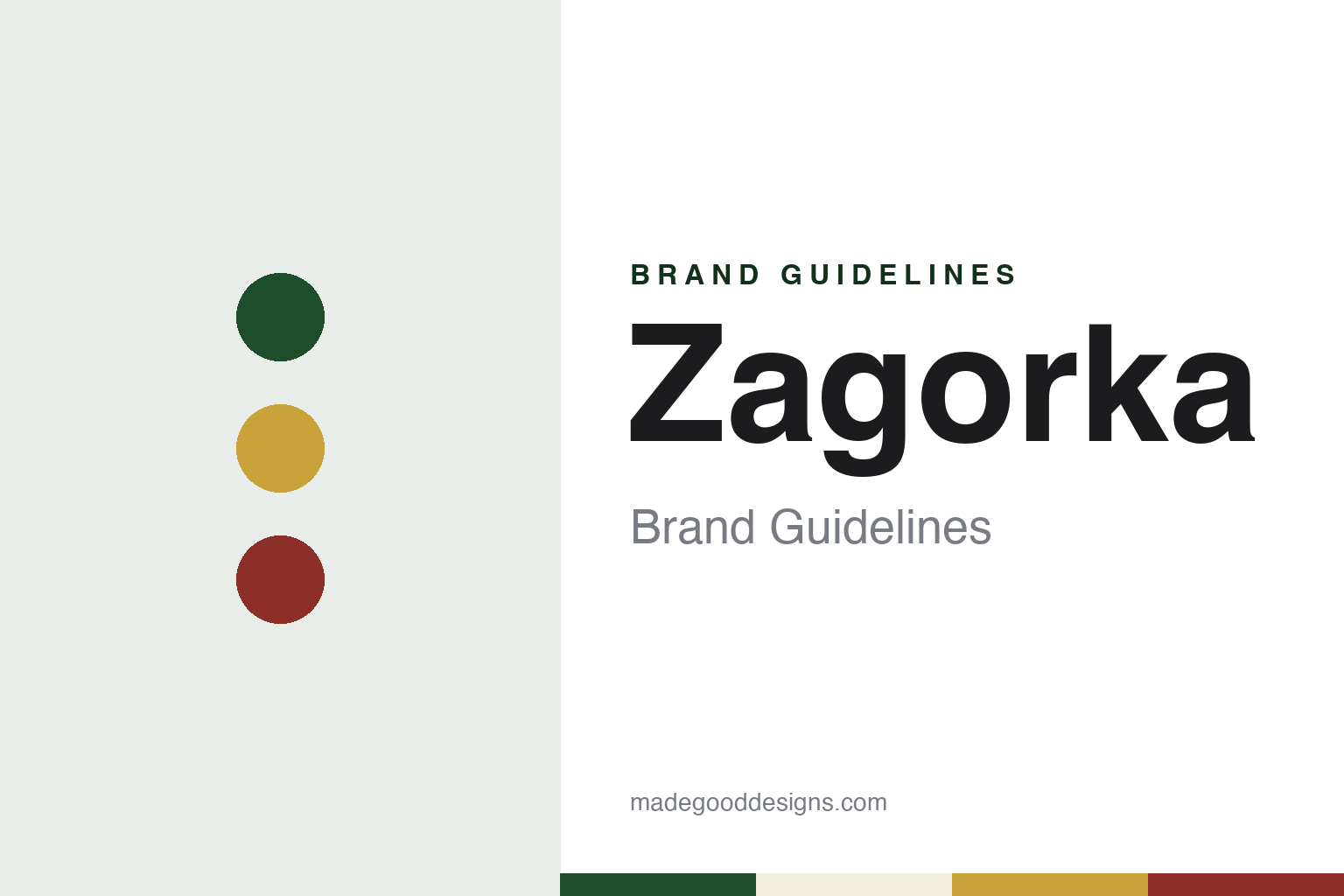
Two constants: a hop green, malt gold and brick red palette and an old-style Cyrillic serif register. Abstract homage — not a Zagorka product or mark; no bottle, label or logo is reproduced.
Badashtnost
A Prague-trained doctor, a local bank and a brewery.
Zagorka is brewed in Stara Zagora, a city in central southern Bulgaria, and the company behind it traces its roots to 1902. Bulgarian Wikipedia, citing a 1996 history of the Bulgarian brewing industry published by the Union of Brewers in Bulgaria, says that in that year Dr Konstantin Kozhuharov, who had studied medicine in Prague, returned to his home town and, with fellow citizens, decided to build a brewery there. Its capital came from a local credit company called Badashtnost (“Future”), founded in 1886, which became the main shareholder and gave the brewery its name. The machines came from the Czech lands and Germany, and brewers were hired from abroad. Locals simply called the plant “the Birariata,” the beer house, the company says.
The first business did not last. Bulgarian Wikipedia says beer was not yet a popular drink, an attempt to sell in Istanbul failed for lack of refrigerated wagons, and when the Badashtnost bank itself ran into trouble the brewery was declared insolvent and stood idle for several years. In 1918, the same source says, the brothers Nikola and Zlati Zlatev set up a joint-stock company called Trakia, bought the buildings and machinery, and restarted brewing in 1921; the company’s own history places the Trakia purchase “a decade” after 1902. Trakia beer sold across southern Bulgaria. The company says that in 1918 the brewery took on Andrey Brashovanov, whom it calls the first Bulgarian master brewer, a graduate of the brewing school in Grimma, Germany, who went on to write the first Bulgarian textbook on brewing.
A second stop followed. On 3 April 1927, Bulgarian Wikipedia says, the country’s 18 breweries formed a cartel in the face of heavy excise duties, and it closed 12 of them, including Stara Zagora’s. The machinery was sold, but the buildings survived, and they became the base for the brewery that would carry the Zagorka name.
Colour
A state brewery, a city name and a run of firsts.
The name Zagorka comes with the rebuilt, state-run brewery, and the sources date its start differently. The company says repairs began in 1949 thanks to Brashovanov, and that when they were finished the first hectolitres of beer named “Zagorka” were brewed. Bulgarian Wikipedia, citing the 1996 industry history, says the government decided to restore brewing in Stara Zagora in 1954 and that the new Zagorka brewery went into regular operation on 6 April 1958; both English and Bulgarian Wikipedia date the beer itself to 1958. The plant was enlarged in the 1960s with a new maltings fitted with Czech equipment, renamed a brewing works at the end of the decade, and rebuilt again from 1984 with new Czech brewhouses.
The company presents its state-era history as a run of firsts. It says Zagorka was the first Bulgarian brewery to label its bottles and close them with metal crown caps by machine rather than by hand, the first to run a nationwide advertising campaign, on radio, in the press and with a poster for Zagorka beer, and the first to install a line for filling beer into cans. Bulgarian Wikipedia, citing the trade magazine Regal in 2012, says Zagorka began exporting at the end of the 1980s, when it made Zagorka Vita, the first Bulgarian non-alcoholic beer, for markets in the Middle East, and that from 1981 it entered the Monde Selection competition in Brussels, collecting a grand gold medal and quality trophy in 1985.
Its lettering has changed with the times. English Wikipedia says the label was first written in Cyrillic, that in the late 1990s the range briefly carried both scripts — Zagorka Light with a Cyrillic label, Zagorka Special with a Latin one — and that today the name is written mostly in Latin letters. Today the brand’s own site lists Zagorka Special, which it says is made with 100% Bulgarian malt, a non-alcoholic Zagorka 0,0% and Zagorka Retro, an unpasteurised beer it sells partly on the strength of its bottle, under the line “Доброто тук” (“The good here”). English Wikipedia also records two seasonal beers, a dark Zagorka Reserve from 2011 and a grape-flavoured Zagorka Fusion from 2012.
Typography
Design and documentation.
The seven brands in this group all make food or drink, and all of them come from Romania or Bulgaria: Ursus, Timișoreana, Borsec, Dorna, Napolact, ROM and Zagorka. Food and drink brands from these two countries in general sit at many different points in the trade, from names that still carry a town or a region to names that now belong to much larger international groups, and a single brand can be sold everywhere from a village shop to a supermarket shelf.
A food or drink brand’s identity is usually carried less by a single product than by a pack, a name and the taste or occasion it promises, because the company behind the name may have changed hands, moved its production or grown far beyond the place where it started. That makes the questions behind each name worth asking plainly: who started it, who owns it now, and where its products are actually made and packed.
Each guide separates what independent sources record from what the company says about itself — its founding story, its owners over time, where its products are made and how its packaging has changed — and marks plainly what rests only on the company’s own word.
Aa
An old-style serif with Cyrillic for a brand that has been written in two scripts. (Specimen set in Old Standard TT, a serif STAND-IN; NOT the Zagorka logo.)
Zagorka
Privatisation, a Sofia brewery and Heineken.
Zagorka was the first brewing company in Bulgaria to be privatised. Bulgarian Wikipedia says that on 28 October 1994 Brewinvest, a Greek-registered company owned in equal halves by the Dutch brewer Heineken and Coca-Cola Hellenic Bottling Company, bought 80% of the shares; the company itself describes 1994 as the year Zagorka joined the Heineken family. In 1997, the same sources say, Brewinvest also took a majority stake in the Ariana brewery in Sofia, which was merged into Zagorka AD in 2003. Production of Ariana’s beers and of the strong dark Stolichno bock then moved to Stara Zagora, so that the company now brews three Bulgarian brands alongside Heineken, Amstel and Desperados, made under licence, according to Bulgarian and English Wikipedia.
Today the company names Heineken International B.V., of the Netherlands, as its majority shareholder. The brewery remains in Stara Zagora, with an administrative office in Sofia, and it has opened its doors to visitors. In 2009, the company says, it opened Bulgaria’s first beer museum at the brewery; the tour, now called “The World of Zagorka,” takes adult visitors through the working plant past a bottle from 1902 embossed with the name of the Badashtnost steam brewery, more than 15 kinds of glass used over the years and a can of Zagorka Vita. In October 2013 Zagorka opened a finished-goods warehouse certified under the BREEAM building standard, which the news site Vesti.bg reported at the time as Bulgaria’s first green industrial building and the first such warehouse at any Heineken brewery worldwide. In 2012, the business site money.bg reported, Zagorka and three other beers from the company won gold medals at Monde Selection.
For a design guide, Zagorka shows how a brewery can carry a city’s name through bankruptcy, a cartel closure, state ownership and a multinational parent, and how its lettering moved from Cyrillic to Latin along the way. Compare Ursus and Timișoreana, two Romanian beer brands. For this guide we use a hop green, a malt gold and a brick red with an old-style serif, an unofficial interpretation; no product or logo is reproduced.
Explore & save
Keep Zagorka’s identity on hand — save it to a board in the Made Good inspiration library.
Zagorka identity set
Pin the Zagorka hop green, malt gold and brick red palette and the old-style Cyrillic serif register to your own board.