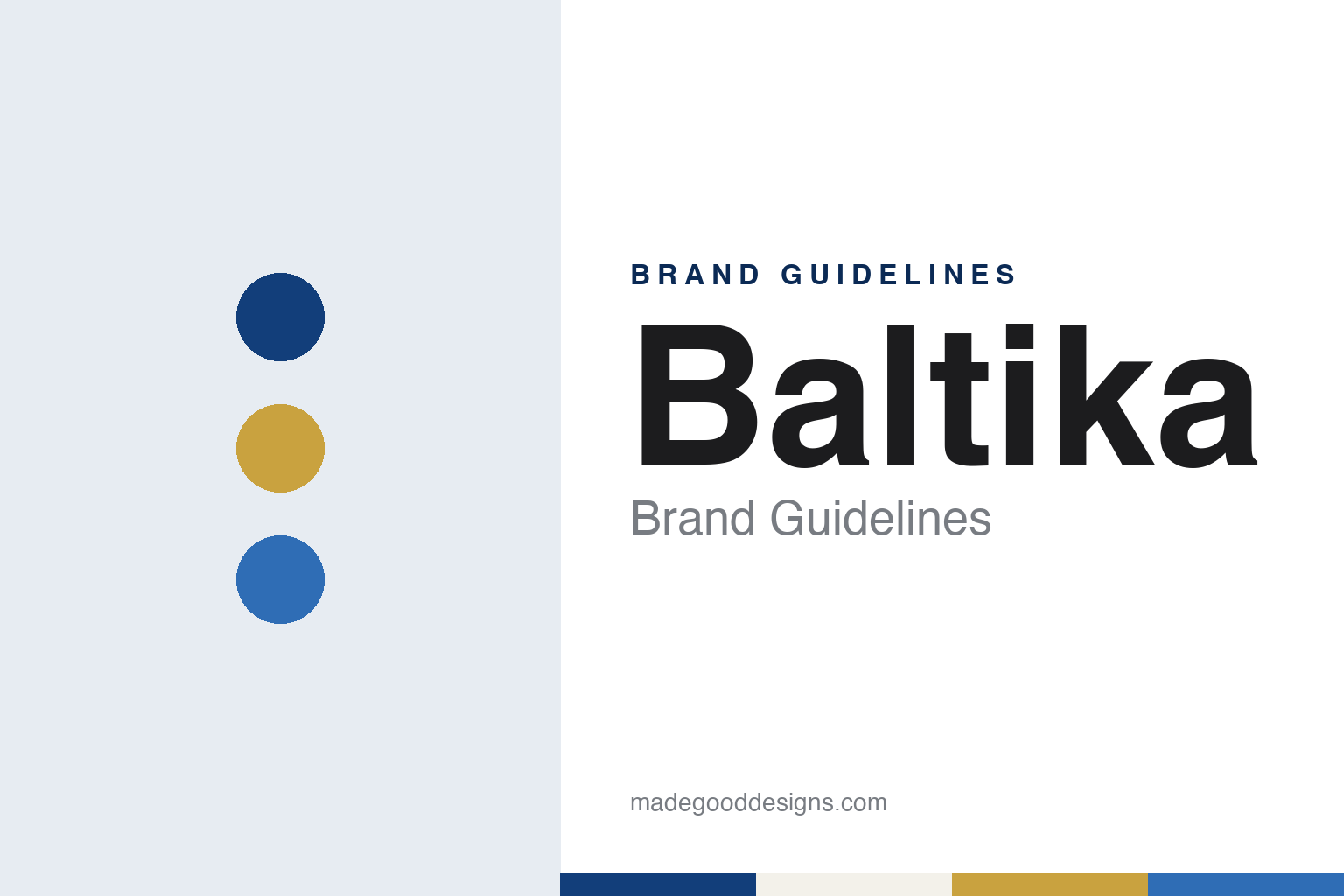
Baltika Brand Guidelines
The St Petersburg brewery that numbered its beers.
Aa
Two constants: a Baltic blue, wave blue and gold palette and a condensed numeral sans register. Abstract homage — not a Baltika product or mark; no can, label or logo is reproduced.
A brewery on the Baltic
A new plant, a privatisation and a Scandinavian shareholder.
Baltika is a brewer from St Petersburg. Russian Wikipedia says the city’s Baltika brewery began production in 1990 and that from 1991 to 2004 it was run by Taimuraz Bolloev, first as director, then as general director and finally as president. Beer under the Baltika brand name followed in 1992, Russian Wikipedia’s article on the beer says.
The company took shape with Russia’s privatisation. In 1992 the brewery became an open joint-stock company, and in 1993 Baltic Beverages Holding, a brewing venture of Scandinavian brewers, became its largest shareholder, Russian and English Wikipedia say. In 1998 the business took the name Baltika Breweries. In 2000 it opened a malting plant in St Petersburg with the French maltster Groupe Soufflet, and in September 2001 its shares were listed on the RTS exchange; the newspaper Kommersant reported in January 2002 that its market value had reached $1.3 billion.
Baltika grew by building and buying breweries across Russia. At the end of 2006 it merged with three Russian brewers — Vena in St Petersburg, Pikra in Krasnoyarsk and Yarpivo in Yaroslavl — and in 2007 they became one legal entity, the company announced at the time. Russian Wikipedia lists its production sites today as St Petersburg, which is also its head office, plus branches in Voronezh, Novosibirsk, Rostov-on-Don, Samara, Tula, Khabarovsk and Yaroslavl; the Krasnoyarsk and Chelyabinsk plants closed on 30 April 2015.
Colour
Numbers on the label and three waves in the logo.
Baltika’s best-known design idea is a number. Instead of naming each beer, the brewery numbered them. Russian Wikipedia says No. 1, No. 2 and No. 3 have been made since 1992, with No. 3, a pale lager now called “Classic,” the most widely sold of the brand’s pale beers. Nos. 4, 5, 6 and 7 followed in 1994: No. 4 a dark beer, No. 6 a porter and No. 7 “Export”, a pale lager. No. 9, a strong lager, came in 1998. The non-alcoholic beer, which had used the number 8 in the 1990s, became No. 0 in 2001, freeing No. 8 for a wheat beer. Some numbers changed contents over time — No. 2 was used for a range of fruit-flavoured beer drinks from 2001 before returning to a light beer in 2004 — and limited editions such as No. 10, for the company’s tenth anniversary in 2000, sat outside the core run. Named beers such as Leningradskoye, launched in 2003 for St Petersburg’s 300th anniversary, have been added alongside.
The name also travelled. Russian Wikipedia, citing Vedomosti, says Baltika was one of two Russian brands, with Lukoil, in the Financial Times’ list of the world’s 100 biggest brands in April 2007, and that it had dropped out of the list by 2010.
The corporate logo is better documented than most. Russian Wikipedia says that from 1990 until November 2013 it showed three blue wavy lines beside the word “Балтика” in large blue letters. On 20 November 2013 the company announced a new corporate identity. Its press release said the logo kept three elements — the lettered name, the three waves and a descriptor reading “Part of the Carlsberg Group” — and kept the name’s spelling, the company colour and the waves. Blue remained the main corporate colour, made darker and deeper, while gold was given a special role to stress the link with beer and the company’s market lead. The release said the change applied to communications about the company, not to the consumer Baltika beer brand. Russian Wikipedia says the Carlsberg descriptor was removed in 2022. For the typeface question, see our separate Baltika font guide.
Typography
Design and documentation.
The seven brands in this group are all drink names from Poland, Russia, Georgia and Brazil: Tyskie, Lech, Okocim, Baltika, Natakhtari, Skol and Itubaína. Drink brands from these countries in general sit at many different points in the trade, from names that still carry the town or brewery where they began to names that now belong to much larger drinks groups, and a single brand can be sold everywhere from a corner shop to a supermarket shelf.
A drink brand’s identity is usually carried less by a single product than by a bottle, a can, a label and a name, because the company behind the name may have changed hands, moved its production or grown far beyond the place where it started. That makes the questions behind each name worth asking plainly: who started it, who owns it now, and where its drinks are actually made and bottled.
Each guide separates what independent sources record from what the company says about itself — its founding story, its owners over time, where its drinks are made and how its packaging has changed — and marks plainly what rests only on the company’s own word.
№ 3
A condensed sans for a beer range that is ordered by numbers. (Specimen set in Oswald, a sans STAND-IN; NOT the Baltika logo.)
Baltika
Carlsberg ownership, and a change of hands in 2023–24.
Baltika’s largest shareholder became part of a global brewer. In April 2008 Baltika joined the Carlsberg Group, Russian Wikipedia says, and became the core of the group’s Eastern Europe region. At the end of 2012 Carlsberg bought out the remaining minority shareholders and Baltika was delisted, Reuters reported, and Russian Wikipedia says it was then converted from a joint-stock company into a limited liability company. The 2013 identity update followed that buy-out; the company called Baltika the largest of the Carlsberg Group companies.
Ownership changed again: Russia placed Baltika under temporary state management by presidential decree on 16 July 2023, the BBC reported, and in December 2024 Carlsberg Group announced it had divested its shares, with the business bought by the Russian company VG Invest, Interfax reported on 6 December 2024. Dmitry Vizir, a former vice-president, became general director later that month, Vedomosti reported.
The headquarters and the first brewery remain in St Petersburg. Alongside its own numbered beers the company makes other brands, among them the Žatecký Gus lagers and the Khlebny Krai kvass, Russian Wikipedia says, and it has made energy drinks under the Flash Up name. English Wikipedia says Baltika brands are also produced under licence in Kazakhstan, Azerbaijan and Tajikistan.
For a design guide, Baltika shows how a plain number, a blue-and-gold palette and three waves can give a whole beer range one system. Compare Saku, the Estonian brewery, and Aldaris, the Riga brewery, two other Baltic beer names. For this guide we use a Baltic blue, a wave blue and a gold with a condensed sans, an unofficial interpretation; no product or logo is reproduced.
Explore & save
Keep Baltika’s identity on hand — save it to a board in the Made Good inspiration library.
Baltika identity set
Pin the Baltika Baltic blue, wave blue and gold palette and the condensed numeral sans register to your own board.


