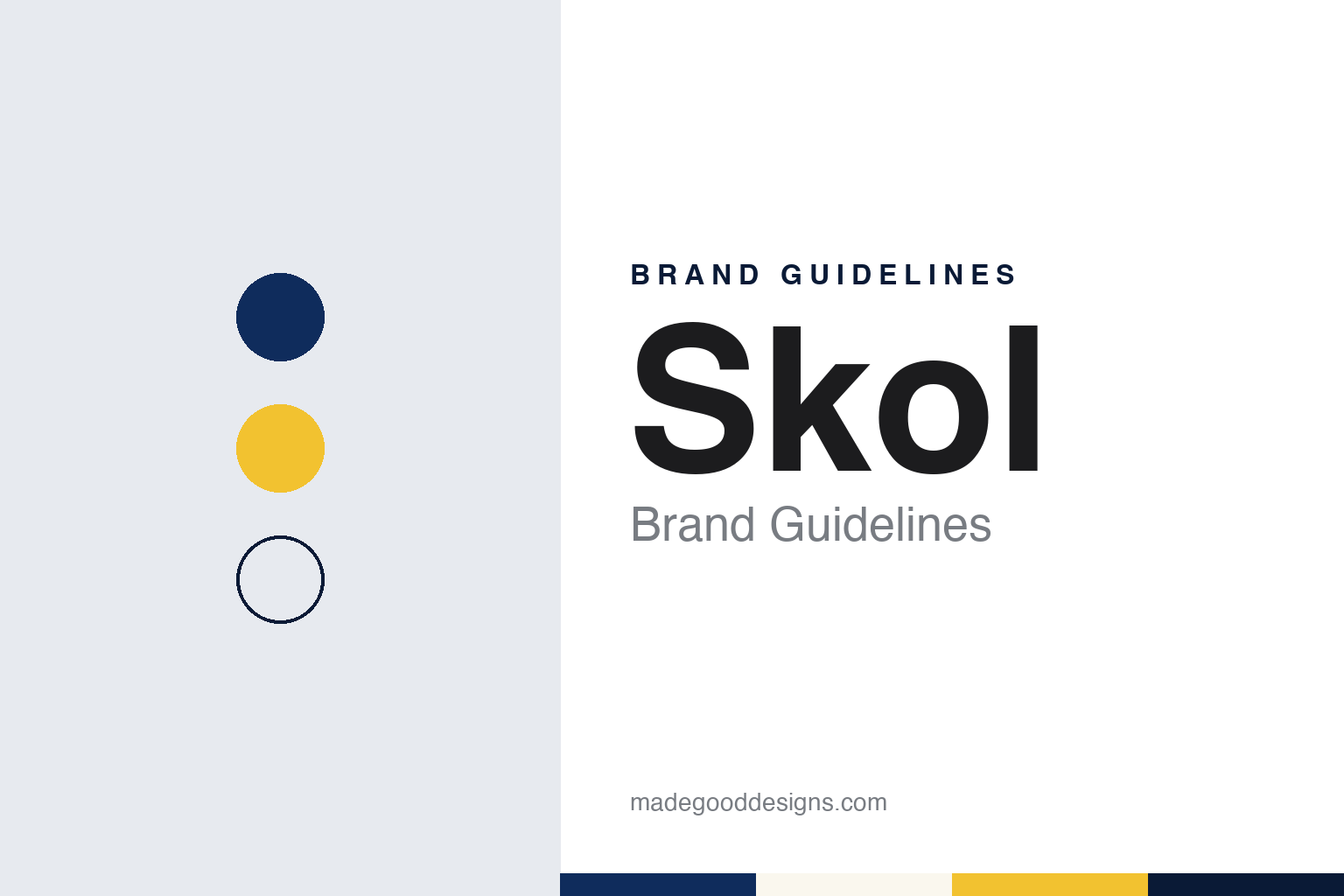
Skol Brand Guidelines
The Scottish-born lager licensed from Brazil to Malaysia.
Aa
Two constants: a Skol blue, yellow and white palette and a rounded sans register. Abstract homage — not a Skol product or mark; no can, label or logo is reproduced.
Graham’s Skol
A Scottish lager named after a Scandinavian toast.
Skol began in Scotland. English Wikipedia, citing Ian Hornsey’s A History of Beer and Brewing (2003), says the lager was first brewed by Ind Coope at Alloa as Graham’s Golden Lager, and that in 1958 it was renamed Graham’s Skol to give a Scandinavian impression, because the brewing plant had been imported from Sweden; the name was later shortened to Skol. Carlsberg, in a 2004 press release, says the beer was “first brewed in 1959 for the European market.”
The name is an English spelling of skål, the Scandinavian toast. Portuguese Wikipedia notes that the Swedish word literally means a bowl or cup, and that it is used for toasts in the Nordic languages much as Brazilians say “saúde!”
The step that made Skol international came in 1964. Four brewers — Allied Breweries of Britain, Labatt of Canada, Pripps-Bryggerierna of Sweden and Unibra of Belgium — formed Skol International, according to English Wikipedia, which cites a 1969 report by Britain’s Monopolies Commission. Its aim was a single beer brand that could be licensed, brewed and marketed around the world. Carlsberg’s 2004 release describes the same company as founded “by four international breweries to market the brand globally.” The Swedish partner has its own Pripps guide.
English Wikipedia adds that in the late 1960s Skol International was heavily advertised on the Dutch pirate station Radio Veronica, with a jingle sung by Patricia Paay, later a Dutch pop singer and television presenter, and that from 1973 to 1982 the Dutch brewer Oranjeboom brewed Skol without success in the Dutch market, as the newspaper Trouw recalled in 2002.
Colour
Brazil, from Rio Claro to Ambev.
Skol’s largest life has been in Brazil. Portuguese Wikipedia says the beer arrived there under licence in 1967, launched first by the Cervejaria Rio Claro, the São Paulo-state brewery that made Caracu, and that it was launched in Brasília on 5 August 1967. The same encyclopedia’s article on Brahma says that in 1980 the Companhia Cervejaria Brahma bought a shareholding in Cervejarias Reunidas Skol Caracu, which it lists among Brahma’s subsidiaries.
On 1 July 1999 Brahma merged with its old rival, the Companhia Antarctica Paulista, to form AmBev, Folha de S.Paulo reported at the time; Brazil’s competition authority, CADE, approved the merger in March 2000, English Wikipedia says. Ambev is now part of Anheuser-Busch InBev, and English Wikipedia names Ambev as the holder of the Skol licence for Brazil. Its stablemates there include Guaraná Antarctica.
Portuguese Wikipedia tells much of the Brazilian brand’s story through its packaging. It says Skol introduced a tinplate can in 1971, was a pioneer of the aluminium can in Brazil in 1989, brought out a 500 ml can and a screw-cap long-neck bottle in 1993, a 355 ml long neck in 1996 and, in 1997, a can with a round mouth. Advertising followed the same line: since 1997 the main slogan has been “A cerveja que desce redondo” — “the beer that goes down round” — with later secondary lines playing on round against square, and the brand sponsored music events including Skol Rock in 1997 and the electronic-music festival Skol Beats from 2000. Line extensions have come and gone; Portuguese Wikipedia lists Skol Lemon (2006–2007) and Skol 360 (2011–2015) among discontinued products. It also says, citing the consultancy Kantar, that Skol was ranked Brazil’s most valuable brand from 2013 to 2019.
Typography
Design and documentation.
The seven brands in this group are all drink names from Poland, Russia, Georgia and Brazil: Tyskie, Lech, Okocim, Baltika, Natakhtari, Skol and Itubaína. Drink brands from these countries in general sit at many different points in the trade, from names that still carry the town or brewery where they began to names that now belong to much larger drinks groups, and a single brand can be sold everywhere from a corner shop to a supermarket shelf.
A drink brand’s identity is usually carried less by a single product than by a bottle, a can, a label and a name, because the company behind the name may have changed hands, moved its production or grown far beyond the place where it started. That makes the questions behind each name worth asking plainly: who started it, who owns it now, and where its drinks are actually made and bottled.
Each guide separates what independent sources record from what the company says about itself — its founding story, its owners over time, where its drinks are made and how its packaging has changed — and marks plainly what rests only on the company’s own word.
Aa
A rounded sans for a beer that “goes down round.” (Specimen set in Nunito, a sans STAND-IN; NOT the Skol logo.)
Skol
One name, three rights-holders.
Outside Brazil, Skol’s ownership is split by region. Carlsberg’s 2004 press release says Carlsberg Breweries holds “the licence to brew and market Skol worldwide, apart from Africa and South America,” and that Skol was then sold in more than 20 countries; the release announced Skol brewed locally by Carlsberg Malaysia. Unibra, one of the 1964 founders, still holds the rights for Africa, English Wikipedia says, and Skol is sold in African countries including Rwanda, Burundi, Guinea and the Democratic Republic of the Congo. English Wikipedia also records Skol produced in Romania and Turkey.
In Britain the brand followed the brewers’ mergers. When Allied Breweries and Carlsberg merged their brewing in 1992 to form Carlsberg-Tetley, production moved from Alloa to the Tetley brewery in Leeds, where it stayed until that brewery closed in 2011, English Wikipedia says; the trade title Talking Retail reported in September 2011 that Carlsberg UK had cut Skol’s strength to 2.8 per cent. The brand has also carried sport: it was the main sponsor of the Fittipaldi Formula One team in 1980, and from 1984 to 1992 the Scottish League Cup was sponsored by Skol and awarded a Skol Cup. English Wikipedia says the cartoon Viking Hägar the Horrible was used in Skol’s promotion for a time.
Awards are recorded region by region too: a Monde Selection gold in 2012, reported by The New Times of Rwanda, and, Carlsberg said in 2005, a gold medal for packaging and a silver for taste at that year’s Australian International Beer Awards.
For a design guide, Skol shows how one name can be licensed across continents and still read as a single brand, while Brazil gives it a local voice through cans and “redondo” slogans; compare it with Pripps, a founding partner, and Tuborg, another Carlsberg beer. For this guide we use a deep blue, a yellow and a white with a rounded sans, an unofficial interpretation; no product or logo is reproduced.
Explore & save
Keep Skol’s identity on hand — save it to a board in the Made Good inspiration library.
Skol identity set
Pin the Skol blue, yellow and white palette and the rounded sans register to your own board.