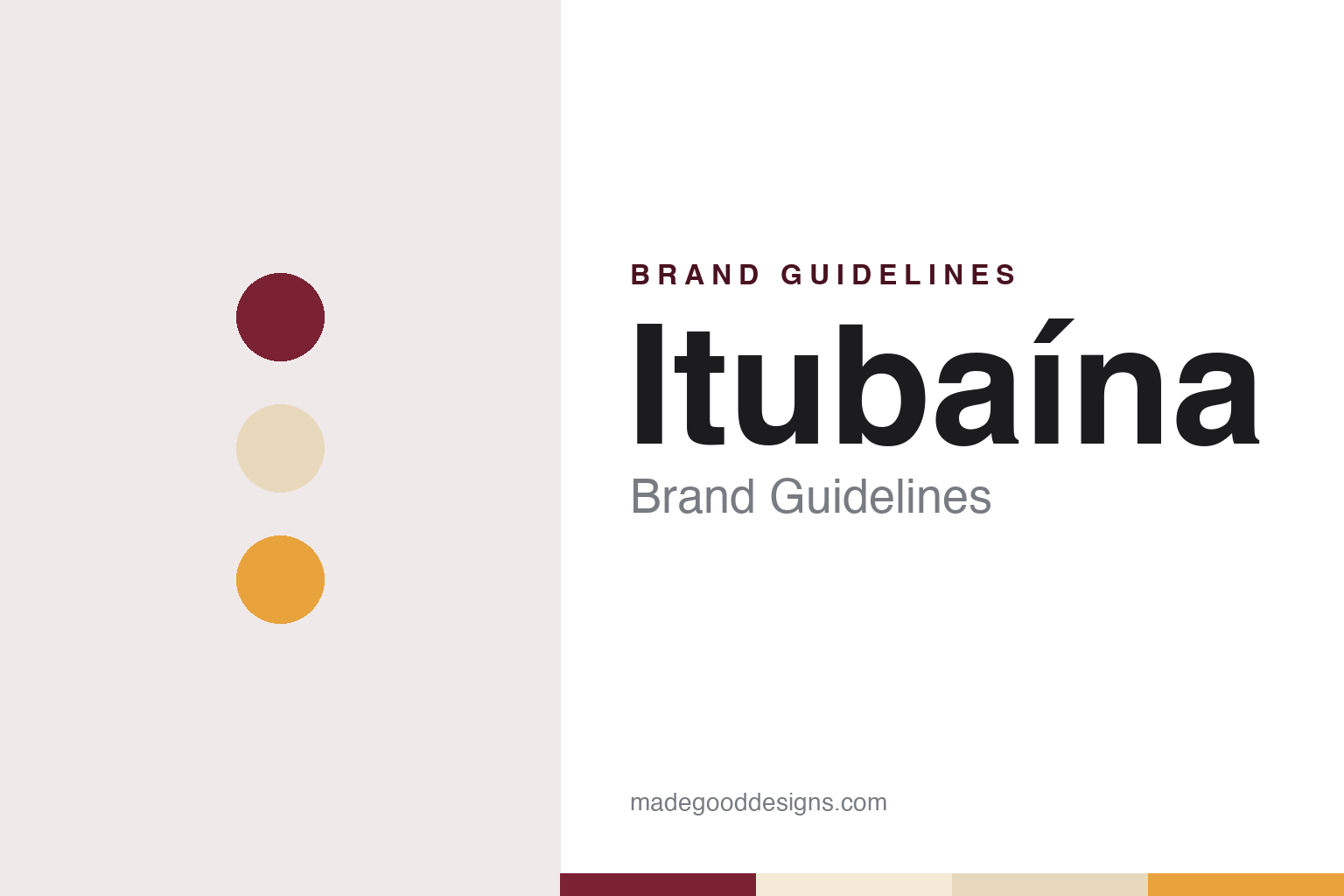
Itubaína Brand Guidelines
The tutti-frutti soda from Itu, since 1954.
Aa
Two constants: a burgundy and beige palette and a fluid rounded sans register. Abstract homage — not an Itubaína product or mark; no pack, logo or bottle is reproduced.
A soda named after its town
A tutti-frutti drink from a family firm in Itu.
Itubaína is a Brazilian soft drink best known for a single flavour: tutti-frutti. Portuguese Wikipedia, citing the brand’s own history page, dates its first flavour to 1954, and the brand used the line “desde 1954” (since 1954) on its website. The business magazine Exame reported in 2019 that the brand was born in the 1950s in Itu, a town in the interior of São Paulo state, and English Wikipedia says the name pays tribute to Itu, where the maker’s first plant stood.
That maker was Schincariol. Portuguese Wikipedia says the company was founded in 1939 by Arthur Primo Schincariol, a native of Capivari in São Paulo state and the son of Italian immigrants, and that it started out making soft drinks before moving into beer in 1989, a date it sources to Folha de S.Paulo. Over time Schincariol grew to as many as thirteen plants, with its head plant in Itu, according to the company’s website as archived in 2010.
Itubaína belongs to a style of drink Brazilians call tubaína, a sweet, fruity soda associated with the interior of São Paulo. Portuguese Wikipedia, citing the news portal UOL in 2020, calls Itubaína the best-known tubaína on the market. The brand’s range grew slowly. An apple flavour arrived in 1975, a two-litre bottle in 2000, and in 2008 the brand launched Itubaína Retrô, in original and zero versions, Portuguese Wikipedia says, citing the brand. A smaller bottle, the “garrafinha,” followed in 2012, and a can of Itubaína Retrô went on sale on 27 August 2013, first in São Paulo state and then in other regions, the trade site Mundo do Marketing reported.
Colour
Retro packs, collectible cans and a 2020 rebrand.
Much of Itubaína’s design history is told through its packs. In January 2015 the brand released cans marking São Paulo’s 461st anniversary in eight versions, each label showing a well-known part of the city; the packaging trade magazine EmbalagemMarca reported that the campaign was developed in-house, with layouts and illustrations by José Salles. A can for the São João festivals in Bahia and Sergipe followed that June, and from July 2015 the PET bottles took on the Retrô style already used on cans and long-neck bottles, the same magazine reported.
Limited editions kept coming. In September 2016 the brand issued cans showing old toys from the Brazilian toy maker Estrela, including Banco Imobiliário and Genius, UOL reported. In October 2017 a run of ten collectible cans was illustrated from fans’ answers to the question “What was your special childhood superpower?”, and that December clear long-neck bottles carried DC’s Justice League characters, drawn by the comics artist Ivan Reis and decorated by Premier Pack, with three thousand bottles of each character, EmbalagemMarca reported. A limited-edition groselha flavour was sold in early 2017, UOL reported.
Advertising followed the same line of nostalgia. Between May and July 2016 the brand ran “Gostoso Como Ser Criança” (“As tasty as being a child”), which the news site G1 described as its first film on free-to-air television; the 30-second spot, created by the agency Leo Burnett Tailor Made, showed people of different ages playing childhood pranks. When a guaraná flavour arrived in September 2018, EmbalagemMarca reported that its packs carried a new graphic design alluding to the days of cork-stoppered guaraná bottles. Exame reported in 2019 that the agency Talent Marcel made films for the launch referring to 1980s pop culture such as Mad Max, Wacky Races and Scooby-Doo, and that Itubaína’s share of the São Paulo market rose from 7.4% to 8.2% after the new flavour.
In March 2020 the brand unveiled a new visual identity across all its packs, products and communications. EmbalagemMarca reported that the rebrand was created by the design agency CBA B+G with the aim of making the brand younger while keeping its authentic, playful character. The main identity kept the brand’s bordô (burgundy) and beige colours in a more vibrant combination, while the lettering became more fluid and sans serif; CBA B+G also produced a brand book to carry the look across the rest of the range.
Typography
Design and documentation.
The seven brands in this group are all drink names from Poland, Russia, Georgia and Brazil: Tyskie, Lech, Okocim, Baltika, Natakhtari, Skol and Itubaína. Drink brands from these countries in general sit at many different points in the trade, from names that still carry the town or brewery where they began to names that now belong to much larger drinks groups, and a single brand can be sold everywhere from a corner shop to a supermarket shelf.
A drink brand’s identity is usually carried less by a single product than by a bottle, a can, a label and a name, because the company behind the name may have changed hands, moved its production or grown far beyond the place where it started. That makes the questions behind each name worth asking plainly: who started it, who owns it now, and where its drinks are actually made and bottled.
Each guide separates what independent sources record from what the company says about itself — its founding story, its owners over time, where its drinks are made and how its packaging has changed — and marks plainly what rests only on the company’s own word.
Aa
A fluid rounded sans for a playful soda brand. (Specimen set in Fredoka, a sans STAND-IN; NOT the Itubaína logo.)
Itubaína
From a family firm to Kirin and then Heineken.
Itubaína has changed hands with its maker. Portuguese Wikipedia says the Schincariol group was sold to the Japanese brewer Kirin Holdings in 2011, and Época Negócios reported in November 2012 that the company had been renamed Brasil Kirin. In February 2017 Época Negócios reported that Heineken was buying Brasil Kirin, a deal that made it Brazil’s second-largest brewer, and Portuguese Wikipedia says Heineken announced the completion of the purchase on 1 June 2017. The brand now belongs to Heineken Brasil; the Itubaína website, as archived in 2021, named Cervejarias Kaiser Brasil S.A., trading as Heineken Brasil, as its operator.
Exame reported in 2019 that Itubaína was the main soft-drink brand Heineken inherited with Brasil Kirin, that it was strong in São Paulo state and that for many consumers it recalled childhood; Bruna Fausto, then a Heineken director, called it “a gem of the soft-drink market.” The newspaper Valor Econômico reported in January 2020 that Heineken held about 5% of the Brazilian soft-drink market with its Schin and Itubaína brands. Its name has also been tested in court: a rival maker, Ferráspari, which held the Tubaína mark, sued over the Itubaína name in 2010, and in January 2015 UOL reported that Schincariol had won the right to keep using it.
For a design guide, Itubaína shows how a regional soda can lean on memory, with retro packs, collectible cans and a burgundy and beige palette kept through each redesign. Compare Guaraná Antarctica, another São Paulo soda, and Inca Kola, Peru’s golden soft drink. For this guide we use a burgundy, a beige and a fizz amber with a rounded sans, an unofficial interpretation; no product or logo is reproduced.
Explore & save
Keep Itubaína’s identity on hand — save it to a board in the Made Good inspiration library.
Itubaína identity set
Pin the Itubaína burgundy, beige and fizz amber palette and the fluid rounded sans register to your own board.