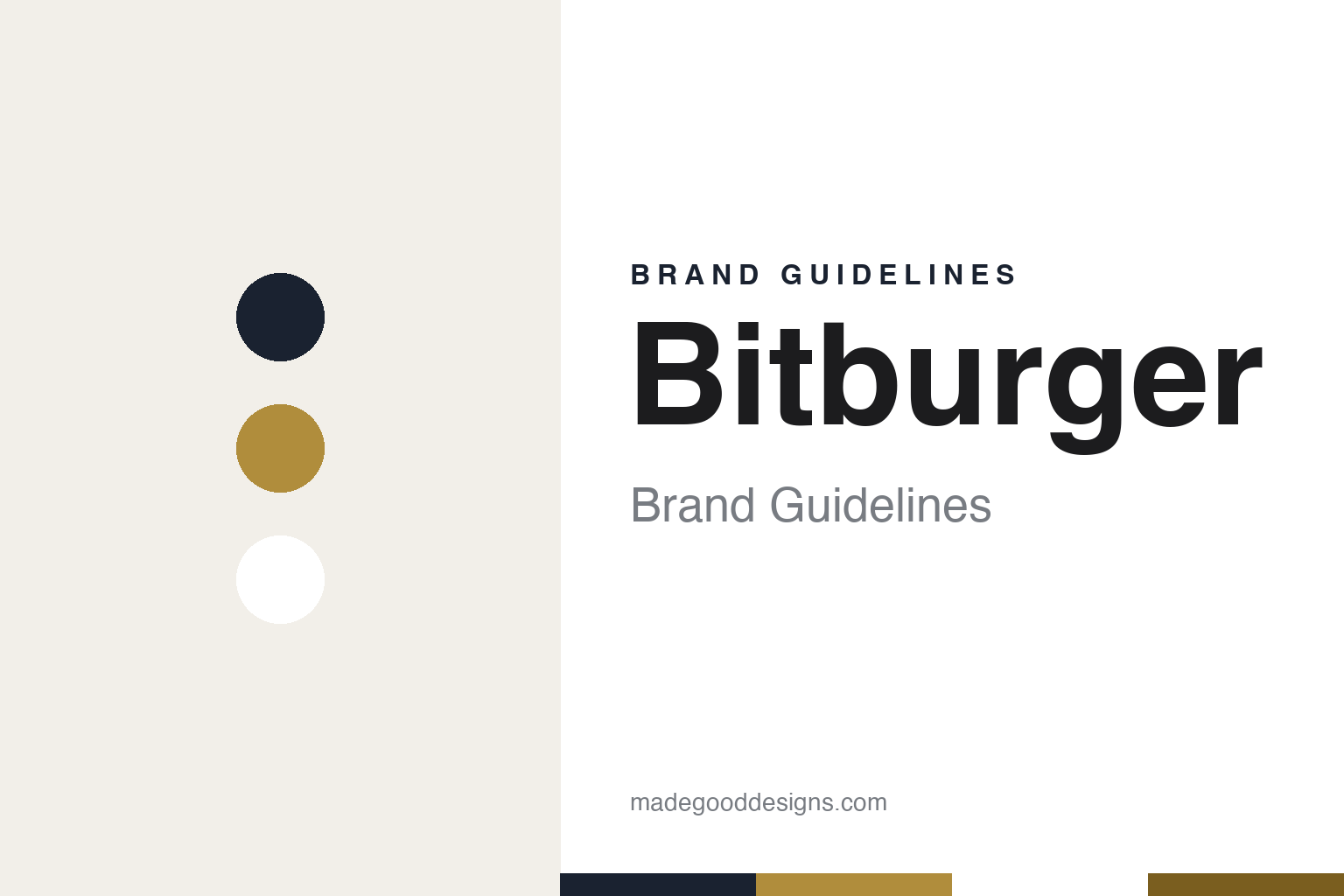
Bitburger Brand Guidelines
The Eifel Pils behind “Bitte ein Bit,” brewed by the Simon family since 1817.
Aa
Two constants: a gold, white and Eifel ink palette and a classic Pils serif register. Abstract homage — not a Bitburger product or mark; no bottle, glass, label or logo is reproduced.
Wallenborn and Simon
A brewer in the Eifel and the family that married in.
Bitburger was founded in 1817 in Bitburg, a small town in the Eifel hills of what is now Rhineland-Palatinate. Its founder was Johann Peter Wallenborn, a trained brewer who, German Wikipedia says, set up his brewery at the age of 33; English Wikipedia, citing Modern Brewery Age in 2004, adds that his father owned a brewery in nearby Kyllburg. The company tells the same founding story.
The brewery passed to the family that still owns it through a marriage. From 1839 Wallenborn’s widow ran the house brewery for a few years. In 1842 his daughter Elisabeth married Ludwig Bertrand Simon, who took over the business and opened a tap room called “Zum Simonbräu,” according to the Portal Rheinische Geschichte of the Rhineland regional association. For decades the beer was sold as Simonbräu, and the company’s legal name, Bitburger Brauerei Th. Simon, still carries the family name.
The next generation turned a local brewery into a regional one. Theobald Simon, Ludwig Bertrand’s son, started delivering beer by horse and cart to inns in the surrounding area in 1876, and the opening of the railway between Trier and Cologne widened the market further. The company says Bitburger was first bottled, in corked bottles, in 1880, and that on 15 January 1883 Theobald Simon brewed his first batch in the Pilsner style. Die Zeit also dated the first Pils to 1883. The company says its first export, in 1886, went by horse and cart to Echternach in Luxembourg. In 1909 the brewery sank its first deep well, and its water still comes from the geological basin beneath the town, German Wikipedia says.
Colour
The Pils ruling, a slogan and a gold-and-white look.
Bitburger played a part in how Germans name their beer. Brewers from the Czech city of Pilsen went to court over the use of “Pilsener,” arguing it was a mark of origin. In 1913, German Wikipedia says, Germany’s highest court, the Reichsgericht, allowed the Bitburg brewery to keep selling its beer as “Original-Simonbräu-Deutsch-Pilsener,” and the ruling established Pils in Germany as the name of a style rather than a place. The company calls it the “Pilsener-Urteil,” the Pilsener judgment.
The company dates the start of its unified brand presence to 1909, when the launch of Bitburger Simonbräu Pilsener came with the brewery’s first large advertising campaign. In 1929, it says, a character called the “Genießer,” or connoisseur, drawn by the graphic artist G. H. Heimig, joined its advertising. The line that defined the brand came in 1951: “Bitte ein Bit”, “A Bit, please,” which the company says was first presented at the ANUGA food fair in Cologne that year. German Wikipedia illustrates the Bitburger logo together with the slogan.
Much of the brand’s design history is about glassware, bottles and crates. German Wikipedia says the brewery introduced the short 0.33-litre returnable bottle known as the Steinie in the early 1950s, and that in 2002 the group registered “STUBBI” as a word mark for that bottle shape. The company says it introduced the “Bit-Pokal,” its first glass made exclusively for pubs and restaurants, in 1964; a modular crate with extra-large advertising panels in 1987; a uniform outdoor look for pubs and restaurants in 1994; and a 0.33-litre longneck bottle with a redesigned label in 2001. From 2016, the company says, it rolled out new outdoor advertising in the brand colours gold and white. Bitburger’s advertising won a Gold Effie in the food category in 1987, according to the GWA Effie yearbook.
Typography
Design and documentation.
The seven brands in this group are all German beer brands: Beck’s, Krombacher, Warsteiner, Bitburger, Paulaner, Erdinger and Radeberger. German beer brands in general sit at many different points in the trade, from family firms that still carry a founder’s name to names that now belong to much larger brewing and drinks groups, and a single brand can be sold everywhere from a corner shop to a supermarket shelf.
A beer brand’s identity is usually carried less by a single product than by a bottle, a label, a name and the town it comes from, because the company behind the name may have changed hands, moved its production or grown far beyond the place where it started. That makes the questions behind each name worth asking plainly: who started it, who owns it now, and where its beer is actually brewed and bottled.
Each guide separates what independent sources record from what the company says about itself — its founding story, its owners over time, where its beer is brewed and how its packaging has changed — and marks plainly what rests only on the company’s own word.
Aa
A classic serif for an Eifel Pils house. (Specimen set in Playfair Display, a serif STAND-IN; NOT the Bitburger logo.)
Th. Simon
A family group, a draught beer and a racing bend.
Bitburger is still owned by the descendants of Ludwig Bertrand Simon. German Wikipedia says the brewery belongs to the Bitburger Braugruppe, which sits alongside a sister company, the Bitburger Holding, under Th. Simon GmbH & Co. KG, the umbrella for the Simon family’s business interests. The holding company keeps the family’s stakes outside brewing, including the mineral-water maker Gerolsteiner and the tool maker Wera. The beer is brewed in Bitburg, where German Wikipedia says the brewery uses two sites: the old brewery in the north of the town, now offices, and a brewing site in the south, with five wells of its own.
The brewing group grew by acquisition. German Wikipedia says it bought the Köstritzer black-beer brewery in Thuringia in 1991, Wernesgrüner in 2002 (sold to Carlsberg in 2020, Handelsblatt reported), and the König brewery in Duisburg and the Licher brewery in Hesse in 2004. The company says these brands have been grouped under the Bitburger Braugruppe since 2007. In 2018, the press-release service presseportal reported, Bitburger, Krombacher and Coca-Cola European Partners Germany set up a joint venture, Kollex, for digital services to drinks wholesalers.
Draught beer and sport carry much of the brand’s visibility. The company says Bitburger became Germany’s top draught-beer brand in 1992, and English Wikipedia, citing Inside Beer, calls it the country’s top-selling draught beer. The brewery says it first sponsored sport at the opening of the Nürburgring in 1927, and a bend on the circuit’s modern Grand Prix track, opened in 1984, was named the “Bit-Kurve.” It partnered the Benetton Formula One team in 1994, and was partner to the German national football team from 1992 to 2018, the trade magazine Horizont reported; the company says it returned as a partner of the German Football Association in 2025.
For a design guide, Bitburger shows how a slogan, a glass and a pair of colours can carry a brand: “Bitte ein Bit,” the pub glass and the gold and white of its outdoor signs. Compare Warsteiner, another family Pils house founded in a small German town, and Beck’s, a German Pils with a long export history. For this guide we use gold, white and Eifel ink with a serif, an unofficial interpretation; no product or logo is reproduced.
Explore & save
Keep Bitburger’s identity on hand — save it to a board in the Made Good inspiration library.
Bitburger identity set
Pin the Bitburger gold, white and Eifel ink palette and the classic Pils serif register to your own board.