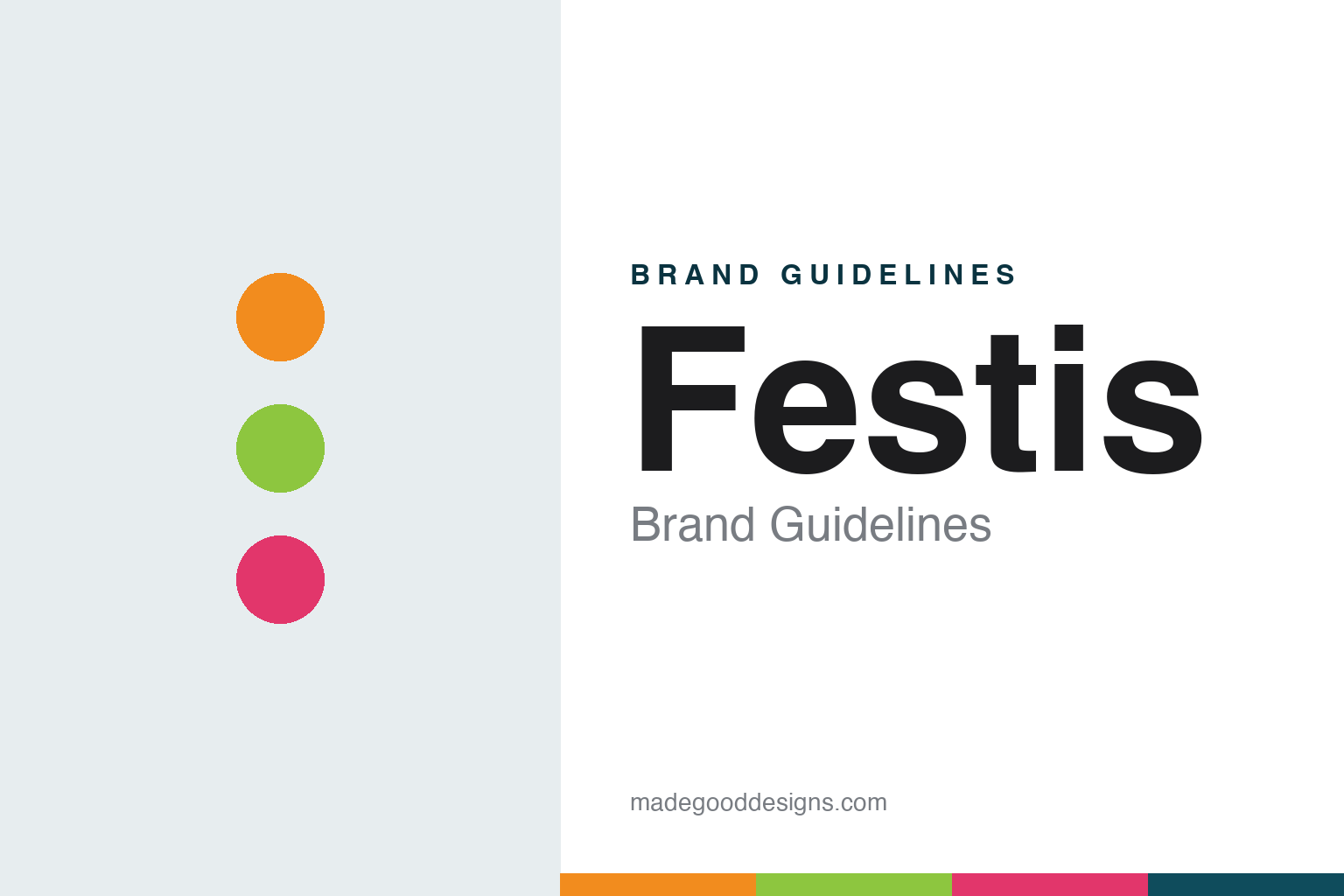
Festis Brand Guidelines
Sweden’s 1961 still drink, from Tetra pyramid to profile bottle.
Aa
Two constants: a classic orange, cactus lime and berry pink palette and a bold grotesque register. Abstract homage — not a Festis product or mark; no bottle, pack or logo is reproduced.
FEST-iS
An orange drink from a Gothenburg water factory.
Festis began as FEST-iS, an orange drink launched in Gothenburg and along the Swedish west coast in April 1961. Swedish Wikipedia, citing the national library’s newspaper archive, points to two reports of the launch on 7 April 1961: the Göteborgs Handels- och Sjöfarts-Tidning, which presented it as a new orange drink from Apotekarnes, and the Arbetar-Tidningen, which led on its packaging. Sales were handled at first by AB Fest-Is, a company formed by several breweries, Swedish Wikipedia says.
The first maker was Apotekarnes, a Gothenburg soft-drink factory with a long history of its own. Swedish Wikipedia says it was founded in 1886 by the pharmacist Johan Gustaf Loberg as a west-coast mineral-water works, took the Apotekarnes name after a merger of local water factories in 1907, and from 1936 worked from a building at Åvägen in the Gårda district designed by the architect Folke Bensow, where drinks such as Solo and Sockerdricka were made. The brewer Pripps bought the business in 1950. The factory closed in 1974; the building later housed museums and, since 2004, a music and events venue called Brewhouse.
Carlsberg Sverige, the brand’s owner today, describes FEST-iS as a fruit drink without carbonation with an orange taste and calls it “Sweden’s first still drink” — a stilldrink, in the Swedish term for a non-carbonated soft drink. In a 2015 press release it called Festis “Sweden’s oldest still drink.” The capitalised FEST-iS spelling has since given way to the single word Festis, the name the company uses on its range today.
Colour
A dated pyramid, then a profile bottle.
The launch was as much about the pack as the drink. FEST-iS came in a 19 cl pyramid pack from Tetra Pak, the tetrahedron shape Carlsberg Sverige calls “the classic pyramid-shaped tetrahedron.” Swedish Wikipedia, citing the 1961 press, says Apotekarnes installed three Tetra machines for it, with a plan for sixteen so the whole country could be supplied; the packed drink was expected to keep for six weeks, and the launch made a point of the pack being stamped with its packing date.
The range and the packs then changed. By 1969 FEST-iS came in four flavours — orange, apple, pear and raspberry — according to a Dagens Nyheter advertisement of 16 June that year, cited by Swedish Wikipedia. In the 1970s it was also filled in another Tetra Pak format, the Rigello. Swedish Wikipedia says Festis was the market leader for many years but had been overtaken by competitors by the early 1990s.
The answer was a relaunch in 1994, made with the advertising agency Rififi, now part of ANR.BBDO. Swedish Wikipedia says it introduced a new profile bottle — a 33 cl glass bottle with a transparent label — and new flavours such as cactus-lime and peach-passion, with commercials made by the directors Jonas Åkerlund and Johan Renck. In 1998 the glass bottle gave way to a PET bottle. Carlsberg Sverige says that since 1994 the flavours, the packaging and the advertising have been radically renewed, and that Festis is now a modern youth drink known for its many flavours and its “unique packaging design.”
The redesigns have continued. In March 2014 Carlsberg Sverige announced a new, colourful design with a sturdier bottle that it said felt good to hold, and labels in strong colours built on each flavour, with the fruits woven into a playful pattern; its marketing manager said the design was inspired by the meeting between a hard city environment and creative making. In April 2015 the company launched Festis Sparkling, the first carbonated Festis, in melon and lime, pear and kiwi, and strawberry and watermelon, calling it the end of a fifty-year taboo. Swedish Wikipedia says the carbonated versions have since gone, and Festis is again sold only as a still drink, with or without sugar, in a 50 cl profile bottle.
Typography
Design and documentation.
The seven brands in this group all make food or drink, and all of them come from Denmark or Sweden: Tuborg, Faxe Kondi, Cocio, Harboe, Carletti, Festis and Loka. Danish and Swedish food and drink brands in general sit at many different points in the trade, from family firms that still carry a founder’s surname to names that now belong to much larger groups, and a single brand can be sold everywhere from a kiosk to a supermarket shelf.
A food or drink brand’s identity is usually carried less by a single product than by a pack, a name and the taste or occasion it promises, because the company behind the name may have changed hands, moved its production or grown far beyond the town where it started. That makes the questions behind each name worth asking plainly: who started it, who owns it now, and where its products are actually made and packed.
Each guide separates what independent sources record from what the company says about itself — its founding story, its owners over time, where its products are made and how its packaging has changed — and marks plainly what rests only on the company’s own word.
Aa
A bold grotesque for a drink that has changed its bottle more often than its name. (Specimen set in Bricolage Grotesque, a sans STAND-IN; NOT the Festis logo.)
Festis
From Pripps to Carlsberg Sverige.
Festis passed to its present owner through the long history of Pripps, the brewer that had bought Apotekarnes in 1950. Swedish Wikipedia traces that history: Pripps, founded in Gothenburg, merged with Stockholmsbryggerier in 1964 as Pripp-Bryggerierna, took the name AB Pripps Bryggerier in 1972, became state-owned in the 1970s and a subsidiary of Procordia in 1986, and was bought by Volvo in 1993. In 1995 Volvo merged it with the Norwegian group Orkla’s Ringnes brewery as Pripps Ringnes, and in 1997 Volvo sold its share to Orkla. After further changes of ownership Pripps was bought by the Danish brewer Carlsberg, and Carlsberg Sverige was formed in 2001 by merging Pripps with Falcon, Swedish Wikipedia says. Swedish Wikipedia names Carlsberg as the owner of Festis.
Today Carlsberg Sverige, based in Solna, markets Festis alongside brands including Pripps Blå, Falcon and Ramlösa. Its current Festis range includes Classic Orange, Cactus & Lime, Guanabana & Pineapple and Wild Strawberry, with organic pear, raspberry and orange versions and sugar-free flavours. The company lists each one as produced in Sweden; Swedish Wikipedia gives Carlsberg Sverige’s production sites as Falkenberg, for beer, and the Ramlösa water factory.
For a design guide, Festis shows how a drink can be defined by its packaging: a date-stamped Tetra pyramid in 1961, a transparent-label profile bottle in 1994, and a patterned, fruit-led redesign in 2014. Compare Tuborg, another Carlsberg brand, and Faxe Kondi, the Danish soft drink. For this guide we use classic orange, cactus lime and berry pink on deep teal with a bold grotesque sans, an unofficial interpretation; no product or logo is reproduced.
Explore & save
Keep Festis’s identity on hand — save it to a board in the Made Good inspiration library.
Festis identity set
Pin the Festis classic orange, cactus lime and berry pink palette and the bold grotesque register to your own board.