Lotus Biscoff Brand Guidelines
The Belgian caramelised biscuit made for coffee.
Aa
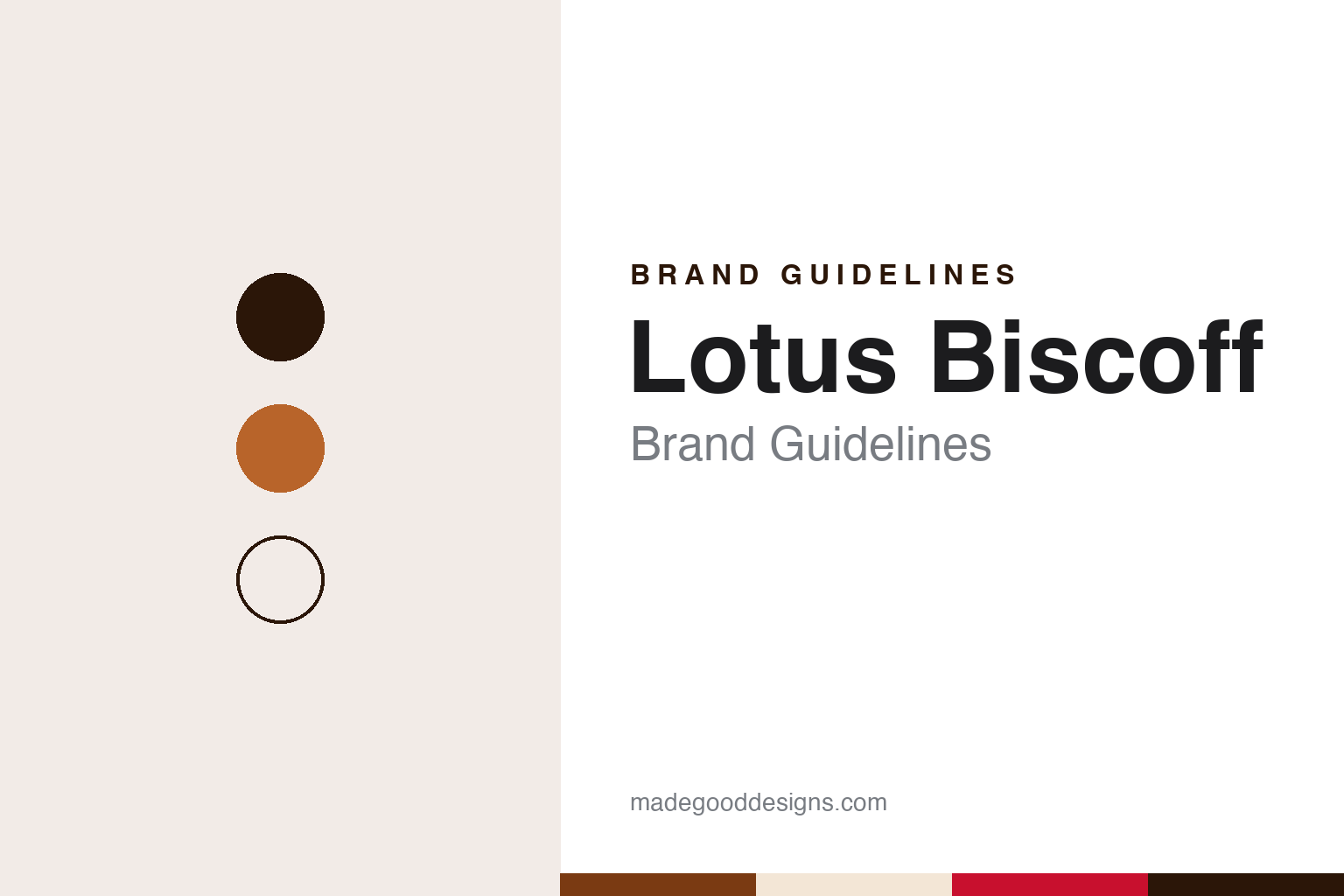
Two constants: a caramel, espresso and red palette and a warm serif register. Abstract homage — not a Lotus Biscoff product or mark; no biscuit, wrapper or logo is reproduced.
A baker in Lembeke
One caramelised biscuit, named after a flower.
Lotus Biscoff began in Lembeke, a village in East Flanders, Belgium, in 1932. The company says its history starts when Jan Boone Sr. “creates a caramelised cookie with nothing but natural ingredients” and names it Lotus, “after the flower that symbolises purity.” Dutch Wikipedia describes him as a baker, and both the English and Dutch Wikipedia entries give the business’s first name as Banket- en Peperkoekbakkerij Lotus — a pastry and gingerbread bakery. The biscuit itself is a speculoos, the spiced, caramelised biscuit of Belgium and the Netherlands, and Dutch Wikipedia notes that its flavour comes from caramelisation during baking.
The idea that defined the brand came in the 1950s. According to Dutch Wikipedia, the company began wrapping the biscuits one by one so that cafés and restaurants could serve them alongside a cup of coffee; the company’s own timeline dates that move to 1956, calling it “the biscuit to be served with coffee.” From 1960 the biscuits were sold in neighbouring countries, from 1980 in Asia, and in the 1990s, the company says, they first reached the United States through airlines.
The name came out of that habit. Biscoff is a contraction of “biscuit” and “coffee,” and Dutch Wikipedia says it was first used in 1986; English Wikipedia says the name was then introduced gradually country by country. At home the biscuit long stayed simply “Lotus”: Dutch Wikipedia reports that only at the end of 2020 did the company decide to use the Biscoff name in Belgium, the Netherlands and France as well.
Colour
In the air, then on the shelf.
Lotus Biscoff’s best-known stage was an aeroplane tray table. Condé Nast Traveler reported in March 2020 that Delta Air Lines began serving Biscoff in flight in the mid-1980s, and quoted Delta’s general manager of menu and service development, Dan Mord: “We currently serve up between 80 to 85 million Biscoff cookies a year.” The same article noted that the company was still headquartered in Lembeke and still run by the same family. The company says the United States became the biggest market for Lotus Biscoff in 2016.
The range has grown around the single biscuit. The company dates Biscoff spread, a sweet spread made with the taste of the caramelised biscuit, to 2008; an international Biscoff ice cream to 2019; and a Biscoff sandwich cookie and, in Belgium, Biscoff chocolate to 2020. Its timeline records one documented packaging change: in 2025 the spread “gets a bespoke jar design,” which the company says was “for stronger shelf impact & brand distinction.” We found no published account of who designs the Biscoff logo or wrapper.
Where the biscuit is made has also widened. English Wikipedia says Biscoff has always been made in Lembeke, and that a factory opened in Mebane, North Carolina, in 2019 was the first to make it outside Belgium; the company’s timeline records the “first US made Biscoff” that year. A third Biscoff plant, in Thailand, was announced in 2022, De Tijd reported; the company says it delivered its first biscuits to the Asia-Pacific region in 2025 and would be fully complete by mid-2026. In 2026 the company announced that it would invest at least €500 million across its Belgian, Thai and US Biscoff sites between 2026 and 2030.
Typography
Biscuits and belonging.
The seven brands in this group all bake biscuits, and they come from five countries: McVitie’s, Walker’s Shortbread and Tunnock’s from Scotland, Fox’s from England, Jacob’s from Ireland, Bahlsen from Germany and Lotus Biscoff from Belgium. Biscuit brands in general sit at many different points in the trade, from family-run bakeries that still work from the town where they began to names that have passed through several corporate owners, and a single packet on a supermarket shelf rarely says which of those it is.
A biscuit brand’s identity is usually carried by a wrapper, a shape and a habit — the biscuit eaten with tea or coffee, at a desk, in a lunchbox or on a plane — more than by the factory behind it, because the name on the front may have changed hands, or changed countries, long after the recipe was settled. That makes the questions behind each name worth asking plainly: who started it, who owns it now, and where its biscuits are actually baked.
Each guide separates what independent sources record from what the company says about itself — its founding story, its owners over time, its factories and its packaging — and marks plainly what rests only on the company’s own word.
Aa
A warm serif for a coffee-table biscuit. (Specimen set in Fraunces, a serif STAND-IN; NOT the Lotus Biscoff logo.)
Lotus Bakeries
Two families, one listed company.
Lotus Biscoff belongs to Lotus Bakeries NV, still based in Lembeke. In 1974 Lotus merged with Corona, a cake and pastry maker founded by Antoine Stevens, bringing in the Stevens family as partners; the company says Karel Boone, whom English Wikipedia identifies as the founder’s son, then became chief executive, a post he held until 2006, when, English Wikipedia says, his brother Matthieu took over. Jan Boone, the founder’s grandson according to English Wikipedia, has been chief executive since 2011. The shares have been listed in Brussels, now Euronext Brussels, since 1988. The company says the two families remain the majority shareholders through a foundation, the Stichting van aandelen Lotus Bakeries; Dutch Wikipedia puts that holding at 50% of the shares and 62.3% of the voting rights as of June 2025. The company joined the BEL20 index in March 2024.
Around the biscuit the company has bought other brands. Its timeline lists Suzy waffles in 1999, the Dutch gingerbread maker Peijnenburg in 2006, the Swedish ginger-thin maker Annas in 2008 and the Dinosaurus biscuit brand in 2012, which Dutch Wikipedia says was made under licence by LU in Herentals until Lotus took over production in 2013. Since 2015 it has added snack brands including nākd, TREK, BEAR and Kiddylicious, and in 2022 the British cracker maker Peter’s Yard. In 2024 it agreed a partnership with Mondelēz International under which, Het Laatste Nieuws reported, Mondelēz would make and sell Biscoff in India, alongside co-branded chocolate products. The company says its revenue passed €1 billion with its 2023 results.
For a design guide, Lotus Biscoff shows how a single use — a biscuit placed beside a cup of coffee — can become the name itself. Compare Verkade, a Dutch biscuit maker from the same speculoos country, and Oreo, another biscuit that travelled the world under one name. For this guide we use caramel, espresso brown and a red with a serif, an unofficial interpretation; no product or logo is reproduced.
Explore & save
Keep Lotus Biscoff’s identity on hand — save it to a board in the Made Good inspiration library.
Lotus Biscoff identity set
Pin the Lotus Biscoff caramel, espresso and red palette and the warm serif register to your own board.