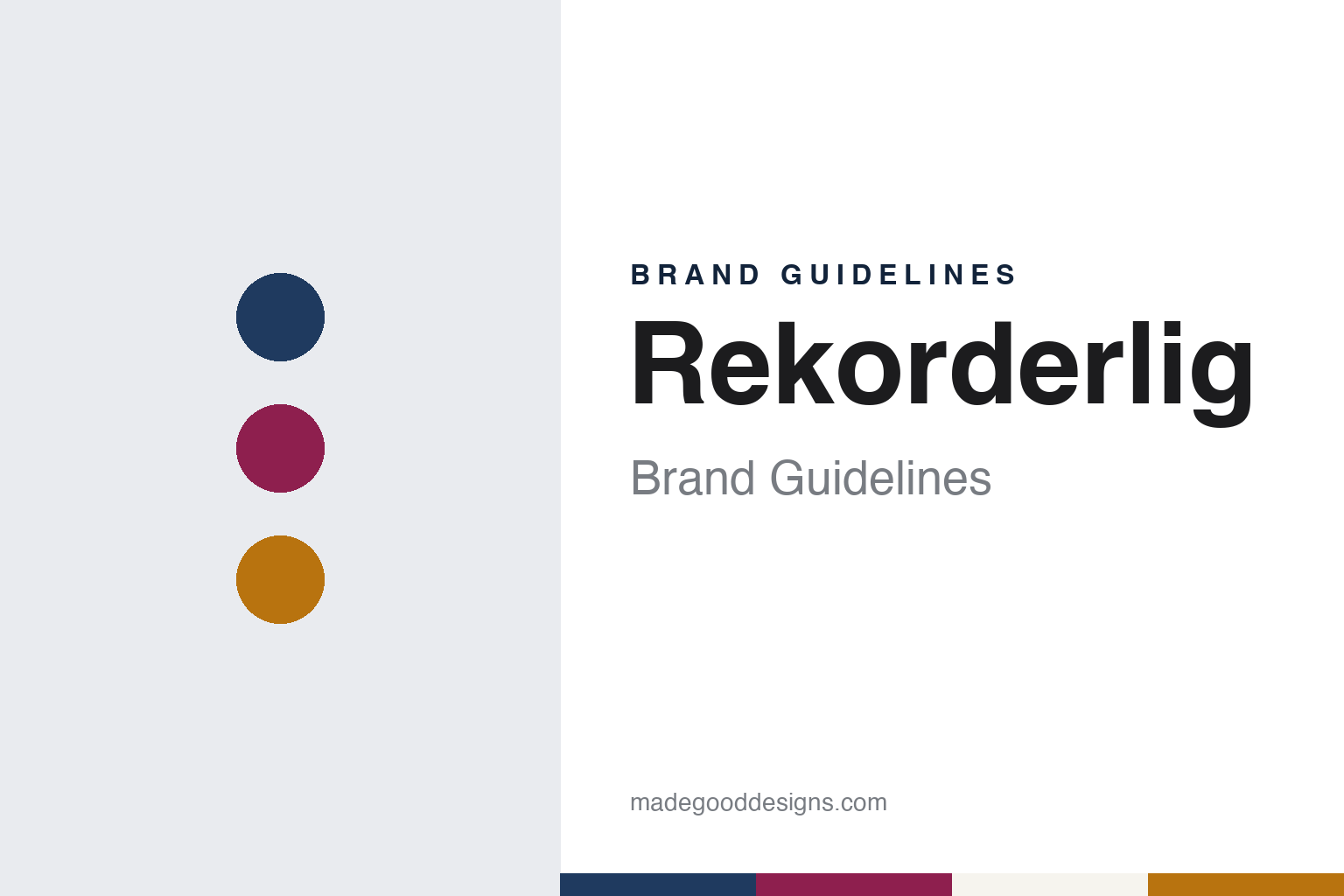
Rekorderlig Brand Guidelines
The fruit cider from a family brewery in Vimmerby, made by Åbro since 1999.
Aa
Two constants: a Nordic blue, wild berry and amber glass palette and a soft display serif register. Abstract homage — not a Rekorderlig product or mark; no label, logo or bottle is reproduced.
A cider from Vimmerby
Three founders, a bar owner and Sweden’s oldest family brewery.
Rekorderlig is a fruit cider made in Vimmerby, in Kalmar County in the Swedish province of Småland, by Åbro Bryggeri. The word is Swedish: Australian Bartender reported in 2014 that it means “trustworthy,” that the name came from the grandmother of one of the founders, and quoted a founder calling it “a name which is hard to say – but easy to remember.”
The brewery behind it is far older than the cider. Swedish Wikipedia says Åbro was founded in 1856 by Lieutenant Per W. Luthander as Vimmerby’s first Bavarian-style brewery, and passed through several owners and a bankruptcy auction before Axel Herman Johansson, who had come from Kalmar in 1889, bought it in 1898 and took full control in 1906. That began a period of family ownership that, Swedish Wikipedia says, makes Åbro Sweden’s oldest family-owned brewery; the owners today are the fourth generation, the Dunge family, and Henrik Dunge is chief executive. In 2018, the article says, Åbro produced 56 million litres, sold in 23 countries and employed 226 people. Its own beers are mainly lagers, led by Åbro Original, alongside Hwila mineral water drawn from Vimmerby’s esker.
The cider began outside the brewery. Australian Bartender, telling the story in 2014, said Rekorderlig was the creation of a Swedish husband-and-wife team, Anders and Helén, and their friend Håkan, and that Henrik Dunge, who wanted a cider for the bars he owned, met Anders in Vimmerby in 1999 while Anders was looking for a production partner. Swedish Wikipedia says Åbro has made Rekorderlig since 1999, and SLTN reported in 2015 that the cider had been produced at the Vimmerby brewery since the brand was created in 1999. Other accounts place the recipe a little earlier: English Wikipedia gives 1996, and Australian Bartender said the cider had been created a couple of years before the 1999 meeting.
Colour
A half-litre bottle, a Swedish word and fruit on a pear base.
The best-known feature is the size of the bottle. Australian Bartender reported in 2014 that Rekorderlig was first served in a 500 ml bottle because of Swedish recycling rules, and that “the Swedish government had more to do with it than a marketing department.” The same article described the cider, in the company’s terms, as semi-sweet and made from fresh European apples or pears rather than syrup or concentrate, with spring water from Vimmerby; the apple, apple-guava, apple-and-blackcurrant and winter ciders were apple-based and the other flavours began from a pear base.
English Wikipedia says the brand was first created with spring water from Vimmerby. In 2017 Åbro opened a cider factory next to the brewery, Swedish Wikipedia says.
Britain took the fruit flavours early. In July 2010 the Morning Advertiser described Manchester’s Chilli Marketing as the brand’s importer in Great Britain, listed a range of Apple, Pear, Strawberry-Lime and Wild Berries, and quoted its managing director, Kieron Barton, saying the packaging had “true unisex appeal.”
Packaging has been adjusted market by market. In Australia, where Coca-Cola Amatil was the exclusive distributor, Packaging News reported in November 2020 that the 330 ml range was moving from amber to clear glass so that drinkers could see the colour of the cider, starting with Strawberry-Lime in a complementary coloured label, while the 500 ml range stayed in amber. Brand manager Elle Lewis said the labels were designed in-house with the brand’s global partner, Åbro Bryggeri.
Sponsorship has carried the name too. English Wikipedia, citing NME, says Rekorderlig sponsored the Best New Artist award at the 2012 NME Awards; the Huddersfield Daily Examiner reported in June 2012 that the cider would appear on Huddersfield Town’s home shirts, which it did from the 2012–13 season to the end of 2014–15, English Wikipedia says. English Wikipedia adds that the brand has run a pop-up Rekorderlig Cider Lodge at the Southbank Centre’s winter events in London, and the New Zealand Herald reported in 2015 that the brand sponsored a national kubb competition in Hawke’s Bay.
Typography
Design and documentation.
The seven brands in this group are all cider names: Strongbow, Magners, Bulmers, Somersby, Kopparberg, Rekorderlig and Thatchers. Cider brands in general sit at many different points in the trade, from family farms that still carry a founder’s name to labels that now belong to much larger drinks groups, and a single brand can be sold everywhere from a corner shop to a pub bar.
A cider brand’s identity is usually carried less by a single bottle or can than by a label, a name and the place it promises, because the company behind the name may have changed hands, moved its production or grown far beyond the place where it started. That makes the questions behind each name worth asking plainly: who started it, who owns it now, and where its cider is actually made and packed.
Each guide separates what independent sources record from what the company says about itself — its founding story, its owners over time, where its cider is made and how its labels have changed — and marks plainly what rests only on the company’s own word.
Aa
A soft display serif for a long Swedish word. (Specimen set in Fraunces, a serif STAND-IN; NOT the Rekorderlig logo.)
Rekorderlig
A Swedish brand owner and a British partner.
The brand belongs to Vimmerby, but the British business changed hands. On 2 July 2015 SLTN reported that Molson Coors, the owner of Carling, had bought Rekorderlig UK from Chilli Marketing Brands for an undisclosed sum, giving it exclusive rights to distribute, sell and market the full Rekorderlig range in the on- and off-trade across the United Kingdom, Ireland and the Channel Islands. The paper said production would continue at the family-owned brewery in Vimmerby. Frederic Landtmeters, managing director of Molson Coors UK & Ireland, called the deal “another milestone,” and Chilli Marketing’s joint owner Gareth Whittle said the brand had “already demonstrated incredible growth.”
Åbro, meanwhile, remains a brewery with its own Swedish identity. Swedish Wikipedia notes that it was the main sponsor and shirt sponsor of the Stockholm football club AIK until 2017, that it offers guided tours with an English pub and a German bierstube on site, and that its lager Ey’ Bro is named after a 2001 clip in which the rappers Eminem and Proof joked about the Swedish beer.
For a design guide, Rekorderlig shows how a cider with a hard-to-pronounce Swedish name, a half-litre bottle born of recycling rules and a pear base for its fruit flavours could be made in one small town and sold through partners abroad. Compare Kopparberg, the fruit cider brewed in Kopparberg, and Savanna, the South African dry cider. For this guide we use Nordic blue, wild berry and amber glass with a serif, an unofficial interpretation; no product or logo is reproduced.
Explore & save
Keep Rekorderlig’s identity on hand — save it to a board in the Made Good inspiration library.
Rekorderlig identity set
Pin the Rekorderlig Nordic blue, wild berry and amber glass palette and the soft display serif register to your own board.