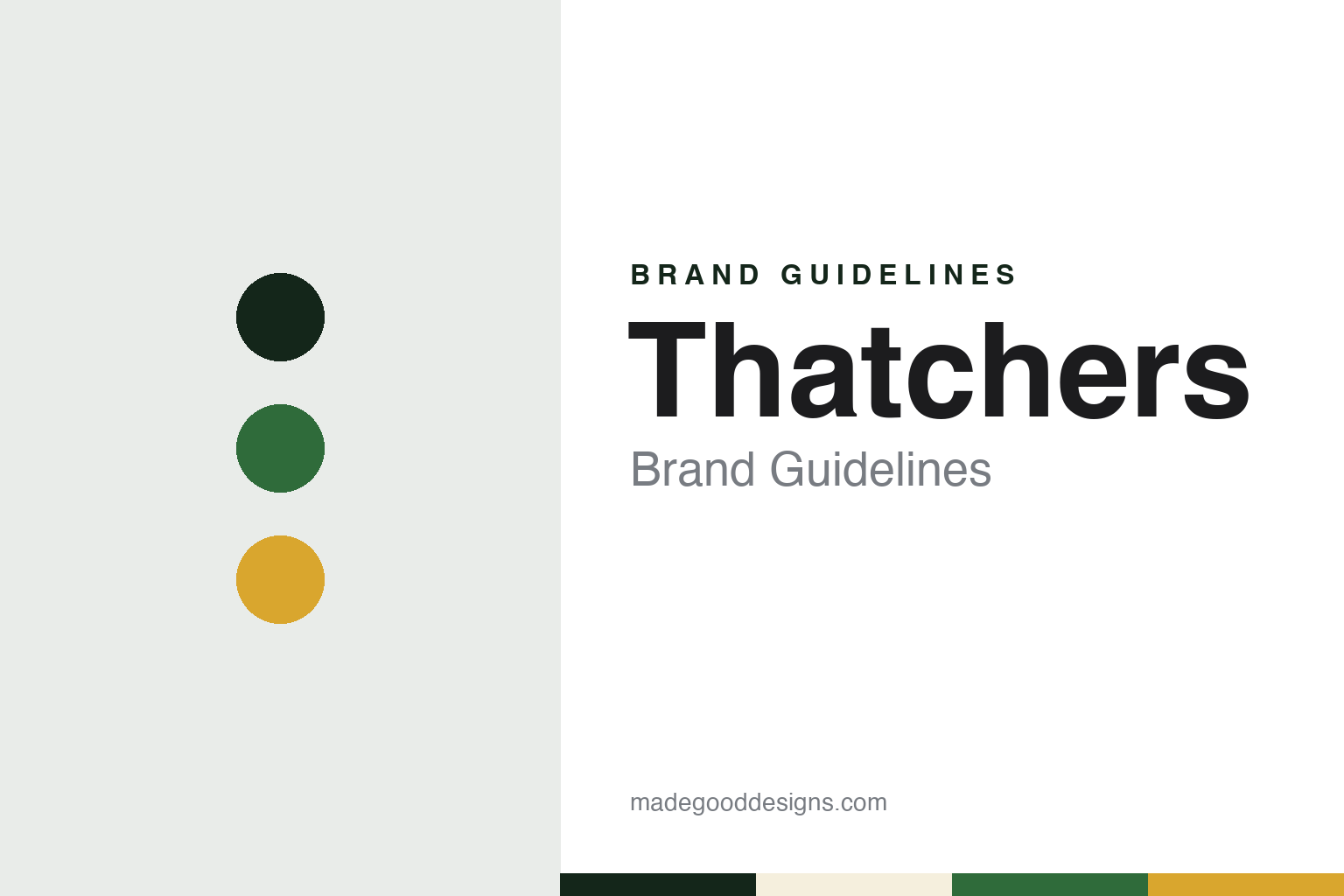
Thatchers Brand Guidelines
The Somerset family cider maker of Myrtle Farm since 1904.
Aa
Two constants: an orchard green, cider gold and blossom cream palette and a farmhouse serif register. Abstract homage — not a Thatchers product or mark; no can, bottle, label or logo is reproduced.
Myrtle Farm
A farmer, his workers and a cider press.
Thatchers began on Myrtle Farm in Sandford, a village in North Somerset, in 1904. The company says that the Somerset farmer William Thatcher made the first Thatchers cider there that year, at first for his own farm workers, who took some of it as part of their wages, and that he soon began selling it in the surrounding villages. English Wikipedia, citing the Weston & Somerset Mercury in 2012, gives the same founding year and founder.
For most of its first century Myrtle Farm was a mixed farm with cider as one part of it. The company’s own timeline records the handovers. William’s son Stanley Thatcher, born in 1910, took over in 1940 with his wife, Mollie; Wikipedia says it was Stanley who began selling draught cider to pubs across Somerset. The farm’s first hydraulic press arrived in 1951. In 1970 the business passed to Stanley’s son, John Thatcher, who, the company says, expanded both the orchards and the number of presses. In 1981 oak vats about 150 years old were moved into the farm’s vat shed, and in 1984, the company says, the farm gave up livestock after 80 years to make room for more orchards.
The fourth generation took charge in 1992, when Martin Thatcher, William’s great-grandson, succeeded his father as managing director, a handover both the company and English Wikipedia record. The company says Martin planted his first tree on the farm at the age of five, in 1973, and later drove the farm’s lorry, delivering cider to pubs around the South West. In 2004 the family marked the centenary of cider making at Myrtle Farm, and the company now names Martin’s daughter, Eleanor Thatcher, as its fifth-generation cider maker.
Colour
Gold, single-variety Katy and a modern range.
The name most drinkers know is Thatchers Gold, the company’s flagship apple cider. In June 2007 the Morning Advertiser reported a relaunch of Gold built on its Somerset provenance, with Martin Thatcher saying the brand had been well established in pubs and shops over recent years. The same report described a redesign that kept the Gold script lettering and added a green background across bottle labels, bar fonts and point-of-sale material; Gold was then a 4.8% cider aged in oak.
Thatchers also made its name with single-variety ciders, each made from one apple rather than a blend. The best known is Katy, named after the Katy apple, which the company describes as a cross between Worcester Pearmain and James Grieve. In February 2008 the Morning Advertiser reported a new look for the single-variety range, including a reshaped, lighter 500-millilitre bottle and a redesigned label, and said Katy had sold two million bottles in the previous twelve months, making it the best seller in the range.
The company’s timeline lists the newer ciders that followed: Haze, a cloudy cider, in 2015; Rosé in 2019; an alcohol-free cider, Zero, and Cloudy Lemon in 2020; Blood Orange in 2022; and Juicy Apple in 2024, to mark 120 years of cider making. In 2016 it added a gin, Orchard Cut Apple Gin, and in 2025 it put its Vintage cider into a can with a new design. The company says Gold went on sale in Australia in 2015 and is sold in more than 20 countries.
The orchards are central to the story the brand tells. The company says Myrtle Farm now covers about 500 acres, after it bought 180 acres of orchard at Shiplate, overlooking the Bristol Channel, in 2010, and that it planted more than 13,000 trees in a new 50-acre orchard in 2025. English Wikipedia says the company also buys apples from other growers nearby, trains many trees on wires in hedgerow-style orchards harvested with a purpose-built machine, and can press up to 500 tonnes of apples a day at the height of the season. Its Exhibition Orchard holds 458 apple varieties, the company says, and in 2014 it made a limited-edition cider from all of them.
Typography
Design and documentation.
The seven brands in this group are all cider names: Strongbow, Magners, Bulmers, Somersby, Kopparberg, Rekorderlig and Thatchers. Cider brands in general sit at many different points in the trade, from family farms that still carry a founder’s name to labels that now belong to much larger drinks groups, and a single brand can be sold everywhere from a corner shop to a pub bar.
A cider brand’s identity is usually carried less by a single bottle or can than by a label, a name and the place it promises, because the company behind the name may have changed hands, moved its production or grown far beyond the place where it started. That makes the questions behind each name worth asking plainly: who started it, who owns it now, and where its cider is actually made and packed.
Each guide separates what independent sources record from what the company says about itself — its founding story, its owners over time, where its cider is made and how its labels have changed — and marks plainly what rests only on the company’s own word.
Aa
A warm farmhouse serif for a Somerset cider maker that has kept its family name on the label since 1904. (Specimen set in Fraunces, a serif STAND-IN; NOT the Thatchers logo or its script lettering.)
Thatchers
A family farm, a village pub and a court case over lemons.
Thatchers is still owned by the Thatcher family, English Wikipedia says, and it is still based at Myrtle Farm. The brand is written Thatchers, without an apostrophe, on the company’s own website, while the family name is Thatcher. Its public face is local: the company says it began farm open days in 1993, expanded its farm shop in 2007 and in 2015 reopened The Railway Inn in Sandford as a Thatchers pub. Its first television advertisement ran in 2010, and English Wikipedia says a 2015 national campaign, “Time Stops,” was built around a Friday tasting at Myrtle Farm at which Martin Thatcher samples each batch. The same article lists sponsorships of rugby, cricket and football clubs across the South West. In 2022 the Royal Bath and West Society gave Martin Thatcher a special award for outstanding services to the cider industry, the company says.
The brand’s packaging has also been tested in court. In 2022 Aldi launched a Taurus Cloudy Lemon Cider, two years after Thatchers’ own Cloudy Lemon, and Thatchers sued for trade mark infringement. The Intellectual Property Enterprise Court dismissed the claim in January 2024, but on 20 January 2025 the Court of Appeal overturned that ruling; Grocery Gazette reported that Lord Justice Arnold found Aldi had intended to take advantage of the reputation of Thatchers’ mark, and the law firm Lewis Silkin noted his phrase that Aldi was “riding on the coattails” of the Thatchers cider. Aldi called the decision wrong, and in June 2025 Food Manufacture reported that the UK Supreme Court had refused Aldi permission to appeal, leaving the Court of Appeal judgment final.
For a design guide, Thatchers shows how a family name, a farm and a script wordmark kept through a 2007 redesign can carry a Somerset cider maker well beyond its village, and how far a brand will go to protect the look of a can; see also our guides to Yeo Valley, the Somerset family dairy brand, and Bulmers, the Herefordshire cider name. For this guide we use an orchard green, a cider gold and a blossom cream with a farmhouse serif, an unofficial interpretation; no product or logo is reproduced.
Explore & save
Keep Thatchers’s identity on hand — save it to a board in the Made Good inspiration library.
Thatchers identity set
Pin the Thatchers orchard green, cider gold and blossom cream palette and the farmhouse serif register to your own board.


