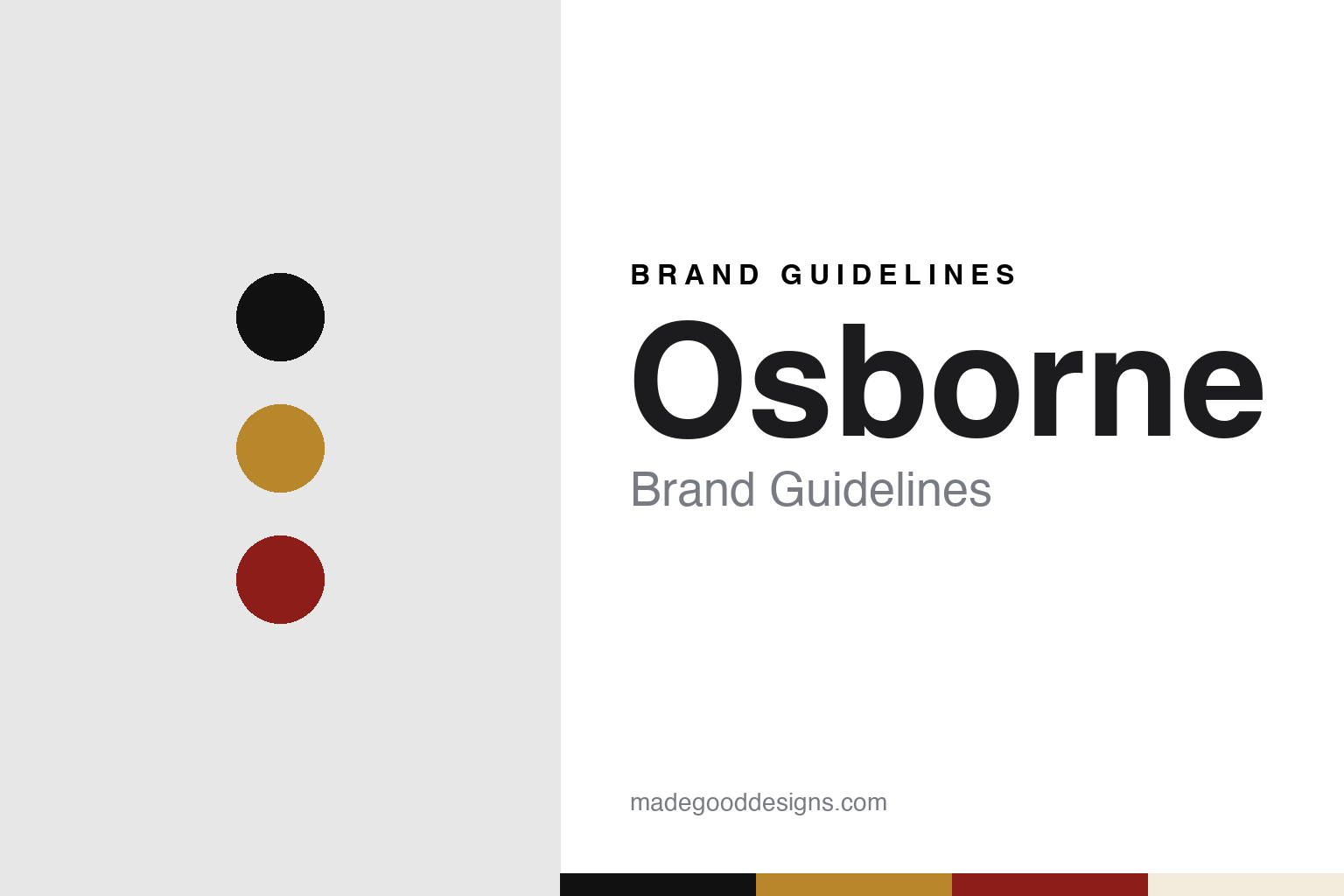
Osborne Brand Guidelines
The El Puerto de Santa María house behind Spain’s roadside bull.
Aa
Two constants: a bull black, sherry amber and albariza white palette and a heavy grotesque sans register. Abstract homage — not an Osborne product or mark; no bull, label or logo is reproduced.
An Englishman in the sherry trade
From a Cádiz partnership to a family name.
Osborne is a family-owned Spanish drinks and food group based in El Puerto de Santa María, on the Bay of Cádiz, one of the three sherry towns of the Marco de Jerez. The group dates itself to 1772 and marked its 250th anniversary in 2022. Its founder is Thomas Osborne Mann, a young English merchant from Exeter in Devon who, Spanish Wikipedia says, came to Cádiz in the late eighteenth century, worked for the exporters Lonergan and White and befriended the British consul Sir James Duff and his partner William Gordon.
The 1772 date belongs to that older partnership. Forbes España reported in January 2022 that the company was set up in 1772 by James Duff and Juan Haurie, and that Osborne Mann, first involved as a lender, became the principal partner in 1830. The sherry site sherrynotes.com, writing in 2014, gives 1833 for the partnership in Duff Gordon and says Osborne had been shipping sherry under his own name since 1804. In 1825, Spanish Wikipedia says, he married Aurora Böhl de Faber, daughter of the German consul in Cádiz, and moved to El Puerto, where he brought his bodegas together under the Osborne name.
After Thomas Osborne Mann’s death in 1854, Forbes España reported, Aurora chose to keep the business rather than sell, and by 1857 the family held the whole company; sherrynotes.com instead dates the family’s purchase of all the shares to 1872. Their son Tomás inherited the firm, and in 1869, Spanish Wikipedia says, a second son, Juan Nicolás, received the papal title of Conde de Osborne. The sherry site says the last Duff Gordon labels disappeared in the 1980s, leaving everything branded Osborne.
Colour
A bull drawn for a brandy, kept by a country.
Osborne’s sherry is made in El Puerto, where the house keeps the old Bodega de Mora in the town centre and the Fino Quinta that sherrynotes.com calls its flagship fino. In the twentieth century brandy carried the group: Spanish Wikipedia says that under Ignacio Osborne Vázquez, who led it from 1935 to 1972, the company built its place in the Spanish brandy market with Veterano and Magno, and that a later plant in Tomelloso, in La Mancha, supplies a large share of the brandy it sells.
The bull came from advertising for Veterano. In 1956, Spanish Wikipedia says, the agency Azor Publicidad, commissioned by Osborne, designed a roadside sign for the brandy, and its director, Manolo Prieto, proposed the figure of a bull: a solid black silhouette carrying the words “Veterano Osborne,” English Wikipedia says. The first boards were wooden, about four metres tall; Spanish Wikipedia dates them to November 1958, while sherrynotes.com puts the first bull beside the A1 Madrid–Burgos road in 1957. From 1961 they were made of sheet metal and seven metres high, and after a 1962 law pushed signs back from the road they grew to about fourteen metres.
The law then turned against them. From July 1988 roadside advertising was banned on state roads, and the lettering was painted out, leaving only the black bull. In September 1994 new road regulations ordered the bulls removed. After public objection, English Wikipedia says, the Congress of Deputies declared them part of the cultural and artistic heritage of the peoples of Spain, and in December 1997 the Supreme Court allowed them to stay because of their aesthetic or cultural significance. English Wikipedia counted 92 bulls in July 2022.
Typography
Design and documentation.
The seven brands in this group are all wine and spirits names: Torres, Osborne, Fundador, Ypióca, Blandy’s, Brancott Estate and Villa Maria. Wine and spirits brands in general sit at many different points in the trade, from family houses that still carry a founder’s name to labels that now belong to much larger drinks groups, and a single brand can be sold everywhere from a corner shop to a restaurant list.
A wine or spirits brand’s identity is usually carried less by a single bottle than by a label, a name and the place it promises, because the company behind the name may have changed hands, moved its production or grown far beyond the place where it started. That makes the questions behind each name worth asking plainly: who started it, who owns it now, and where its wine or spirit is actually made and bottled.
Each guide separates what independent sources record from what the company says about itself — its founding story, its owners over time, where its wine or spirit is made and how its labels have changed — and marks plainly what rests only on the company’s own word.
Aa
A heavy grotesque sans for a name painted on a roadside sign. (Specimen set in Archivo Black, a sans-serif STAND-IN; NOT the Osborne logo.)
Osborne
A family group with a symbol it shares with a country.
The bull’s public status left a question about who owns it. Osborne keeps the commercial rights, and in January 2006, Spanish Wikipedia says, the provincial court in Seville convicted traders who had used the bull on souvenirs, holding that its cultural standing does not take away Osborne’s trademark rights. Spanish Wikipedia says Osborne began licensing the bull for fashion, gifts and food in 2009. For the symbol’s 65th birthday in 2021, the British paper i reported a redesign, and bulls now stand as far away as Copenhagen’s Superkilen park, since 2012, and Matsunoyama in Japan, since 2018.
The group has grown well beyond sherry and brandy. It bought Anís del Mono, the Badalona anisette, from the Bosch family in 1974, Ara reported in 2021, when it moved part of that production to El Puerto; another account gives 1975. Spanish Wikipedia says Osborne also owns the Jabugo ham maker Sánchez Romero Carvajal, whose Cinco Jotas ham has been made there since 1879. The group sold the mineral water Solán de Cabras to Mahou San Miguel in 2011, Alimarket reported, and in July 2014 the Chinese group Fosun took a minority stake through a capital increase, the first outside shareholder in the company’s history, Alimarket and FoodNavigator reported.
The family still runs the group. Forbes España reported in 2022 that it is chaired by Ignacio Osborne Cólogan, of the sixth generation, and Spanish Wikipedia says he became president in 2017, with Fernando Terry Osborne appointed chief executive the same year. In February 2023 El Puerto de Santa María gave the company its Gold Medal, the company says. The name is a common one shared with unrelated firms, so the group’s own site is osborne.es.
For a design guide, Osborne shows how a sign drawn to sell one brandy can outgrow its product, lose its words and still be recognised as a company’s mark. Compare Torres, the Penedès wine and brandy family, and Fundador, the Jerez brandy. For this guide we use bull black, sherry amber and albariza white with a heavy sans, an unofficial interpretation; no product or logo is reproduced.
Explore & save
Keep Osborne’s identity on hand — save it to a board in the Made Good inspiration library.
Osborne identity set
Pin the Osborne bull black, sherry amber and albariza white palette and the heavy grotesque sans register to your own board.