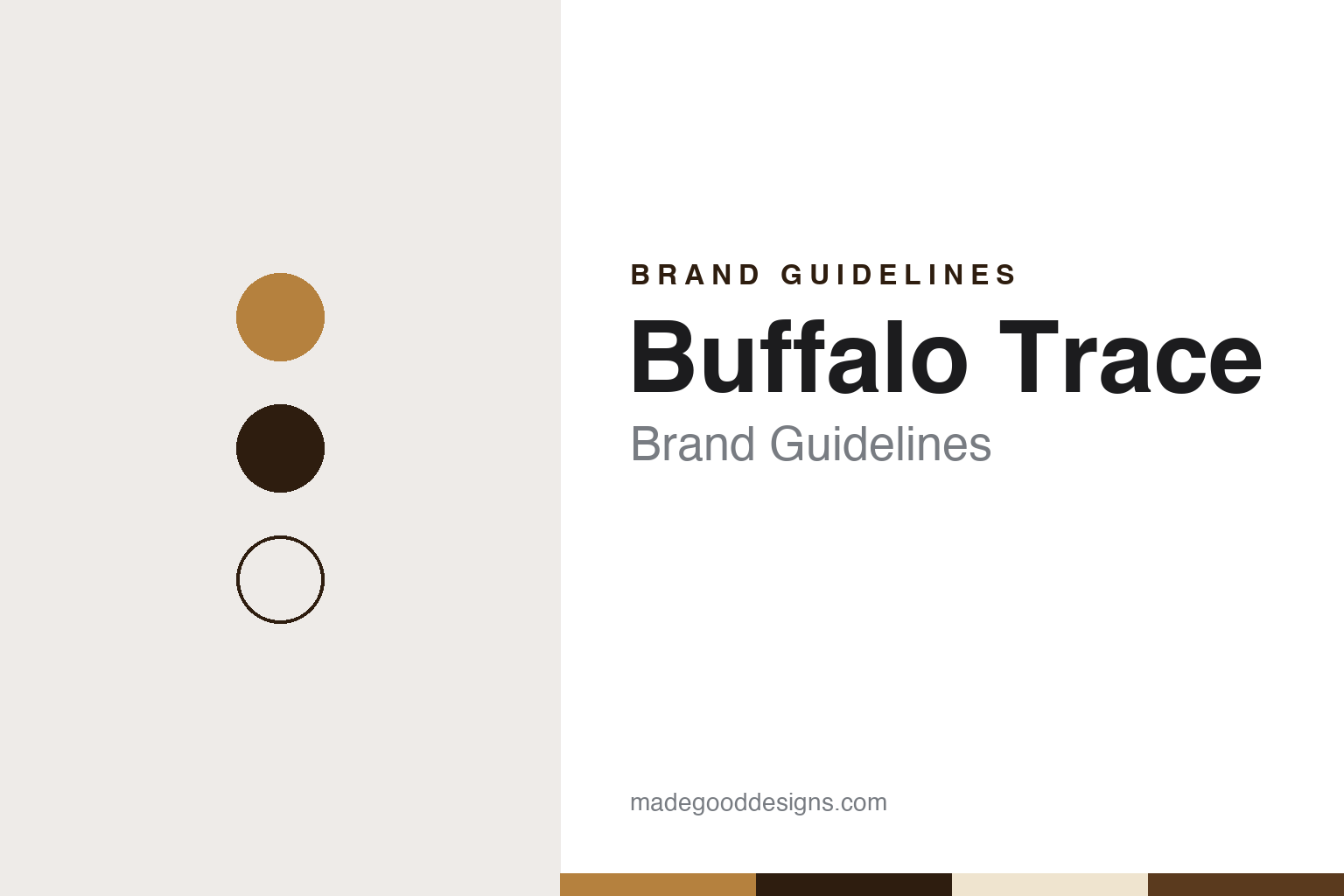
Buffalo Trace Brand Guidelines
The Frankfort distillery renamed for a buffalo crossing in 1999.
Aa
Two constants: a barrel amber, charred oak and limestone palette and an old-style serif register. Abstract homage — not a Buffalo Trace product or mark; no label, logo or bottle is reproduced.
A crossing on the Kentucky River
From O.F.C. to George T. Stagg to Buffalo Trace.
Buffalo Trace is both a bourbon and the distillery that makes it, on the banks of the Kentucky River in Frankfort, the state capital. English Wikipedia explains the name: it refers to an ancient buffalo trackway, part of the route known as the Vincennes Trace, that crossed the river in Franklin County. The distillery took that name in 1999.
The site’s history is much older than the name. English Wikipedia, citing the whiskey writer Susan Reigler (2013), says records indicate distilling began on the land in 1775, by the brothers Hancock and Willis Lee; citing Klebe (2015), it says the first distillery building was put up in 1812 by Harrison Blanton, though the article’s own summary box gives 1805, so the two dates sit side by side. In 1870 the distiller Edmund H. Taylor Jr. bought the property and called it the O.F.C. Distillery; sources expand the initials as both “Old Fire Copper” and “Old Fashioned Copper.” About eight years later Taylor sold it to George T. Stagg, and the plant traded under the Stagg name for much of the next century.
Stagg left a technical mark. The 2001 registration form for the National Register of Historic Places, cited by English Wikipedia, says that in 1886 the distillery installed steam heating in its storage warehouses, describing them as the first climate-controlled warehouses for ageing whiskey in the nation. The company says the distillery stayed open through Prohibition, making whiskey for medicinal purposes, and it describes itself as the oldest continuously operating distillery in the United States, a title other Kentucky distilleries with early roots also point to.
Colour
A New Orleans company, a new name and a bourbon to match.
The modern era began with a change of owner. The Sazerac Company bought the George T. Stagg Distillery in 1992, English Wikipedia says, citing a 2001 history by Jaye. Sazerac is a privately held company owned by William Goldring and his family; English Wikipedia gives its headquarters as Metairie, Louisiana, in the New Orleans area, with its principal office in Louisville, Kentucky, since 2009. The same article lists Sazerac’s other distilleries, among them Barton 1792 in Bardstown and A. Smith Bowman in Virginia.
In 1999 the plant was renamed the Buffalo Trace Distillery, and a bourbon of the same name followed in August 1999, two months after the change, English Wikipedia says.
The distillery’s listings record the shift of name. It was entered on the National Register of Historic Places on 2 May 2001 under its old name, the George T. Stagg Distillery, and the US Department of the Interior announced its designation as a National Historic Landmark on 11 March 2013.
Much of the distillery’s reputation rests on the brands it makes besides its namesake. English Wikipedia lists Eagle Rare, W. L. Weller, E. H. Taylor and George T. Stagg among its own labels; Blanton’s and others are made with Age International, a former owner now part of Japan’s Takara group; and since an agreement of June 2002 the Van Winkle family’s bourbons, including Pappy Van Winkle’s Family Reserve, have been made there.
Typography
Design and documentation.
The seven brands in this group are all North American whiskey names: Bulleit, Woodford Reserve, Buffalo Trace, Four Roses, Knob Creek, Evan Williams and Crown Royal. Whiskey brands in general sit at many different points in the trade, from names that still carry a founder or a distillery to labels that now belong to much larger drinks groups, and a single brand can be sold everywhere from a corner shop to a bar shelf.
A whiskey brand’s identity is usually carried less by a single bottle than by a label, a name and the place it promises, because the company behind the name may have changed hands, moved its production or grown far beyond the place where it started. That makes the questions behind each name worth asking plainly: who started it, who owns it now, and where its whiskey is actually distilled, aged and bottled.
Each guide separates what independent sources record from what the company says about itself — its founding story, its owners over time, where its whiskey is made and how its labels have changed — and marks plainly what rests only on the company’s own word.
Aa
An old-style serif for a bourbon named after a place. (Specimen set in Libre Caslon Text, a serif STAND-IN; NOT the Buffalo Trace logo.)
Buffalo Trace
Master distillers, buried foundations and a river that rises.
Continuity in the stillhouse has been part of the story. English Wikipedia names Gary Gayheart as master distiller from 1985 until his retirement in 2005, succeeded by Harlen Wheatley. In October 2016, the company said, workers renovating an old building on the campus uncovered the foundations of an 1873 distillery building that had burned in 1882, along with fermenters of the period; the site was later opened to visitors. The old O.F.C. name has returned too: in March 2022 the distillery released six-litre bottles of O.F.C. Vintage bourbon distilled in 1982, each paired with a digital token and sold for charity, The Spirits Business reported.
Fame brought attention of another kind. In October 2013 the Franklin County sheriff began investigating missing bottles of Pappy Van Winkle bourbon from the distillery, a case the press called “Pappygate”; in September 2017, the Associated Press reported, a former Buffalo Trace loading-dock worker pleaded guilty to theft charges in a wider whiskey-theft case, while his lawyer said he was not responsible for the 2013 theft.
The riverside setting that gave the brand its name also carries risk. BourbonBlog reported on 9 April 2025 that heavy rain had pushed the Kentucky River at Frankfort to about 48 feet, the second-highest level in the distillery’s history, flooding much of the campus and suspending visits.
Online, the distillery’s own site is buffalotracedistillery.com.
For a design guide, Buffalo Trace shows how a distillery with two earlier names chose a third from the landscape around it, and built a bourbon brand on an old buffalo crossing rather than a founder’s signature. Compare Maker’s Mark, the Loretto bourbon with its red wax, and Wild Turkey, the Lawrenceburg bourbon named on a hunting trip. For this guide we use barrel amber, charred oak and limestone with an old-style serif, an unofficial interpretation; no product or logo is reproduced.
Explore & save
Keep Buffalo Trace’s identity on hand — save it to a board in the Made Good inspiration library.
Buffalo Trace identity set
Pin the Buffalo Trace barrel amber, charred oak and limestone palette and the old-style serif register to your own board.