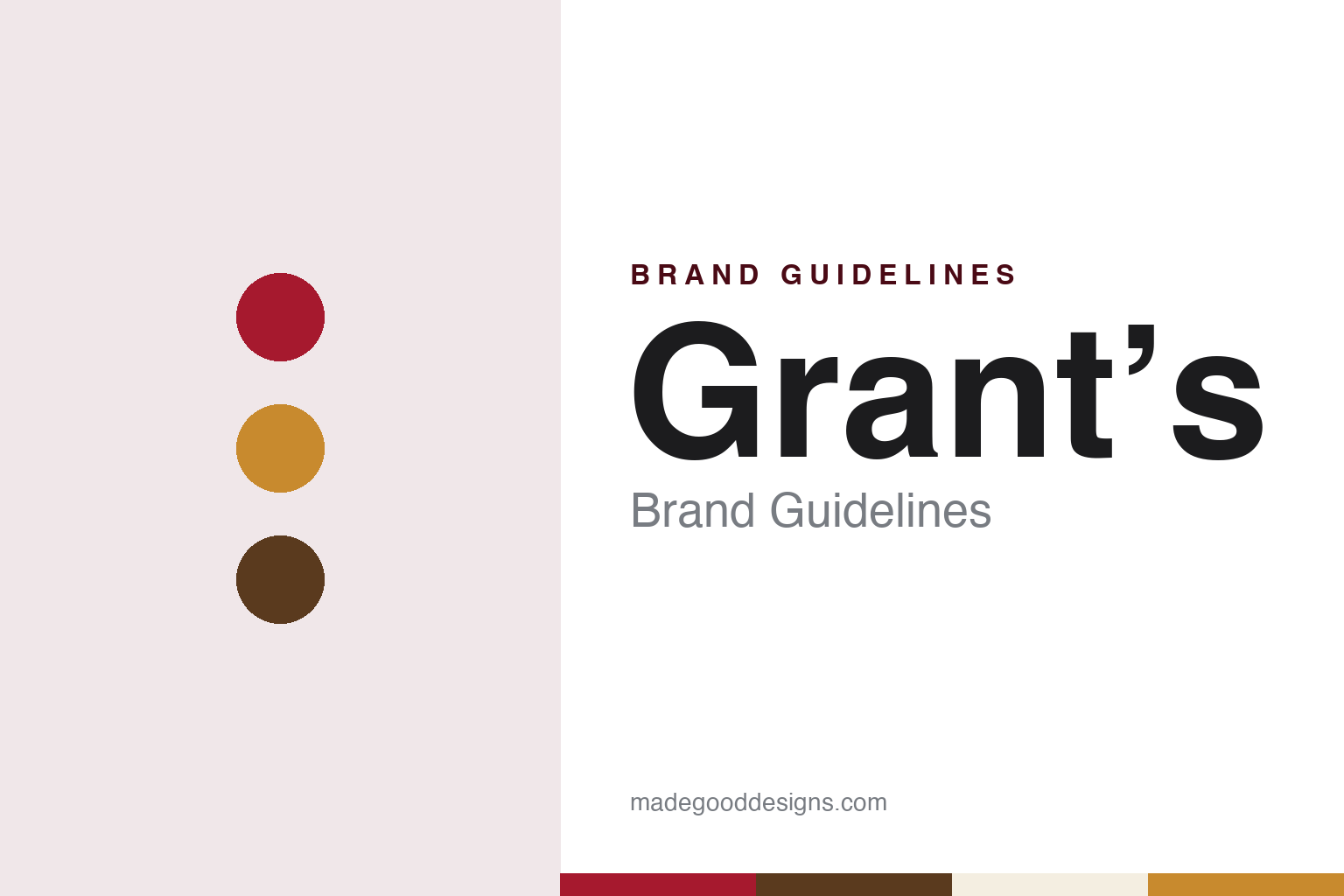
Grant’s Brand Guidelines
A Dufftown family’s blend in a three-sided bottle.
Aa
Two constants: a Standfast red, glass amber and oak brown palette and a classic old-style serif register. Abstract homage — not a Grant’s product or mark; no label, bottle or coat of arms is reproduced.
Standfast
A distilling family in Dufftown, and the blend it sent out into the world.
Grant’s is the blended Scotch whisky of William Grant & Sons, the family-owned distiller headquartered at Dufftown in Speyside, which English Wikipedia describes as the largest of the handful of Scotch whisky distillers still in family ownership. The company dates itself to 1887. William Grant and his sons began building the Glenfiddich distillery in 1886, and its first spirit flowed on Christmas Day 1887, English Wikipedia says, citing Gavin D. Smith’s The Secret Still (2002). A second distillery, Balvenie, followed next door in the 1890s.
The blend came a decade later. Scotchwhisky.com’s brand history says William Grant first began to sell blended whisky in 1898, and that early blends went out under several names, among them Best Procurable, Hare and Hounds and Liqueur. The one that stuck was Standfast, taken from the Grant clan motto, “Standfast Craigellachie!”
Selling it took persistence. In 1903, the same history says, Grant recruited his son-in-law Charles Gordon as sales director to sell Standfast from a base in Glasgow. Gordon and William’s third son, Charles, set up a duty-paid warehouse in the basement of the Gorbals Parish Church, where blended whisky sent by rail from Dufftown was decanted from casks into two-gallon stoneware jars for the city’s licensed trade. Scotchwhisky.com records that Gordon made 181 calls before he sold his first case. In 1909 he set out on a world tour which, in the same account, established Grant’s as an international brand, and the blend later found notable success in post-war North America.
The company secured its own grain whisky in 1963, when it built the Girvan grain distillery in Ayrshire. Scotchwhisky.com says the key grain in Grant’s comes from Girvan, while the principal malts among the 25 or so in the blend include the company’s own Glenfiddich, Balvenie, Kininvie and Ailsa Bay.
Colour
Three sides, a clan motto and a family name.
The shape is the brand. In 1957, Scotchwhisky.com records, Grant’s appeared in its now familiar triangular bottle, designed by Hans Schleger, a refugee from Nazi Germany. English Wikipedia’s article on Schleger says he founded his own firm, Hans Schleger & Associates, in 1953, created identities, posters and campaigns for clients including Penguin, the John Lewis Partnership, ICI, Shell-Mex & BP and the Edinburgh Festival, and designed the triangular bottle for both Glenfiddich and Grant’s Scotch Whisky. The same article notes that in the 1950s and 1960s he became associated with developing a particularly British aesthetic.
The name changed long after the bottle. Scotchwhisky.com says the blend was known as Grant’s Standfast until the mid-1980s, when it was renamed Grant’s Family Reserve, a name chosen to reflect that William Grant & Sons remained an independent company in family ownership. Later makeovers, the same source says, embossed the Grant coat of arms and motto onto the glass and added “Est 1887” and the legend “Independent Family Distillers for Five Generations.”
In July 2018 the range was overhauled. Drinks International reported on 6 July 2018 that Grant’s was launching a global brand refresh led by Grant’s Triple Wood, alongside Triple Wood Smoky, a Rum Cask Finish and an 8 Year Old Sherry Cask Finish. Drinks Enthusiast reported the same day that Triple Wood replaced Family Reserve, in new packaging, in all major retailers from August, the name pointing to the three cask types used in maturation: virgin oak, American oak and refill bourbon casks. Drinks International quoted the master blender Brian Kinsman: “The triple wood process is at the very heart of what we create here at Grant’s.”
Typography
Design and documentation.
The seven brands in this group are all blended Scotch whiskies: Dewar’s, J&B, Ballantine’s, Grant’s, Bell’s, Teacher’s and Cutty Sark. Blended Scotch brands in general sit at many different points in the trade, from names that still carry a founder’s or merchant’s name to labels that now belong to much larger drinks groups, and a single brand can be sold everywhere from a corner shop to a hotel bar.
A blended Scotch brand’s identity is usually carried less by a single distillery than by a label, a name and the style of the blend, because the company behind the name may have changed hands, moved its blending and bottling or grown far beyond the place where it started. That makes the questions behind each name worth asking plainly: who started it, who owns it now, and where its whisky is actually blended and bottled.
Each guide separates what independent sources record from what the company says about itself — its founding story, its owners over time, where its whisky is blended and how its labels have changed — and marks plainly what rests only on the company’s own word.
Aa
A classic old-style serif for a family name on three-sided glass. (Specimen set in Libre Caslon Text, a serif STAND-IN; NOT the Grant’s logo.)
Grant’s
One blend inside a growing family company.
Grant’s sits inside a larger family business. English Wikipedia places William Grant & Sons’ operational headquarters at Strathclyde Business Park in North Lanarkshire and its sales and marketing headquarters in Richmond, London, and says the company is still run by William Grant’s descendants. Kinsman succeeded David Stewart as master blender, Drinks International reported in March 2010; English Wikipedia notes that Stewart had held the post for 47 years. Beyond whisky, the company launched Hendrick’s gin, produced at Girvan, in 1999. In September 2024 it agreed to buy The Famous Grouse and Naked Malt from Edrington, The Spirits Business reported, and The Drinks Business reported on 2 July 2025 that the sale had been completed, putting another well-known blend in the same stable as Grant’s.
The blend has been extended and pruned over the years. Scotchwhisky.com records the introduction of Sherry Cask Reserve and Ale Cask Reserve in 2001, a 25-year-old blend in travel retail in 2009 and Grant’s Signature in 2014, aimed at younger drinkers. Scotchwhisky.com says the blend is sold in some 180 countries, and in 2021 Grant’s was the world’s third-best-selling Scotch whisky, behind Johnnie Walker and Ballantine’s, according to Scotchwhisky.com’s annual ranking cited by English Wikipedia.
For a design guide, Grant’s shows how a single bottle shape, a clan motto and a family name can hold a blend together for more than a century, through three names and a modernist redesign of the glass in 1957. Compare Glenfiddich, the family’s single malt from the same Dufftown site, and The Famous Grouse, the Perth blend the company bought in 2025. For this guide we use Standfast red, glass amber and oak brown with a serif, an unofficial interpretation; no product or logo is reproduced.
Explore & save
Keep Grant’s’s identity on hand — save it to a board in the Made Good inspiration library.
Grant’s identity set
Pin the Grant’s Standfast red, glass amber and oak brown palette and the classic old-style serif register to your own board.