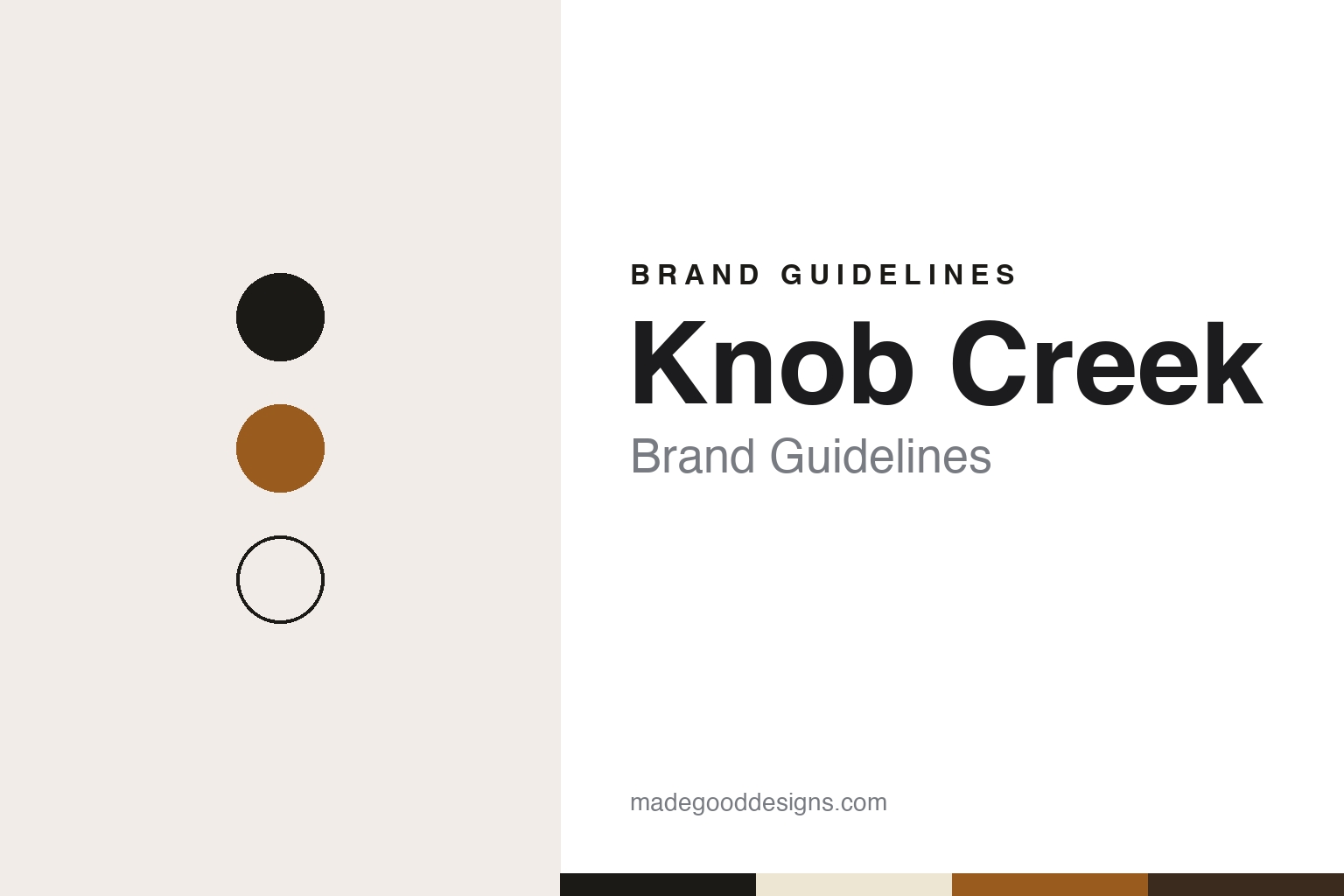
Knob Creek Brand Guidelines
Booker Noe’s 1992 small-batch bourbon in a newspaper-style wrap.
Aa
Two constants: a Knob Creek ink, newsprint and amber palette and a newspaper serif register. Abstract homage — not a Knob Creek product or mark; no bottle, label or logo is reproduced.
Booker’s Collection
A master distiller, four bourbons and a creek.
Knob Creek is a Kentucky straight bourbon made at the Jim Beam distillery in Clermont, Kentucky, English Wikipedia says, and it dates from 1992. Its owner’s brand history says Knob Creek was established that year as a key member of the Small Batch Bourbon Collection created by Booker Noe, Jim Beam’s master distiller and the grandson of Jim Beam himself. The collection had four members: Booker’s, the uncut barrel-strength bourbon that carried Noe’s own name; Basil Hayden’s; Baker’s; and Knob Creek.
Noe was a company man of long standing. A tribute entered in the Congressional Record by Senator Jim Bunning of Kentucky on 26 February 2004 said Noe had entered the family business in 1950 and was named master distiller in 1965, and it marked his death that week at his home in Bardstown. Beam’s history says he retired as master distiller in 1992, the year Knob Creek appeared, and Booker’s had preceded it as a public release in 1988, according to F. Paul Pacult’s 2003 history of the company, American Still Life.
The name comes from a place. Beam says it pays homage to Abraham Lincoln, whose family’s second Kentucky farm was known as “the Knob Creek place”; English Wikipedia describes the bourbon as named after the nearby Knob Creek Farm, the Lincoln boyhood home. The whiskey inside is a close relation of the house brand. In their 1995 book The Book of Classic American Whiskeys, Mark Waymack and James Harris wrote that Knob Creek shares the same general formulation as Jim Beam but is aged and packaged differently. The core bottling is aged nine years and bottled at 100 proof, well above the minimums required for a Kentucky straight bourbon.
Colour
A square bottle and a newspaper wrap.
Knob Creek’s look is built on two ideas from the past. English Wikipedia describes a rectangular bottle with a corked or twist-on cap and a wax-sealed top. A Knob Creek-sponsored feature in The Daily Beast in July 2020 said the square bottle imitated pre-Prohibition apothecary containers, and that the label was a nod to old repurposed newspaper wrappers, used to protect bottles when money was tight.
The label has been refreshed without losing that idea. The Bourbon Review reported on 27 February 2019 that the three core bottlings, Small Batch, Single Barrel and Rye, were getting “a sleek, modern redesign in the form of a new label,” with the “prohibition style” whiskey itself unchanged. For a closer look at the lettering itself, see our guide to the Knob Creek font.
The range has grown around the nine-year flagship. English Wikipedia lists a 120-proof Single Barrel Reserve; Single Barrel Select, picked by individual retailers; a Knob Creek Rye, released in 2012 and sold as “Patiently Aged” rather than with an age statement; and Smoked Maple, which The Spirits Business reported on 26 September 2013 as the brand’s first flavoured bourbon. In 2016 a one-off Knob Creek 2001 limited edition marked the passing of the work from Booker Noe to his son Fred Noe, made from barrels Booker had laid down in 2001. Tasting Table reviewed a 21 Year Old in October 2025, the oldest Knob Creek to date.
Awards have followed the core bottling. English Wikipedia, citing results archived from the San Francisco World Spirits Competition, says the competition gave Knob Creek two double gold and three gold medals between 2005 and 2012, and named it Best Bourbon in 2015.
Typography
Design and documentation.
The seven brands in this group are all North American whiskey names: Bulleit, Woodford Reserve, Buffalo Trace, Four Roses, Knob Creek, Evan Williams and Crown Royal. Whiskey brands in general sit at many different points in the trade, from names that still carry a founder or a distillery to labels that now belong to much larger drinks groups, and a single brand can be sold everywhere from a corner shop to a bar shelf.
A whiskey brand’s identity is usually carried less by a single bottle than by a label, a name and the place it promises, because the company behind the name may have changed hands, moved its production or grown far beyond the place where it started. That makes the questions behind each name worth asking plainly: who started it, who owns it now, and where its whiskey is actually distilled, aged and bottled.
Each guide separates what independent sources record from what the company says about itself — its founding story, its owners over time, where its whiskey is made and how its labels have changed — and marks plainly what rests only on the company’s own word.
Aa
A high-contrast newspaper serif for a front-page label. (Specimen set in Old Standard TT, a serif STAND-IN; NOT the Knob Creek logo.)
Knob Creek
From Beam to Beam Suntory to Suntory Global Spirits.
Knob Creek has changed owners only as Jim Beam has. English Wikipedia’s account of the company says Fortune Brands bought Jim Beam Brands Worldwide in 2005, and that the spirits business, renamed Beam Global Spirits & Wine in 2006, became an independent listed company, Beam Inc., on 3 October 2011. In January 2014 Japan’s Suntory announced a deal to buy Beam, USA Today reported; Suntory completed the purchase in April 2014 and the business became Beam Suntory, headquartered in Chicago. In May 2024 it was renamed Suntory Global Spirits, with a new visual identity, Forbes reported.
Popularity has brought stock problems. The Guardian reported on 20 July 2009 that Beam was publicising a shortage of Knob Creek, as demand had outrun the forecast made when that whiskey was laid down in 2000. In 2016 the nine-year age statement was removed from the label because stock could not guarantee it, The Whiskey Wash reported that September; Beam’s own history records that the age statement returned to the pack in 2020.
The name needs care online. Knob Creek Farm, Lincoln’s boyhood home, is a historic site in its own right, and a Kentucky shooting range also uses the name; the bourbon’s own site is knobcreek.com.
For a design guide, Knob Creek shows how a square bottle and a label made to look like a wrapped newspaper can turn an idea about the past into a shelf signature for more than three decades. Compare Jim Beam, the house bourbon from the same distillery, and Maker’s Mark, its stablemate under Suntory Global Spirits. For this guide we use printer’s ink, newsprint and barrel amber with a high-contrast serif, an unofficial interpretation; no product or logo is reproduced.
Explore & save
Keep Knob Creek’s identity on hand — save it to a board in the Made Good inspiration library.
Knob Creek identity set
Pin the Knob Creek ink, newsprint and barrel amber palette and the newspaper serif register to your own board.