J&B Brand Guidelines
The London wine merchant’s blend made for post-Prohibition America.
Aa
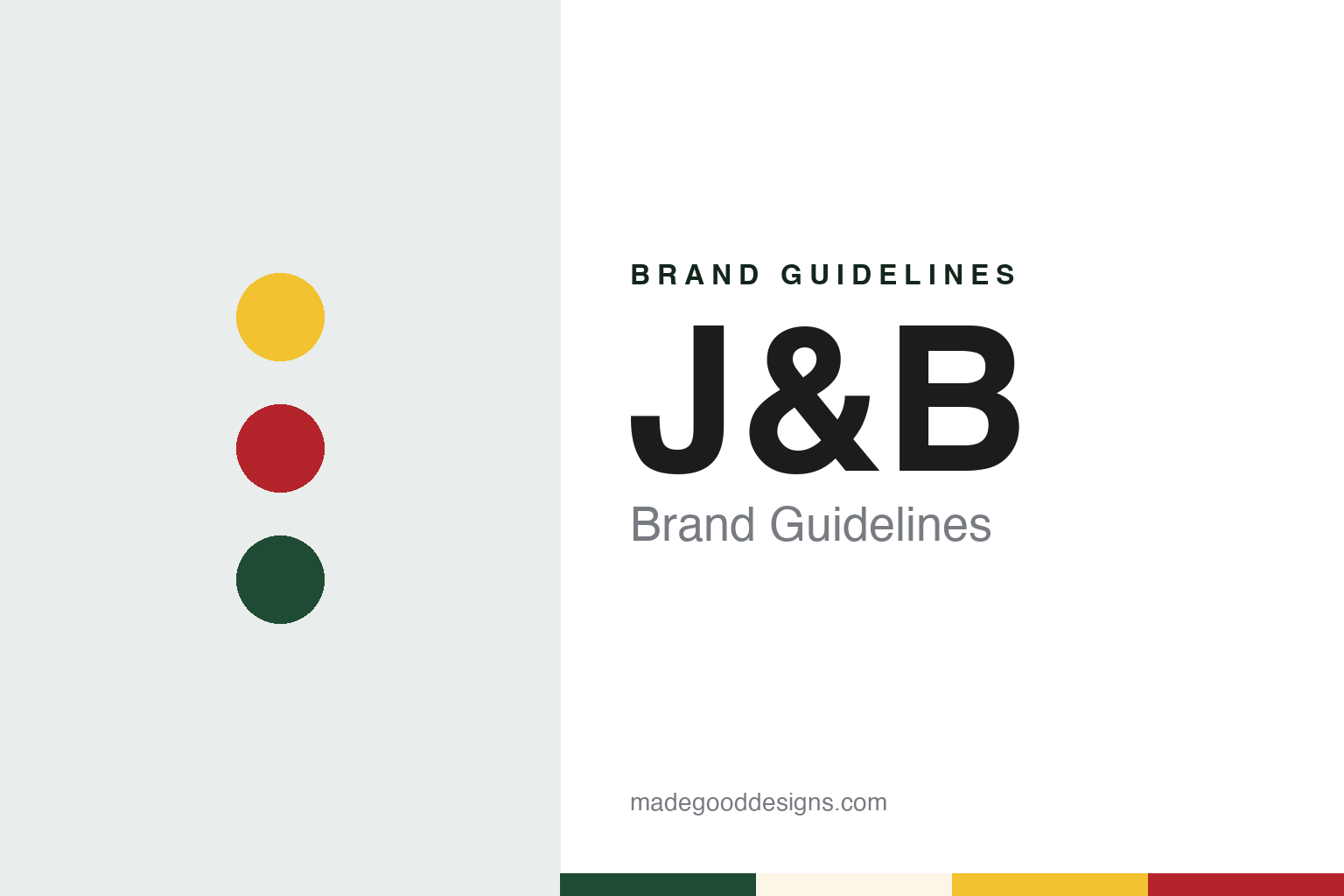
Two constants: a rare yellow, merchant red and bottle green palette and a Didone display serif register. Abstract homage — not a J&B product or mark; no label, logo or bottle is reproduced.
A Bolognese merchant in London
Giacomo Justerini, George Johnson and a royal warrant.
The letters J and B stand for a London wine merchant much older than the whisky. In 1749 Giacomo Justerini, from Bologna, and an English partner, George Johnson, set up as wine merchants in London, trading as Johnson & Justerini, English Wikipedia says, citing the firm’s own history; the Scotch whisky reference site scotchwhisky.com places the first shop on Pall Mall. Justerini went back to Italy in 1760 after selling his share to Johnson, who brought his grandson Augustus into the business and bought from suppliers in Bordeaux, Cadiz, Reims, Genoa, Dijon and Palermo.
Royal custom followed early. The firm received its first Royal Warrant from George III in 1761 and has held one from every British monarch since, English Wikipedia says, citing the Royal Warrant Holders Association; Harpers Wine & Spirit repeated the point when the house marked its 275th anniversary in October 2024. Whisky was in stock long before it was a brand: scotchwhisky.com notes an advertisement in The Morning Post on 17 June 1779 that listed “usquebaugh,” an old word for whisky, among the goods for sale.
The name on the door changed in 1831, when Alfred Brooks bought the business from the Johnson family and it became Justerini & Brooks, English Wikipedia and scotchwhisky.com say. The merchant still trades under that name from St James’s Street in London, with offices in Edinburgh and Hong Kong, selling fine wine to private collectors, hotels and restaurants. The firm is known for Burgundy, Barolo and German wines, English Wikipedia says, and J&B Rare carries the same initials on bottles sold around the world.
Colour
Eddie Tatham, Charles Julian and a blend for America.
J&B Rare was made for one market. Eddie Tatham of Justerini & Brooks visited the United States in 1930 and concluded that Scotch would have great opportunities once Prohibition ended, scotchwhisky.com says. He worked with the blender Charles Julian, whom The Whiskey Wash describes as the creator of Cutty Sark, and the new blend was designed for the American palate as a rival to Cutty Sark. scotchwhisky.com says J&B Rare was introduced as Prohibition ended in 1933; by 1963 it was selling a million cases a year in the United States, according to the same profile and Diageo.
The recipe is pale and Speyside-led. English Wikipedia, citing Dorling Kindersley’s Great Whiskies, describes J&B Rare as a blend of 42 malt and grain whiskies, among them the single malts Knockando, Auchroisk, Strathmill and Glen Spey; scotchwhisky.com calls Knockando the “heart malt.” The Whiskey Wash wrote in January 2025 that the whisky is light in colour and that its “distinctive yellow label and retro design” have stayed close to the 1930s original.
The bottle became a piece of film furniture. English Wikipedia, citing Mikel Koven’s 2006 study La Dolce Morte, says J&B bottles turned up with remarkable regularity in Italian giallo and crime films of the 1970s, and it is the whisky Kurt Russell’s character drinks in John Carpenter’s The Thing of 1982. scotchwhisky.com adds that in 1958 the blend reached the Las Vegas club scene, where Frank Sinatra, Dean Martin and Sammy Davis Jr were reportedly seen drinking it on stage.
Typography
Design and documentation.
The seven brands in this group are all blended Scotch whiskies: Dewar’s, J&B, Ballantine’s, Grant’s, Bell’s, Teacher’s and Cutty Sark. Blended Scotch brands in general sit at many different points in the trade, from names that still carry a founder’s or merchant’s name to labels that now belong to much larger drinks groups, and a single brand can be sold everywhere from a corner shop to a hotel bar.
A blended Scotch brand’s identity is usually carried less by a single distillery than by a label, a name and the style of the blend, because the company behind the name may have changed hands, moved its blending and bottling or grown far beyond the place where it started. That makes the questions behind each name worth asking plainly: who started it, who owns it now, and where its whisky is actually blended and bottled.
Each guide separates what independent sources record from what the company says about itself — its founding story, its owners over time, where its whisky is blended and how its labels have changed — and marks plainly what rests only on the company’s own word.
Aa
A high-contrast Didone serif for a merchant’s initials. (Specimen set in Bodoni Moda, a serif STAND-IN; NOT the J&B logo.)
J&B
From IDV and Grand Metropolitan to Diageo, and a party in Spain.
The merchant joined a larger group in 1962, when Justerini & Brooks merged with W&A Gilbey to form International Distillers & Vintners. Grand Metropolitan took over that group in 1972, and when Grand Metropolitan merged with Guinness in 1997 to form Diageo, IDV became part of United Distillers & Vintners, English Wikipedia and scotchwhisky.com say. Diageo owns both the J&B whisky brand and the Justerini & Brooks wine business today.
Europe became the brand’s second home. scotchwhisky.com dates J&B Rare’s arrival in Spain to 1962, and says that by the 1970s sales had reached three million cases a year. In Southern Europe the blend is now marketed as a party whisky. Diageo launched its first global campaign for the brand, “Start a Party,” in 2007; the year before, J&B tried a chill-filtered spin-off, J&B -6ºC, aimed at younger vodka drinkers, and withdrew it after twelve months, scotchwhisky.com says. Design Week reported in March 2005 that the consultancy Bloom designed the identity and packaging for that spin-off. In 2014 came J&B Urban Honey, labelled as Scotch whisky “infused with honey.” In Spain the initials were also the subject of a long trademark dispute with Destilerías Julio Borrajo of Talavera de la Reina over a “J.B.” mark, which ended in an out-of-court settlement in 2008, Forbes España reported in June 2021.
One practical note: J&B is written with an ampersand, and the merchant’s own website goes by “Justerinis,” so both forms are worth searching when tracing the firm’s history.
For a design guide, J&B shows how two initials and a yellow label can carry a merchant’s name onto a mass-market bottle, and how a design left largely alone since the 1930s can become a recognisable prop. Compare Cutty Sark, the blend J&B Rare was made to rival, and Tanqueray, another London name in the Diageo portfolio. For this guide we use rare yellow, merchant red and bottle green with a serif, an unofficial interpretation; no product or logo is reproduced.
Explore & save
Keep J&B’s identity on hand — save it to a board in the Made Good inspiration library.
J&B identity set
Pin the J&B rare yellow, merchant red and bottle green palette and the Didone display serif register to your own board.