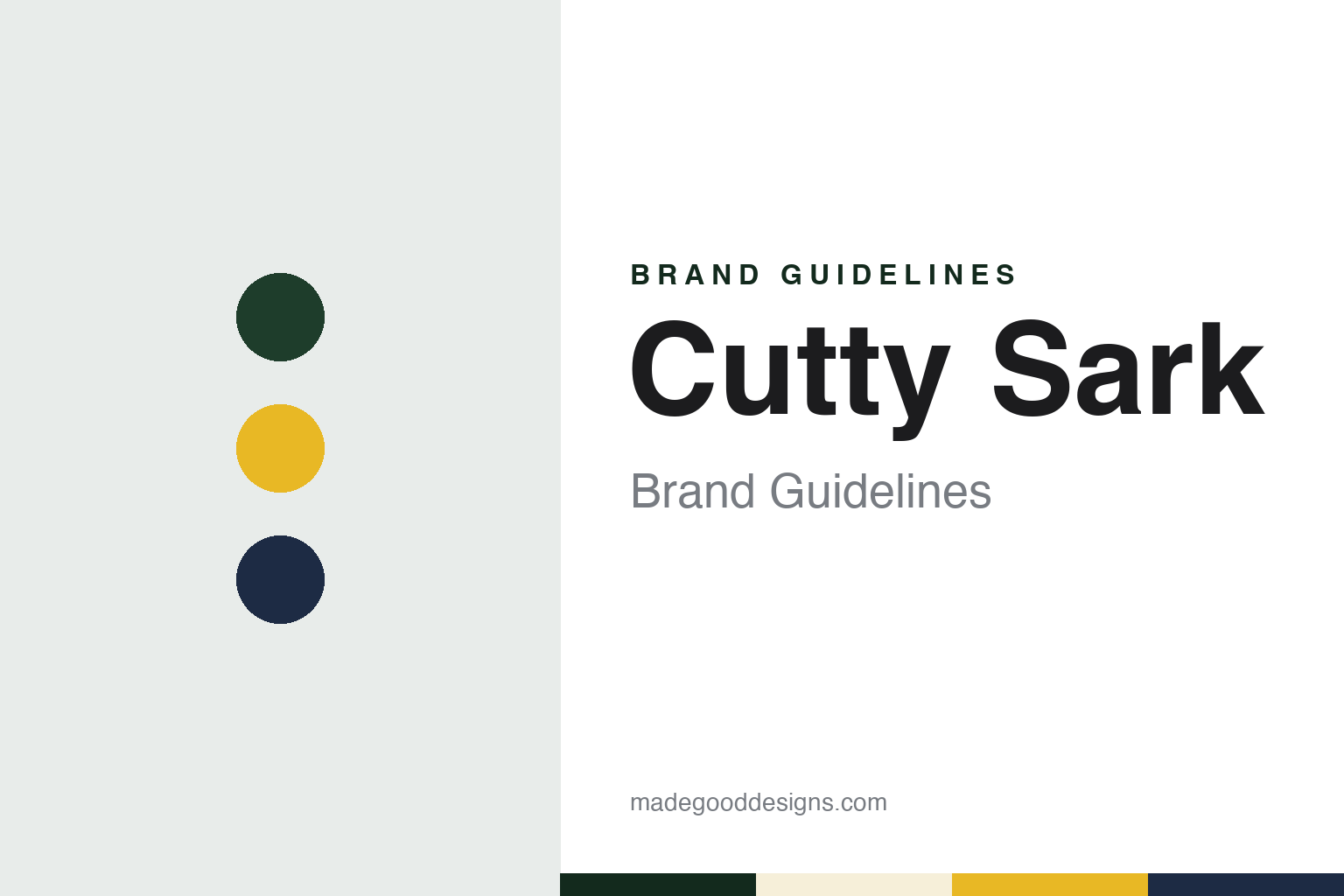
Cutty Sark Brand Guidelines
A London wine merchant’s blend, a clipper’s name and a yellow label.
Aa
Two constants: a label yellow, bottle green and clipper navy palette and a merchant’s-label serif register. Abstract homage — not a Cutty Sark product or mark; no bottle, label or logo is reproduced.
No. 3 St James’s Street
A wine merchant’s lunch, an artist and a clipper’s name.
Cutty Sark began not at a distillery but in a London wine shop. The blend was created in March 1923 as a product of Berry Bros. & Rudd, the wine and spirits merchant at No. 3 St James’s Street; English Wikipedia gives the date as 23 March and French Wikipedia as 20 March. English Wikipedia, citing the whisky writer Charles MacLean, says the first home of the blend is considered to have been The Glenrothes distillery in Speyside.
The merchant’s own account of the launch comes from Ronnie Cox, its brands heritage director, writing on the Berry Bros. & Rudd website in 2017. He says the Scottish artist James McBey came to a partners’ lunch in March 1923 while the firm was looking for a name for a newly selected blend of lighter-style whiskies, and suggested “Cutty Sark”. McBey, a largely self-taught etcher from Newburgh in Aberdeenshire, then designed the label on a napkin, Cox writes, and the directors sent it to the printers asking for a background that looked “aged.” According to the same account, the printers made a mistake and the label came back yellow. Cox names Francis Berry and Hugh Rudd as the partners of the day.
The name belongs first to a ship. The Cutty Sark is a tea clipper built in 1869 at Dumbarton on the River Leven in Scotland, and she was named after the witch in Robert Burns’s poem “Tam o’ Shanter,” who wears a cutty sark, Scots for a short shift. The clipper, now preserved in dry dock at Greenwich in London, is a separate thing from the whisky; the brand borrowed her name and image. When the ship reopened to the public in 2012 after conservation and a fire in 2007, Berry Bros. & Rudd was listed among the funders of the project.
Colour
Prohibition, an American importer and a ship on the label.
By the merchant’s account, the blend’s early markets lay overseas. Cutty Sark’s own website says it was launched “at the heart of the Prohibition era” and was created to defy conventions. Cox writes that Francis Berry had built agencies overseas and set up an agreement in the Bahamas as American Prohibition approached, that the firm’s records show the first Cutty Sark export price list in 1927, and that it is generally assumed the whisky was a favourite of the rum-runner Captain William McCoy. He attributes the blend’s success in part to its light, unsmoky style, which he calls friendly to claret. Berry Bros. & Rudd also says that in 1961 Cutty Sark became the first Scotch to sell more than 12 million bottles in the United States in a single year.
Legal American trade went through a separate importer. English Wikipedia, citing a Harvard Business School archive, says The Buckingham Corporation, incorporated in Delaware in 1933 with offices in New York, held the sole right to import Cutty Sark into the United States. The New York Times reported in 1964 that Schenley Industries had bought control of Buckingham, and in 1970 that Northwest Industries was buying it; Allied-Lyons bought Buckingham in 1989, the paper reported, and the trade magazine Brandweek said Skyy Spirits took the distribution rights in 1999.
The bottle itself has stayed recognisable. English Wikipedia describes the core blend, Cutty Sark Original, as sold in a green bottle with a yellow label, and says the drawing of the clipper on the label is by the Swedish marine painter Carl Georg August Wallin and has been on the bottles since 1955. The brand’s name also went to sea: the ship page on English Wikipedia says the maker formerly sponsored the Cutty Sark Tall Ships’ Races, and French Wikipedia puts that sponsorship at 1973 to 2003. Behind the merchant’s name, the whisky was long tied to the Glasgow blenders Robertson & Baxter: English Wikipedia, citing the Oxford Dictionary of National Biography, says the firm owned the brand in the 1950s while Berry Bros. & Rudd still marketed it.
Typography
Design and documentation.
The seven brands in this group are all blended Scotch whiskies: Dewar’s, J&B, Ballantine’s, Grant’s, Bell’s, Teacher’s and Cutty Sark. Blended Scotch brands in general sit at many different points in the trade, from names that still carry a founder’s or merchant’s name to labels that now belong to much larger drinks groups, and a single brand can be sold everywhere from a corner shop to a hotel bar.
A blended Scotch brand’s identity is usually carried less by a single distillery than by a label, a name and the style of the blend, because the company behind the name may have changed hands, moved its blending and bottling or grown far beyond the place where it started. That makes the questions behind each name worth asking plainly: who started it, who owns it now, and where its whisky is actually blended and bottled.
Each guide separates what independent sources record from what the company says about itself — its founding story, its owners over time, where its whisky is blended and how its labels have changed — and marks plainly what rests only on the company’s own word.
Cutty Sark
A merchant’s-label serif for a London wine shop’s blend named after a clipper. (Specimen set in Libre Caslon Text, a serif STAND-IN; NOT the Cutty Sark logo or label lettering.)
Cutty Sark
From Edrington to a French spirits group.
Berry Bros. & Rudd kept the name for almost nine decades. In 2010 it sold Cutty Sark to The Edrington Group, the Glasgow company created in 1961 by the Robertson sisters to hold the Robertson & Baxter whisky interests, which English Wikipedia describes as the merchant’s long-standing trading partner; under the deal Berry Bros. & Rudd took over The Glenrothes single malt brand, and sold it back to Edrington in 2017. Just Drinks reported in 2011 that Edrington moved Cutty Sark’s American distribution to Rémy Cointreau, and in 2014 Edrington set up its own American arm.
Eight years later, Drinks International reported on 28 November 2018 that Edrington had sold Cutty Sark to La Martiniquaise-Bardinet, the French spirits group founded in 1934 by Jean Cayard, adding that Edrington’s association with the brand went back to the 1930s and that it would keep providing blending, bottling and related services during a transition period. The group’s president, Jean-Pierre Cayard, told the magazine the deal would speed its international expansion and placed Cutty Sark alongside its Label 5, Sir Edward’s and Glen Moray whiskies. In Scotland, La Martiniquaise runs the Glen Moray distillery in Speyside and the Starlaw grain distillery at Bathgate, West Lothian, which English Wikipedia says together supply whisky for the Cutty Sark and Label 5 blends and which has its own blending and bottling plant. In August 2021 the Daily Record reported that West Lothian Council had rejected plans to add maturation warehouses at Starlaw after objections from local residents.
The centenary came in 2023. Drinks International reported that April that the brand was marking 100 years with a limited edition carrying a new label and gift box but the same whisky, and a campaign called “Never Ending Adventure.” The brand’s website now lists a range that includes Original, Prohibition and a 12-year-old under the line “Proud to be different, born to mix.”
For a design guide, Cutty Sark shows how a borrowed ship’s name, an artist’s sketch and a printer’s yellow can carry a London merchant’s blend across a century of owners. Compare The Famous Grouse, another blend that passed through Edrington’s hands, and The Macallan, the Speyside single malt at the heart of Edrington. For this guide we use a label yellow, a bottle green and a clipper navy with a Caslon-style serif, an unofficial interpretation; no product or logo is reproduced.
Explore & save
Keep Cutty Sark’s identity on hand — save it to a board in the Made Good inspiration library.
Cutty Sark identity set
Pin the Cutty Sark label yellow, bottle green and clipper navy palette and the merchant’s-label serif register to your own board.