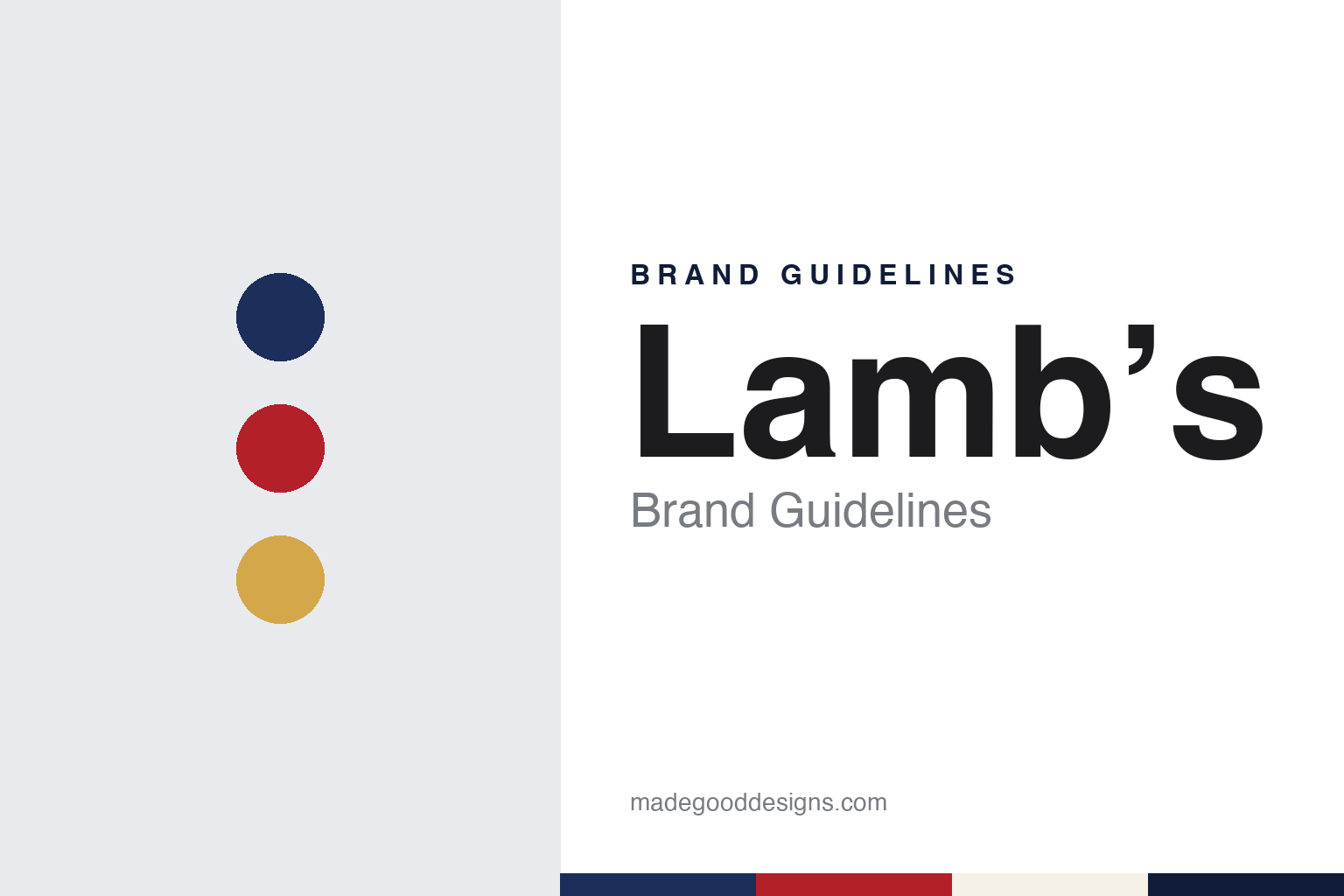
Lamb’s Brand Guidelines
Alfred Lamb’s 1849 London navy rum.
Aa
Two constants: a navy, ensign red and brass palette and a condensed sans register. Abstract homage — not a Lamb’s product or mark; no label, logo or bottle is reproduced.
Eighteen rums in London
A merchant’s son, a blend and a navy name.
Lamb’s is a London rum. English Wikipedia says that in 1849 Alfred Lamb, a 22-year-old Londoner and the son of the wine and spirits merchant William Lamb, blended 18 rums from Barbados, Guyana, Jamaica and Trinidad to make Lamb’s Navy Rum, and that his business took the name Alfred Lamb & Son. The recipe, in other words, was a merchant’s blend made in a port city, from rums distilled across the British Caribbean.
The name borrows from a naval custom rather than a contract. The term “navy rum,” English Wikipedia explains, comes from the Royal Navy’s daily rum ration for sailors, which replaced French brandy after the English conquest of Jamaica in 1655 gave the fleet access to rum. Lamb’s, the same article notes, was never an official supplier to the Royal Navy; the word is a style and a story, not a warrant.
The firm stayed a London merchant for nearly a century. English Wikipedia says Alfred Lamb & Son was bombed out of its premises on Great Tower Street in the City of London during the Second World War, as was its competitor White Keeling Rum Merchants. Both were taken in by a third rum house, Portal, Dingwall & Norris, at 40 Eastcheap, and in 1946 the three merged to form United Rum Merchants. The brand then moved into large drinks groups: English Wikipedia says Lamb’s became part of the Allied Lyons portfolio in 1984.
Colour
A rum that became Canadian as much as British.
The brand’s second home is Canada. In 1952 the Canadian distiller Corby Distilleries signed an agreement with United Rum Merchants to bottle Lamb’s under licence in Canada, English Wikipedia says, citing Corby’s own history. When the brand changed hands in 2026, the president of its new North American owner called it one of Canada’s most recognised rum brands.
Ownership followed the licence. When Pernod Ricard bought Allied Domecq in 2005, it became Corby’s majority shareholder, and Corby’s history page says that in the same year Corby acquired the international rights to Lamb’s. Corby’s 2006 annual report describes the agreement as signed in March 2006, covering the rights outside Canada, which Corby already held, in exchange for its stake in the liqueur brand Tia Maria. English Wikipedia says Lamb’s has since been bottled in Canada for North American markets and in England by Halewood International for Europe, Africa and Asia; just-drinks reported in March 2007 that Halewood had secured the UK distribution rights.
The advertising leaned on the navy theme once the navy itself stopped pouring. English Wikipedia says the brand launched a campaign called “Join the Lamb’s Navy” in 1970, the year the Royal Navy ended its daily rum ration. The range was later extended: English Wikipedia says Lamb’s Spiced was launched by Halewood in 2009 for international markets and, after sales fell short of expectations, was reformulated in 2014, and a trade report in August 2014 described a taste and image refresh of the spiced rum by Corby.
Typography
Design and documentation.
The seven brands in this group are all rum and bitters names: Diplomático, Gosling’s, Myers’s, Lamb’s, Wray & Nephew, El Dorado and Angostura. Rum and bitters brands in general sit at many different points in the trade, from family houses that still carry a founder’s name to labels that now belong to much larger drinks groups, and a single brand can be sold everywhere from a corner shop to a cocktail bar.
A rum or bitters brand’s identity is usually carried less by a single bottle than by a label, a name and the place it promises, because the company behind the name may have changed hands, moved its production or grown far beyond the place where it started. That makes the questions behind each name worth asking plainly: who started it, who owns it now, and where its rum or bitters is actually made and bottled.
Each guide separates what independent sources record from what the company says about itself — its founding story, its owners over time, where its rum or bitters is made and how its labels have changed — and marks plainly what rests only on the company’s own word.
Aa
A condensed sans for a stencilled, nautical register. (Specimen set in Oswald, a sans-serif STAND-IN; NOT the Lamb’s logo.)
Lamb’s
A brand split between two new owners.
In 2026 Lamb’s left Corby. On 5 August 2026 Corby Spirit and Wine announced that it had signed a definitive agreement and sold the Lamb’s rum brand, its intellectual property and its inventories to two buyers. Maison des Futailles, a subsidiary of the Quebec company Phildan (Dandurand Group), took the rights in North America; Glen Turner Company, a subsidiary of the French group COFEPP (La Martiniquaise-Bardinet), took the rights in the rest of the world. Corby said it and its affiliates would support production and distribution for the buyers for a period after closing, and presented the divestment as part of a plan to simplify its portfolio and free capital and resources for other opportunities.
The announcement explained the sale from both sides. Global Drinks Intel reported on 7 August 2026 that Corby’s chief executive, Florence Tresarrieu, called it a disciplined portfolio decision that would let the company focus on higher-priority categories. On the buying side, Christophe Pichambert of La Martiniquaise-Bardinet described Lamb’s in the release as a well-established brand in the United Kingdom, and Phildan pointed to its standing in Canada. The two markets that adopted the London rum, Britain and Canada, are now looked after by two different companies, one French and one Québécois.
The brand has carried several names over its life: Lamb’s Navy Rum on the original blend, simply Lamb’s on later ranges such as Lamb’s Spiced, and Alfred Lamb & Son as the house that made it. Across them, the founder’s surname and the navy are the fixed points, from the 1849 blend to the “Join the Lamb’s Navy” campaign of 1970.
For a design guide, Lamb’s shows how a merchant’s blend, a borrowed naval name and a long licence in Canada can keep a London rum alive through mergers, wartime bombing, several corporate owners and a split by territory. Compare Mount Gay, the Barbados rum house, and El Dorado, the rum of Guyana, two of the islands and coasts Alfred Lamb blended from. For this guide we use navy, ensign red and brass with a condensed sans, an unofficial interpretation; no product or logo is reproduced.
Explore & save
Keep Lamb’s’s identity on hand — save it to a board in the Made Good inspiration library.
Lamb’s identity set
Pin the Lamb’s navy, ensign red and brass palette and the condensed sans register to your own board.