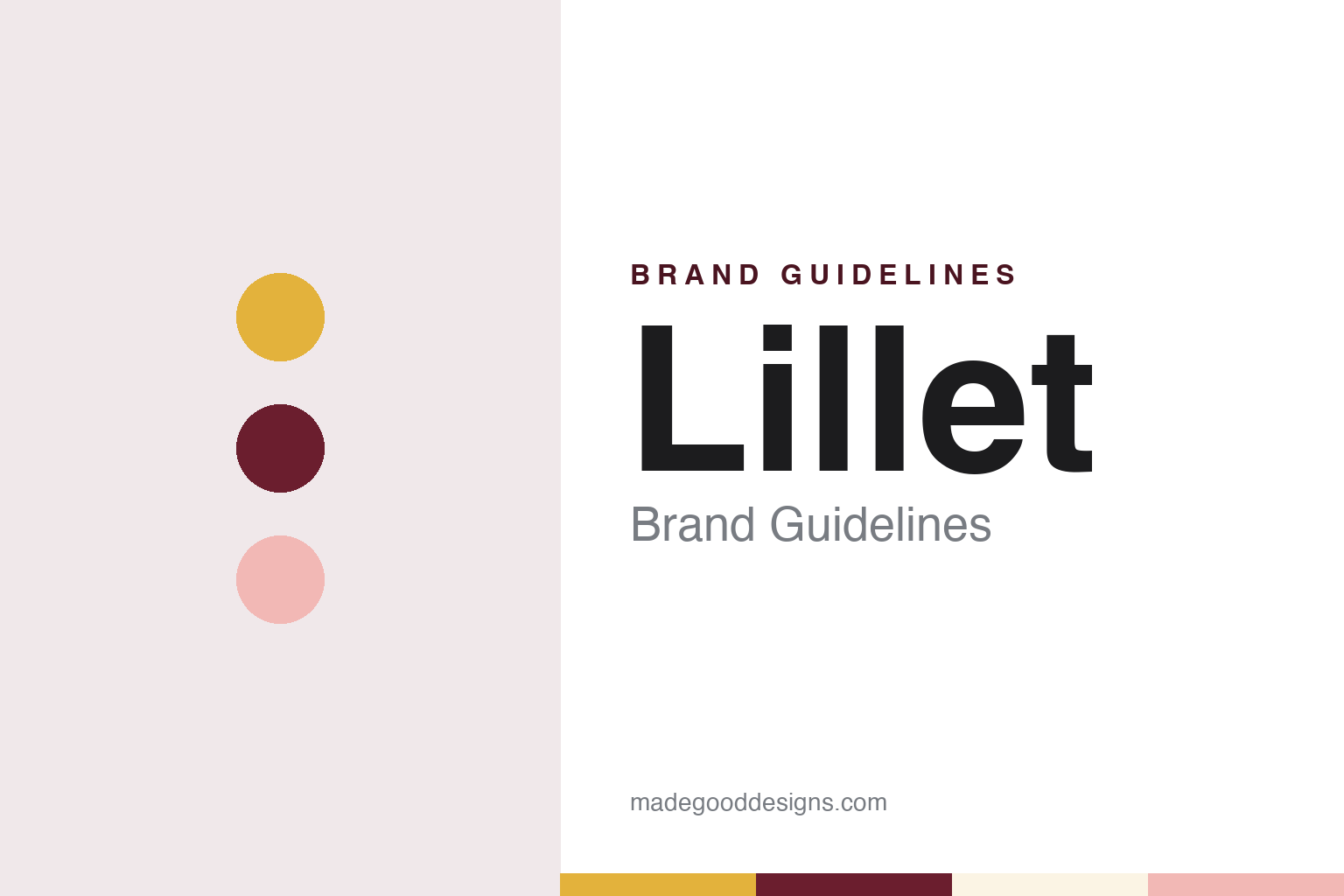
Lillet Brand Guidelines
The Podensac aperitif of 1872, Kina Lillet and La Vendangeuse.
Aa
Two constants: a Blanc gold, claret and rosé pink palette and a Didone serif register. Abstract homage — not a Lillet product or mark; no label, logo, bottle or poster is reproduced.
Lillet Frères
Two brothers, a wine town south of Bordeaux and a quinine aperitif.
Lillet comes from Podensac, a small town in the Gironde, south of Bordeaux. French Wikipedia says the firm Lillet Frères was founded there in 1872 by the brothers Paul and Raymond Lillet, who were liqueur makers and merchants in wine and spirits; the company’s own 2017 press kit tells the same story, describing the brothers as merchants of fine wines, liqueurs and spirits who created a new aperitif in the house’s cellars. French Wikipedia traces the idea back to a Bordeaux doctor, Père Kermann, who it says had travelled to Brazil and later made quinine liqueurs and tonics in Bordeaux.
The drink that made the name was Kina Lillet. English Wikipedia, drawing on the historian Olivier Londeix’s history of the company, published by the Presses universitaires de Bordeaux, dates it to 1887 and says it was originally white. It was a wine-based aperitif flavoured with cinchona bark, the source of quinine, which is where the “Kina” came from. Under European Union rules it is classed as an aromatised wine rather than a spirit or liqueur.
The recipe is still built the same way. English Wikipedia describes a blend of about 85 percent Bordeaux wine, Sémillon for the white and rosé and Merlot for the red, and about 15 percent macerated liqueurs, mostly of citrus fruit. The company says it infuses sweet oranges from Spain and Turkey, bitter oranges from Haiti and cinchona bark from South America in alcohol, presses the fruit after some weeks and then blends the infusions with the wine, a stage it calls vinage; the white and the red then spend several months in oak casks, while the rosé is bottled directly.
Lillet reached the United States after the Second World War. French Wikipedia says the New York merchant Michel Dreyfus brought it there in 1946, and English Wikipedia credits the American importer with suggesting a red version. In 1962, Pierre Lillet, Raymond’s grandson, created Lillet Rouge for the American market, according to both Wikipedias and the company.
Colour
Enamel plates, posters and a grape picker.
Lillet has advertised itself through pictures for well over a century. English Wikipedia, again citing Londeix, lists its first enamelled iron advertising plates in 1896, a first illustrated poster in 1903 drawn by Raymond Lillet himself, and a second, designed by Georges Dol, in 1906.
The image most associated with the brand came later. The company’s 2017 press kit says that in 1937 the French artist Robert Wolff, known by the pseudonym Roby, created “the most striking poster in the brand’s history,” La Vendangeuse, the grape picker, and that it remains well known in France and in the United States. The press kit places it in the interwar years, when Lillet became a fashionable aperitif at official receptions and grand events.
The poster tradition continued. English Wikipedia lists a poster by Roger Seguin on a blue ground in 1967 and, in the brand’s recent history, illustrations by Stina Persson in 2008, a visual campaign by Matthieu Forichon in 2011, illustrations by Sara Singh in 2012 and rooftop photographs by Pauline Daniel in 2014.
The bottle has changed too. The company says Lillet was relaunched in France at the end of the 1980s with a new bottle whose design it calls boldly contemporary for its time. The name changed with it. The press kit says the drink was called Kina Lillet until the 1970s, while Difford’s Guide ties the change to Bruno Borie, a member of a Bordeaux château-owning family, who bought Lillet Frères in 1985 and relaunched the brand in 1986 with a revised recipe and without the word “Kina”; English Wikipedia says the reformulation of 1985 was carried out with the Institute of Oenology of the University of Bordeaux. Today’s white is sold as Lillet Blanc.
Lillet’s best-known appearance is in print. In Ian Fleming’s first James Bond novel, Casino Royale (1953), Bond orders a martini made with gin, vodka and Kina Lillet and names it the “Vesper” after Vesper Lynd; the drink returns in the 2006 film. The company’s press kit links the Vesper to Lillet Dry, a drier version for the British and American markets, which it dates to 1945 and English Wikipedia dates to 1920. French Wikipedia adds that in Thomas Harris’s 1988 novel The Silence of the Lambs, Hannibal Lecter takes his Lillet with ice and a slice of orange.
Typography
Design and documentation.
The seven brands in this group are aperitif, vermouth and liqueur names: Lillet, Suze, Dubonnet, Noilly Prat, Carpano, Cocchi and Licor Beirão. Aperitif, vermouth and liqueur brands in general sit at many different points in the trade, from family houses that still carry a founder’s name to labels that now belong to much larger drinks groups, and a single brand can be sold everywhere from a corner shop to a cocktail bar.
An aperitif, vermouth or liqueur brand’s identity is usually carried less by a single bottle than by a label, a name and the place it promises, because the company behind the name may have changed hands, moved its production or grown far beyond the place where it started. That makes the questions behind each name worth asking plainly: who started it, who owns it now, and where it is actually made and bottled.
Each guide separates what independent sources record from what the company says about itself — its founding story, its owners over time, where its drinks are made and how its labels have changed — and marks plainly what rests only on the company’s own word.
Aa
A high-contrast Didone serif for a Bordeaux aperitif with a poster history. (Specimen set in Playfair Display, a serif STAND-IN; NOT the Lillet logo.)
Lillet
From a family house to a Pernod Ricard brand.
The family era ended in the 1980s. French Wikipedia says the Lillet family sold the company to Bruno Borie in 1985, and that in 2008 the brand was sold to Ricard, a subsidiary of the Pernod Ricard group; the trade title Wine Business International, citing the Bordeaux daily Sud Ouest, reported that Borie was negotiating the sale to Pernod Ricard. The group, which the company’s press kit says was formed in 1975 by bringing together Ricard and Pernod, also owns Ricard pastis.
Lillet is still made in Podensac, where French Wikipedia says the house keeps its headquarters. Under Pernod Ricard the range has grown. The company says Lillet Rosé was launched in 2011 and won a Chairman’s Trophy at the Ultimate Beverage Challenge; English Wikipedia names Jean Bernard Blancheton as the cellar master at the time. The same company material promotes the “Lillet Vive,” Lillet Blanc lengthened with tonic and garnished with cucumber, strawberry and mint, which English Wikipedia says is a familiar long drink in Germany, Austria and Switzerland. French Wikipedia says that by 2024 Germany had become the brand’s largest market, ahead of Austria, France, the United States and Switzerland.
The brand’s visual history has been studied as well as sold. Olivier Londeix’s book on the company, covering the family business up to the Borie sale, is the main source for the dates of its posters and plates; English Wikipedia relies on it for the dates of the work of Raymond Lillet, Georges Dol and Roger Seguin. The company says the 1937 grape picker remains very well known in France and in the United States.
The Vesper is still part of the brand’s own material: the recipe in the company’s 2017 press kit uses Lillet Blanc with gin and vodka.
For a design guide, Lillet shows how a regional aperitif can build a recognisable image from a poster archive, a family name in a single word and three colours of wine, white, red and rosé, carried across more than 150 years and several owners. Compare Ricard, the Marseille pastis of the same group, and Suze, the French gentian aperitif that Pernod Ricard also owns. For this guide we use Blanc gold, claret and rosé pink with a Didone serif, an unofficial interpretation; no product or logo is reproduced.
Explore & save
Keep Lillet’s identity on hand — save it to a board in the Made Good inspiration library.
Lillet identity set
Pin the Lillet Blanc gold, claret and rosé pink palette and the Didone serif register to your own board.