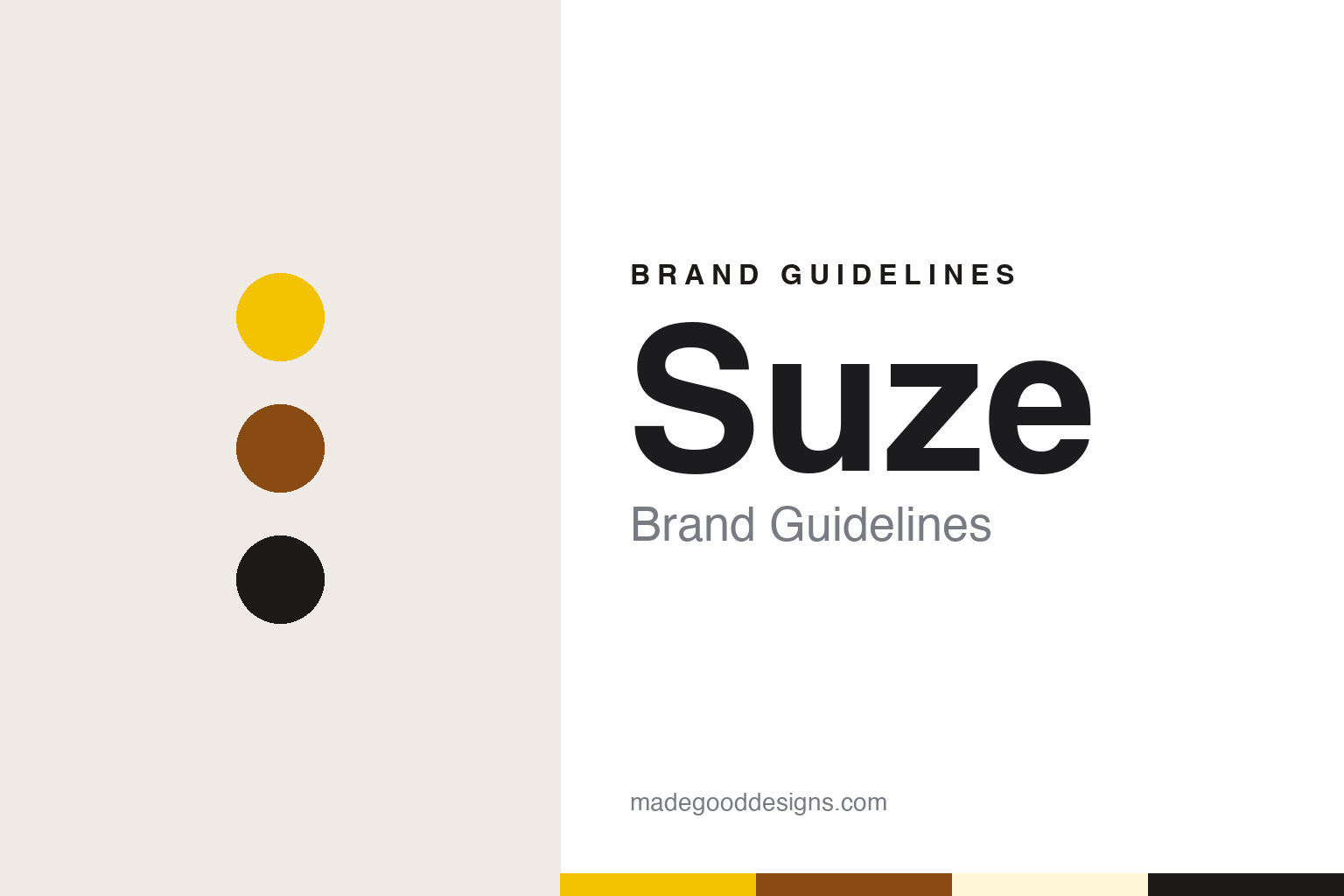
Suze Brand Guidelines
The gentian aperitif of 1889, its tall bottle and Picasso’s collage.
Aa
Two constants: a gentian yellow, amber glass and café black palette and a condensed sans register. Abstract homage — not a Suze product or mark; no label, logo, bottle or artwork is reproduced.
Picotin to Suze
A distiller’s heir, a partner and a root from the mountains.
Suze is a French aperitif made not from wine but from the root of the yellow gentian, a mountain plant. Its own timeline credits Fernand Moureaux, “heir to a distillery,” who it says joined Henri Porte in 1885 to create an aperitif based on gentian roots rather than wine, which the company calls a break with the norm of the time. English Wikipedia says the family distillery Moureaux inherited was at Maisons-Alfort, on the south-eastern edge of Paris.
The public launch came with the Paris Exposition. English Wikipedia says Moureaux first presented the drink as Picotin for the World’s Fair of 1889, and the company says it won a gold medal at the Paris Universal Exhibition, which its timeline dates to 1890; the brand’s bottles carry the line “Depuis 1889,” the Swiss broadcaster swissinfo noted in 2005. In 1898, English Wikipedia says, the name was changed to Suze.
Where that name came from is not settled. English Wikipedia gives two explanations, Moureaux’s sister-in-law Suzanne or the Suze, a river in the Swiss Jura, and swissinfo reported in 2005 that Pernod Ricard’s account favoured the sister-in-law. The same report set out a rival story told in the village of Sonvilier in the Bernese Jura, where a local herbalist, Hans Kappeler, is said to have sold a gentian formula to a French buyer; the writer Raymond Bruckert, quoted by swissinfo, put that sale around 1914, long after Suze was on sale, and the report concluded the full truth would probably never be known.
From the start the company put salesmen on the road. Its timeline says that in 1898 Suze became the first company to have representatives selling its brand in cafés and restaurants, beginning with the restaurants of Les Halles, the Paris market district, a claim that is the company’s own.
Colour
A tall bottle, a yellow drink and a Cubist collage.
The bottle is the brand’s oldest design asset. Suze says it was designed in 1896 by Henri Porte himself, inspired by a long, thin bottle with a short neck that he found in his attic, and that it “has remained unchanged ever since.” The company calls the silhouette monumental and, in describing its 1991 advertising, singles out the drink’s golden-yellow colour and its amber bottle, which it calls unique among aperitifs.
The bottle also entered art history. In 1912 Pablo Picasso made a collage known as La bouteille de Suze (Bottle of Suze), also catalogued as Glass and Bottle of Suze. It belongs to the Mildred Lane Kemper Art Museum at Washington University in St. Louis, which bought it in 1946. The museum describes it as pasted papers, gouache and charcoal, and calls it a key image of Synthetic Cubism: cut newsprint, wallpaper and construction paper suggest a liquor bottle with its label, a glass and an ashtray with a cigarette. The museum notes that the newspaper fragments set reports from the First Balkan War against stories of Parisian frivolity, evoking the café habit of reading the paper over a drink.
Advertising made the name inescapable between the wars. The company says that by the 1920s the Suze name was on walls, vans, jugs and ashtrays, and English Wikipedia says intensive marketing, including sponsorship of the Tour de France in 1933, helped make it one of France’s most popular drinks. English Wikipedia also mentions limited regional flavours in the 1980s, among them a collectible lavender bottle of 1983, the Suze Lavande.
The later campaigns played on the brand’s own history. The company says its 1974 advertising highlighted Suze’s uniqueness and authenticity with an ironic line about copies and counterfeits, and that in 1991 its advertising returned to its roots, leaning on taste, colour and the amber bottle.
Typography
Design and documentation.
The seven brands in this group are aperitif, vermouth and liqueur names: Lillet, Suze, Dubonnet, Noilly Prat, Carpano, Cocchi and Licor Beirão. Aperitif, vermouth and liqueur brands in general sit at many different points in the trade, from family houses that still carry a founder’s name to labels that now belong to much larger drinks groups, and a single brand can be sold everywhere from a corner shop to a cocktail bar.
An aperitif, vermouth or liqueur brand’s identity is usually carried less by a single bottle than by a label, a name and the place it promises, because the company behind the name may have changed hands, moved its production or grown far beyond the place where it started. That makes the questions behind each name worth asking plainly: who started it, who owns it now, and where it is actually made and bottled.
Each guide separates what independent sources record from what the company says about itself — its founding story, its owners over time, where its drinks are made and how its labels have changed — and marks plainly what rests only on the company’s own word.
Aa
A tall condensed sans to echo a tall, narrow bottle. (Specimen set in Oswald, a sans-serif STAND-IN; NOT the Suze logo.)
Suze
From a Paris distillery to a Pernod Ricard brand made at Thuir.
Suze has had one corporate home for six decades. The brand’s timeline says Pernod bought Suze in 1965; ten years later, in 1975, Pernod and Ricard came together to form Pernod Ricard, according to the group’s own boilerplate, and Suze has belonged to that group ever since. The same group owns the anise brands Pernod and Ricard.
Production moved south. The company says that by 2003 Suze was produced at Pernod Ricard’s historic distillery in Thuir, in the Pyrénées-Orientales in the south of France, and it credits the site’s design to Gustave Eiffel. VinePair reported in September 2023 that the Thuir site is the Caves Byrrh, home of another French aperitif, and that Suze became available in the United States in 2012. The brand’s site lists Suze L’Originale and a Suze Tonic 0%.
The brand also has a place in cocktail culture, through the White Negroni, a variation that swaps Suze in for the red Italian bitter of the classic Negroni, as VinePair described in 2023.
The Swiss origin story is the brand’s one long-running dispute. Sonvilier’s claim for Hans Kappeler rests on local memory, swissinfo reported in 2005: Kappeler never filed a patent, and a binder of documents on the case had gone missing from the village’s small museum. Pernod Ricard’s version, with Moureaux and Porte, is the one printed on the brand’s own timeline.
The name needs care online. Suze is also the name of a river in the Swiss Jura, and the brand’s own site is suze.com.
For a design guide, Suze shows how a single bottle shape, kept for well over a century, and a single colour, the yellow of the drink inside, can hold a brand together through café advertising, a Picasso collage and a change of owner. Compare Lillet, the Bordeaux aperitif of the same group, and Pernod, the anise brand that bought Suze. For this guide we use gentian yellow, amber glass and café black with a condensed sans, an unofficial interpretation; no product or logo is reproduced.
Explore & save
Keep Suze’s identity on hand — save it to a board in the Made Good inspiration library.
Suze identity set
Pin the Suze gentian yellow, amber glass and café black palette and the condensed sans register to your own board.


