Crown Royal Brand Guidelines
Seagram’s 1939 royal-tour whisky in the purple bag.
Aa
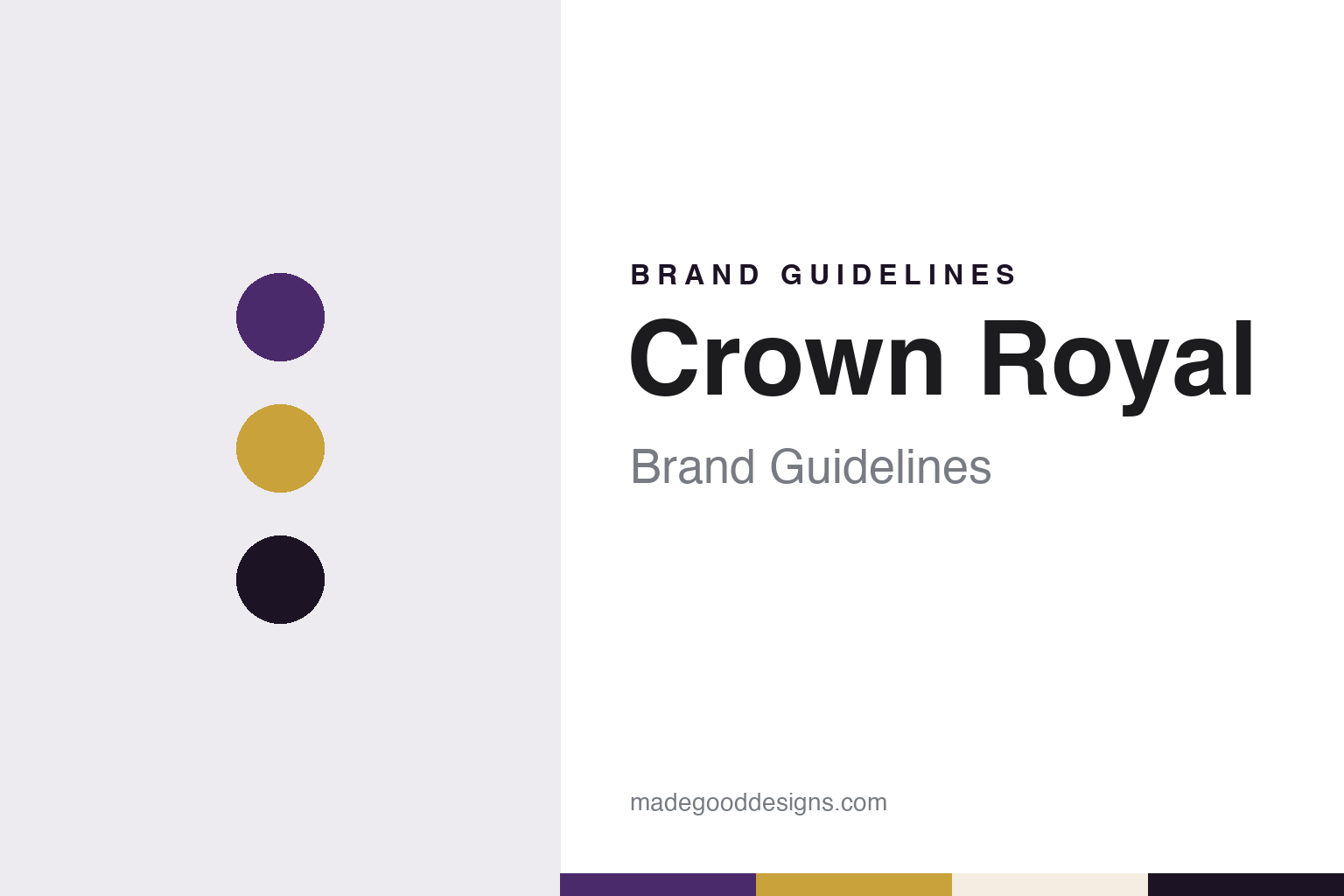
Two constants: a royal purple, stitch gold and night palette and an engraved capital serif register. Abstract homage — not a Crown Royal product or mark; no bottle, bag or logo is reproduced.
A whisky for a royal tour
Seagram, Samuel Bronfman and the spring of 1939.
Crown Royal was introduced in 1939 by Samuel Bronfman, the president of the Canadian distiller Seagram, as a tribute to that year’s royal tour of Canada by King George VI and Queen Elizabeth, English Wikipedia says, citing the brand’s own history and the Royal Household. Bronfman’s business had begun in Montreal in 1924, when he and his brothers founded Distillers Corporation Limited, which later took the Seagram name, according to English Wikipedia’s history of Seagram.
The origin story the brand tells is a story of a single occasion. The company says the King and Queen were the first reigning monarchs to visit Canada, that Bronfman tried more than 600 blends before settling on one made from roughly fifty whiskies, and that ten cases of it were loaded onto the Royal Train that carried the couple across the country. The same account says the finished whisky went into a cut-glass decanter inside a purple bag with gold stitching. These details rest on the company’s word.
For its first quarter-century Crown Royal stayed at home. English Wikipedia, citing the company and The North American Whiskey Guide from Behind the Bar (2014), says the whisky was sold only in Canada until 1964, when it was introduced to the United States and other international markets.
Ownership changed when Seagram itself was broken up. Vivendi Universal, which had acquired Seagram, agreed on 19 December 2000 to sell the Seagram spirits and wine business jointly to Diageo and Pernod Ricard, and the sale completed on 21 December 2001, after the US Federal Trade Commission cleared it, Diageo’s annual filings with the US Securities and Exchange Commission record. Crown Royal went to Diageo, together with Seagram’s V.O., Sterling Vineyards and Captain Morgan; Pernod Ricard took brands including Chivas Regal, The Glenlivet and Martell. The Morning Advertiser reported on 20 December 2001 that the FTC had required Diageo to give up Malibu as a condition of the deal.
Colour
A purple bag, a gold drawstring and a crown on the bottle.
Few spirits are recognised as readily by their packaging as Crown Royal. English Wikipedia describes the original whisky’s purple felt-like bag closed with a gold tasselled drawstring, and the whiskey writer Mark Littler, in The Whiskey Wash in May 2025, described its crown-shaped bottle wrapped in that purple bag and said the bag first appeared with the 1939 tribute whisky. The company itself ties the colour to royalty.
The bag has become a colour code for the range. English Wikipedia lists a tan bag for Crown Royal Reserve, introduced in 1992; a black one for Crown Royal Black, introduced in 2010; a green one for Regal Apple, introduced in November 2014; and a peach one for the Peach whisky of 2019. Other releases have followed: XO in January 2014, finished in cognac casks; Northern Harvest Rye in May 2015; Vanilla in 2016; Blackberry in early 2024; a Single Malt in June 2024; and Marquis, finished in Caribbean rum casks, in 2025, according to the same article.
One of those releases drew particular attention. Northern Harvest Rye was named World Whisky of the Year in Jim Murray’s Whisky Bible 2016, the retailer The Whisky Exchange reported when the guide’s winners were announced. English Wikipedia also records that the standard whisky won gold medals at the San Francisco World Spirits Competition between 2005 and 2012.
The brand has carried its colours into motor racing. English Wikipedia says Crown Royal was title sponsor of the International Race of Champions from 2004 to 2006, sponsored Jamie McMurray’s No. 26 car from 2006 to 2009 and Matt Kenseth’s No. 17 Ford Fusion in 2010 and 2011, and lent its name to the Crown Royal American Turf Stakes at Churchill Downs from 1995 to 2008.
Typography
Design and documentation.
The seven brands in this group are all North American whiskey names: Bulleit, Woodford Reserve, Buffalo Trace, Four Roses, Knob Creek, Evan Williams and Crown Royal. Whiskey brands in general sit at many different points in the trade, from names that still carry a founder or a distillery to labels that now belong to much larger drinks groups, and a single brand can be sold everywhere from a corner shop to a bar shelf.
A whiskey brand’s identity is usually carried less by a single bottle than by a label, a name and the place it promises, because the company behind the name may have changed hands, moved its production or grown far beyond the place where it started. That makes the questions behind each name worth asking plainly: who started it, who owns it now, and where its whiskey is actually distilled, aged and bottled.
Each guide separates what independent sources record from what the company says about itself — its founding story, its owners over time, where its whiskey is made and how its labels have changed — and marks plainly what rests only on the company’s own word.
Aa
An engraved capital serif for a regal wordmark. (Specimen set in Cinzel, a serif STAND-IN; NOT the Crown Royal logo.)
Crown Royal
Distilled on Lake Winnipeg, bottled in more than one place.
The whisky is made at Gimli, Manitoba, on the shore of Lake Winnipeg. English Wikipedia, citing the company, says Crown Royal is produced solely at the Gimli distillery, and the company says its barrels are stored in 56 warehouses on the site. The distillery was built by Seagram; the whisky database whisky.com dates it to 1968, while the reference site Whiskipedia gives 1969. Seagram’s older Ontario distillery at Waterloo closed in the early 1990s, English Wikipedia says, leaving Gimli as the brand’s distilling home.
Bottling has been a separate matter. English Wikipedia says Crown Royal was blended and bottled at Amherstburg, Ontario, near Windsor. BNN Bloomberg reported on 28 August 2025 that Diageo would close the Amherstburg plant in February 2026, and WhiskyCast reported that Diageo planned to move most Crown Royal bottling to its plants in the United States, while bottling for Canada and markets outside the US would continue at Valleyfield, Quebec; Diageo said the whisky would continue to be mashed, distilled and aged in Canada. The decision became a political story: on 2 September 2025 Ontario Premier Doug Ford poured out a bottle of Crown Royal at a news conference in Kitchener in protest at the closure, CBC News and CP24 reported.
The name needs a little care. Crown Royal is not the same brand as Seagram’s Seven Crown, which English Wikipedia lists as a Diageo product, or Seagram’s V.O., another Canadian whisky that passed to Diageo in the same sale. The brand’s own site is crownroyal.com.
For a design guide, Crown Royal shows how a single colour, a drawstring bag and a crowned bottle, all tied to one royal occasion in 1939, can identify a whisky across more than eight decades and several owners. Compare Captain Morgan, the rum that also passed from Seagram to Diageo, and Chivas Regal, the Seagram blended Scotch that went to Pernod Ricard. For this guide we use royal purple, stitch gold and night with a serif, an unofficial interpretation; no product or logo is reproduced.
Explore & save
Keep Crown Royal’s identity on hand — save it to a board in the Made Good inspiration library.
Crown Royal identity set
Pin the Crown Royal royal purple, stitch gold and night palette and the engraved capital serif register to your own board.