Laurent-Perrier Brand Guidelines
The Tours-sur-Marne house behind Grand Siècle and Cuvée Rosé.
Aa
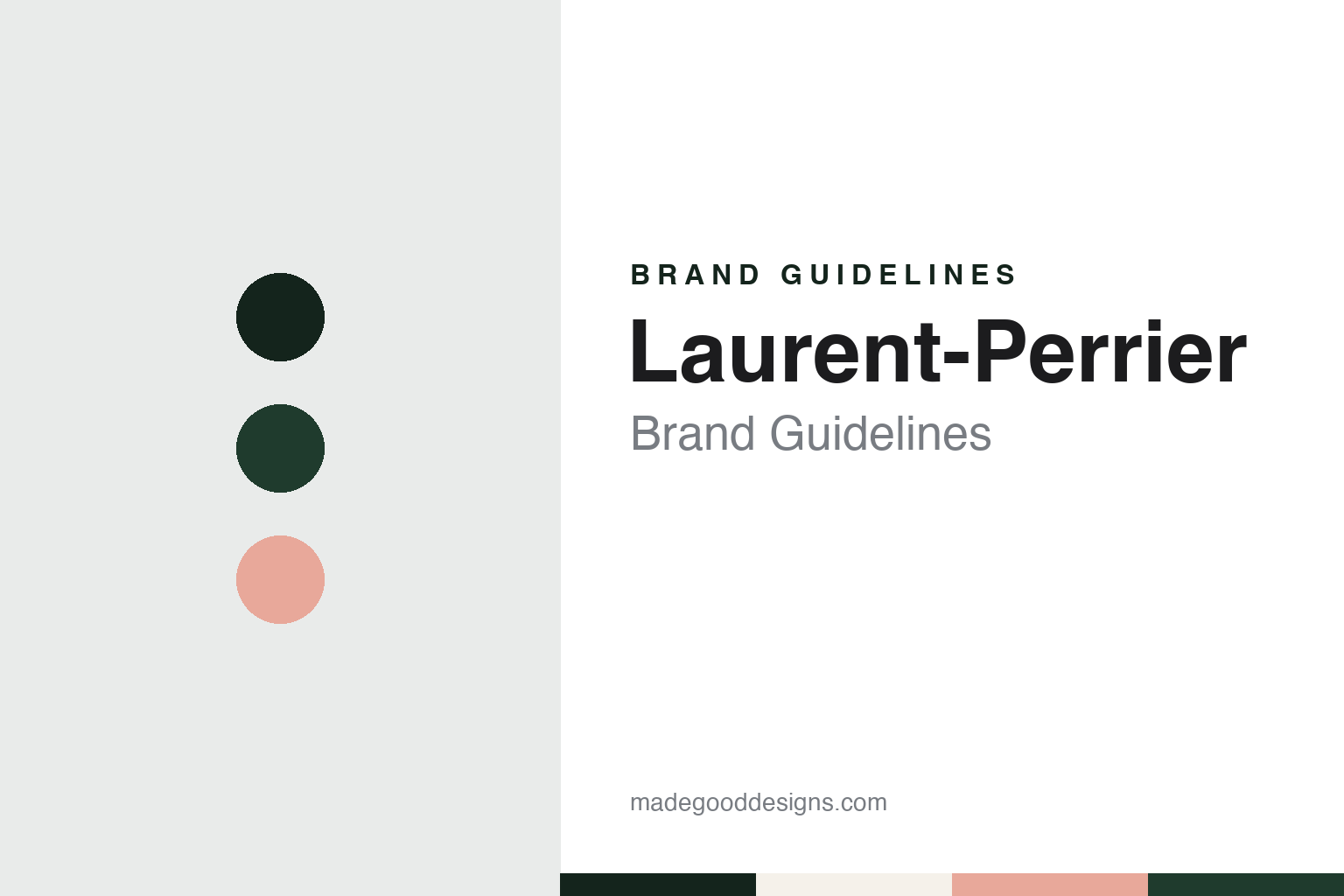
Two constants: a forest green, rosé salmon and chalk white palette and a high-contrast serif register. Abstract homage — not a Laurent-Perrier product or mark; no bottle, label or logo is reproduced.
Pierlot, Laurent and Perrier
A cooper’s firm, a cellar master and a widow’s name.
Laurent-Perrier dates itself to 1812 in Tours-sur-Marne, in the Marne. The company says it was founded by André-Michel Pierlot, a former cooper and bottler from Chigny-les-Roses who settled there as a champagne merchant. The Union des Maisons de Champagne, the trade body of the champagne houses, records that on 28 December 1812 a mark was registered in his name at the Reims commercial court, and says he worked within the walls of a former Cistercian abbey. English Wikipedia names the founder as Alphonse Pierlot; the company names Alphonse as André-Michel’s son and successor.
With no heirs of his own, Alphonse Pierlot left the business to his cellar master, Eugène Laurent, the company says. French Wikipedia, dating the inheritance to 1881, says Laurent bought houses in Tours-sur-Marne, acquired vines in Bouzy, Ambonnay and Tours-sur-Marne, and dug some 800 metres of cellars. In 1887 the house passed to his widow, Mathilde-Émilie Perrier, who joined their two surnames, and it became Veuve Laurent-Perrier. The company says she launched a “Grand Vin Sans Sucre” in 1889 to suit her own taste and that of her British customers, and the trade body lists partners who joined in 1887, 1905 and 1920, among them the Briton Sir Alexander Fletcher Keith Mackenzie.
In 1925 the house passed to her daughter, Eugénie-Hortense Laurent. The Union des Maisons de Champagne says it declined steadily under her and her husband, Henri Couvreur, until it stopped trading. On 22 May 1939, by the trade body’s date, it was taken over by Marie-Louise de Nonancourt, born a Lanson and a sister of Victor and Henri Lanson, who entrusted the rescue to Henry Gondry of the Lanson house; Radio France Internationale and Decanter both gave the year of purchase as 1938 when they wrote about the family in 2010. French Wikipedia says Laurent-Perrier then ranked about 100th among champagne houses.
Colour
Bernard de Nonancourt and the cuvées.
Her son Bernard de Nonancourt took over in 1948, after training at Lanson and Delamotte; Radio France Internationale reported in 2010 that he had served in the Resistance and with General Leclerc’s 2nd Armoured Division. The company says the house then had about 20 employees and sold 80,000 bottles. The trade body records more than a million bottles in 1967 and 6.8 million in 1999, and Decanter wrote in November 2010, after his death that October, that Laurent-Perrier had become the world’s third best-selling champagne brand by 2005.
Several cuvées came out of those decades. Grand Siècle, a blend of grand crus from the Montagne de Reims and the Côte des Blancs drawn from three vintages, was launched in September 1955, according to the Union des Maisons de Champagne; Decanter said de Nonancourt conceived it in 1953 and introduced it in 1960. In 1968 came the Cuvée Rosé, made from pinot noir by skin maceration. In 1981 the house launched Ultra Brut, a champagne with no added dosage that the trade body traces back to the 19th-century Grand Vin Sans Sucre. The company names the blending of reserve wines, the maceration of pinot noir and non-dosage as its three areas of expertise.
The house also became a group. In 1983, the trade body says, Laurent-Perrier took 34% of De Castellane, rising to full ownership in 1999; it bought Salon in 1988 and Delamotte in 1989. French Wikipedia adds the 2004 purchase of Château Malakoff, owner of the Beaumet, Jeanmaire and Oudinot houses, citing Les Échos. The company says the group was listed on the Paris stock exchange in 1999, and that Bernard de Nonancourt’s daughters Alexandra Pereyre de Nonancourt and Stéphanie Meneux de Nonancourt sit on its management board, which Stéphane Dalyac has chaired since 2014. The house describes itself as family-owned and independent. Its cellar masters, the company says, have been Édouard Leclerc from 1950, Alain Terrier from 1983, Michel Fauconnet from 2004 and now Olivier Vigneron.
Typography
Design and documentation.
The seven brands in this group are all champagne houses: Taittinger, Laurent-Perrier, Krug, Mumm, Lanson, Piper-Heidsieck and Ruinart. Champagne houses in general sit at many different points in the trade, from firms that still carry a founding family’s name to names that now belong to much larger drinks groups, and a single house can be sold everywhere from a wine merchant to a supermarket shelf.
A champagne house’s identity is usually carried less by a single wine than by a label, a name and the occasion its bottles promise, because the company behind the name may have changed hands, bought or sold vineyards or grown far beyond the cellars where it started. That makes the questions behind each name worth asking plainly: who started it, who owns it now, and where its wines are actually made and aged.
Each guide separates what independent sources record from what the house says about itself — its founding story, its owners over time, where its wines are made and how its labels and packaging have changed — and marks plainly what rests only on the house’s own word.
Aa
A high-contrast serif for a house that dresses its wines in old bottle shapes. (Specimen set in Bodoni Moda, a serif STAND-IN; NOT the Laurent-Perrier logo.)
Laurent-Perrier
A 17th-century shape and a rosé bottle.
Much of Laurent-Perrier’s design story is told through its bottles. The Union des Maisons de Champagne says Grand Siècle was presented from the start in a bottle with a lengthened neck and a rounded body, a form dating from the 17th century. Decanter wrote in 2010 that the Cuvée Rosé, sold in a specially shaped bottle, proved a hit with drinkers. The house has also attached its name to people and events: the trade body lists tributes to Commandant Cousteau in 1973 and to the Airbus A320 in 1987, and says the house bought the Château de Louvois in 1989 as its guest house, a château once owned by the Le Tellier family, ministers of Louis XIV. The cuvée’s name also travels as an award: Terre de Vins reported in April 2014 that the house’s Prix Grand Siècle had gone to Karl Lagerfeld. Its wordmark and labels are covered in our separate Laurent-Perrier font guide.
For a design guide, Laurent-Perrier shows how a house revived in 1939 built its name on a handful of cuvées — Grand Siècle, Cuvée Rosé and Ultra Brut — and the bottles that carry them. Compare Lanson, the Reims house of Marie-Louise de Nonancourt’s brothers, and Taittinger, another house led today by its founding family. For this guide we use a deep forest green, a rosé salmon and chalk white with a high-contrast serif, an unofficial interpretation; no product or logo is reproduced.
Explore & save
Keep Laurent-Perrier’s identity on hand — save it to a board in the Made Good inspiration library.
Laurent-Perrier identity set
Pin the Laurent-Perrier forest green, rosé salmon and chalk white palette and the high-contrast serif register to your own board.