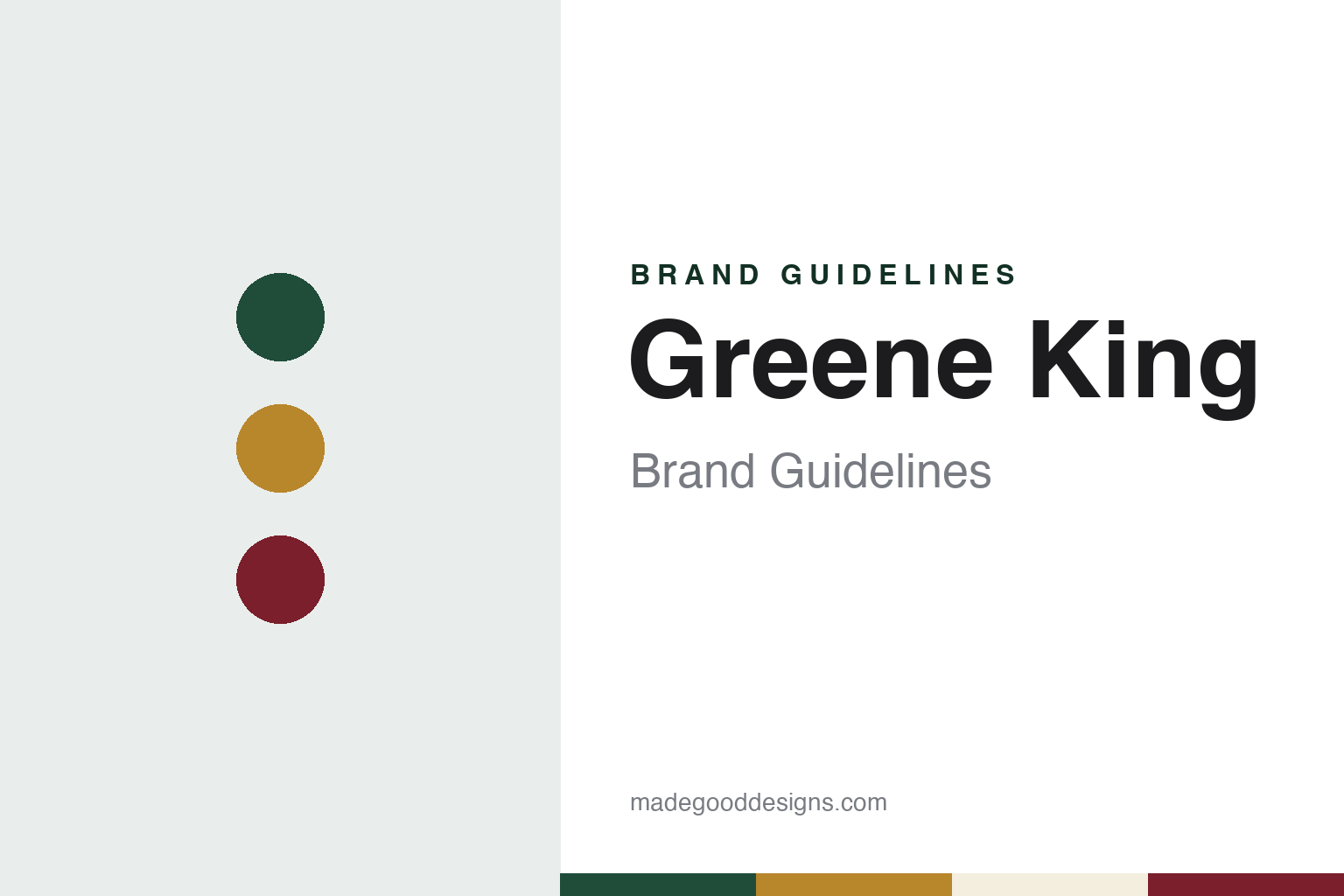
Greene King Brand Guidelines
The Bury St Edmunds brewer and pub company, dated 1799.
Aa
Two constants: an abbey green, ale amber and claret palette and a classic book serif register. Abstract homage — not a Greene King product or mark; no label, logo or pump clip is reproduced.
A Suffolk town and two brewing families
From a Westgate brewery to a merger of names.
Greene King is a brewer and pub company based in Bury St Edmunds, the Suffolk market town that grew up around its medieval abbey. The company gives 1799 as its founding year and names Benjamin Greene as its founder, and English Wikipedia follows that date. The biography of Greene in the Oxford Dictionary of National Biography, as summarised on English Wikipedia, adds detail: Greene’s first brewing partnership in the town, with John Clark, dates from 1801, and in 1806 he set up with William Buck at the Westgate Brewery, the venture that became Greene King. The company’s own timeline also records the Westgate purchase with Buck in 1806, and the Westgate Brewery is still where the company brews.
The business passed down the family. English Wikipedia, citing the History of Parliament’s Victorian Commons project, says Edward Greene took over in 1836; he later sat as Conservative MP for Bury St Edmunds from 1865. In 1887 the Greene business merged with the brewery of Frederick William King, a neighbouring Bury brewer, and the joined names became the company’s name.
Through the twentieth century Greene King grew by buying smaller breweries and pubs across East Anglia and beyond, a pattern that defined it for the next hundred years. English Wikipedia lists Rayments Brewery in 1961 as one early purchase.
Colour
An abbot, an IPA and a hen.
The beer most tied to the town is Abbot Ale. Greene King says it was introduced in 1951 and named through a competition that year, in which a local publican suggested the name, in keeping with the town’s abbey history; the company credits its chief brewer of the time, Bernard Tickner, with the recipe. A 2023 item from the British Guild of Beer Writers also dates the first brew to 1951 at Bury St Edmunds.
The company’s best-known pint is Greene King IPA, a session bitter that won gold in the bitter category at CAMRA’s Great British Beer Festival in 2004, English Wikipedia says; Gold and Reserve variants followed in 2012. The third pillar came by acquisition. Greene King bought the Morland brewery of Abingdon in 1999, The Guardian reported, and with it Old Speckled Hen, a beer Morland first brewed in 1979 and Greene King has brewed since.
The pattern of buying continued. English Wikipedia, citing BBC News and The Guardian, lists Morrells in 2002, Ridley’s and the Scottish brewer Belhaven of Dunbar in 2005, and Hardys & Hansons in 2006. Belhaven, like Westgate, remains a Greene King brewery, the British Guild of Beer Writers noted in 2023. On the pub side the company bought the Hungry Horse chain in 1996 and the Spirit Pub Company in 2015; when that deal completed on 23 June 2015, The Daily Telegraph reported, Greene King had 3,116 sites and was the largest managed pub company in the UK.
The founder’s history became part of the company’s public record in June 2020. Records compiled by University College London’s Legacies of British Slave-ownership project show that Benjamin Greene claimed compensation under the Slavery Abolition Act 1833 for 231 enslaved people on Montserrat and St Kitts, and chief executive Nick Mackenzie issued an apology, calling it inexcusable that a founder had profited from slavery and argued against its abolition, and pledging investment to benefit Black, Asian and minority ethnic communities, ITV News and The Guardian reported on 17 and 18 June 2020.
Typography
Design and documentation.
The seven brands in this group are all British beer names: Fuller’s, Greene King, Adnams, BrewDog, Theakston, Old Speckled Hen and Shepherd Neame. Beer brands in general sit at many different points in the trade, from family brewers that still carry a founder’s name to labels that now belong to much larger drinks groups, and a single brand can be sold everywhere from a corner shop to a pub bar.
A beer brand’s identity is usually carried less by a single bottle than by a pump clip, a label, a name and the place it promises, because the company behind the name may have changed hands, moved its brewing or grown far beyond the town where it started. That makes the questions behind each name worth asking plainly: who started it, who owns it now, and where its beer is actually brewed and packaged.
Each guide separates what independent sources record from what the company says about itself — its founding story, its owners over time, where its beer is brewed and how its labels have changed — and marks plainly what rests only on the company’s own word.
Aa
A classic book serif for a two-family brewing name. (Specimen set in Libre Baskerville, a serif STAND-IN; NOT the Greene King logo.)
Greene King
A listed brewer turned a privately held pub group.
For decades Greene King was listed on the London Stock Exchange. That ended in 2019. In August 2019 CK Asset Holdings, the Hong Kong property group founded by Li Ka-shing, announced a proposed takeover, BBC News reported. Shareholders voted for the deal on 9 October 2019, the High Court approved it later that month, Food Manufacture reported, and the Morning Advertiser reported on 31 October 2019 that the deal had completed. Greene King left the stock market and new directors from the CK side joined the board, while chief executive Nick Mackenzie stayed on to run the business with the existing management team.
Under its new owner Greene King has remained both a brewer and one of Britain’s largest pub operators, running brands such as Hungry Horse alongside its own houses and tenanted pubs. The Times reported in March 2026 that the company planned to sell 150 pubs to concentrate on its core estate.
The name is easy to search for and easy to misread. The company’s site is greeneking.co.uk; the spelling carries a final “e” on Greene, after the founding family.
For a design guide, Greene King shows how a two-family name, a market town and an abbey can anchor a brewer through more than two centuries of mergers, acquisitions and a change of ownership. Compare Adnams, the Suffolk brewer of Southwold, and Fuller’s, the London brewer of Chiswick. For this guide we use abbey green, ale amber and claret with a serif, an unofficial interpretation; no product or logo is reproduced.
Explore & save
Keep Greene King’s identity on hand — save it to a board in the Made Good inspiration library.
Greene King identity set
Pin the Greene King abbey green, ale amber and claret palette and the classic book serif register to your own board.