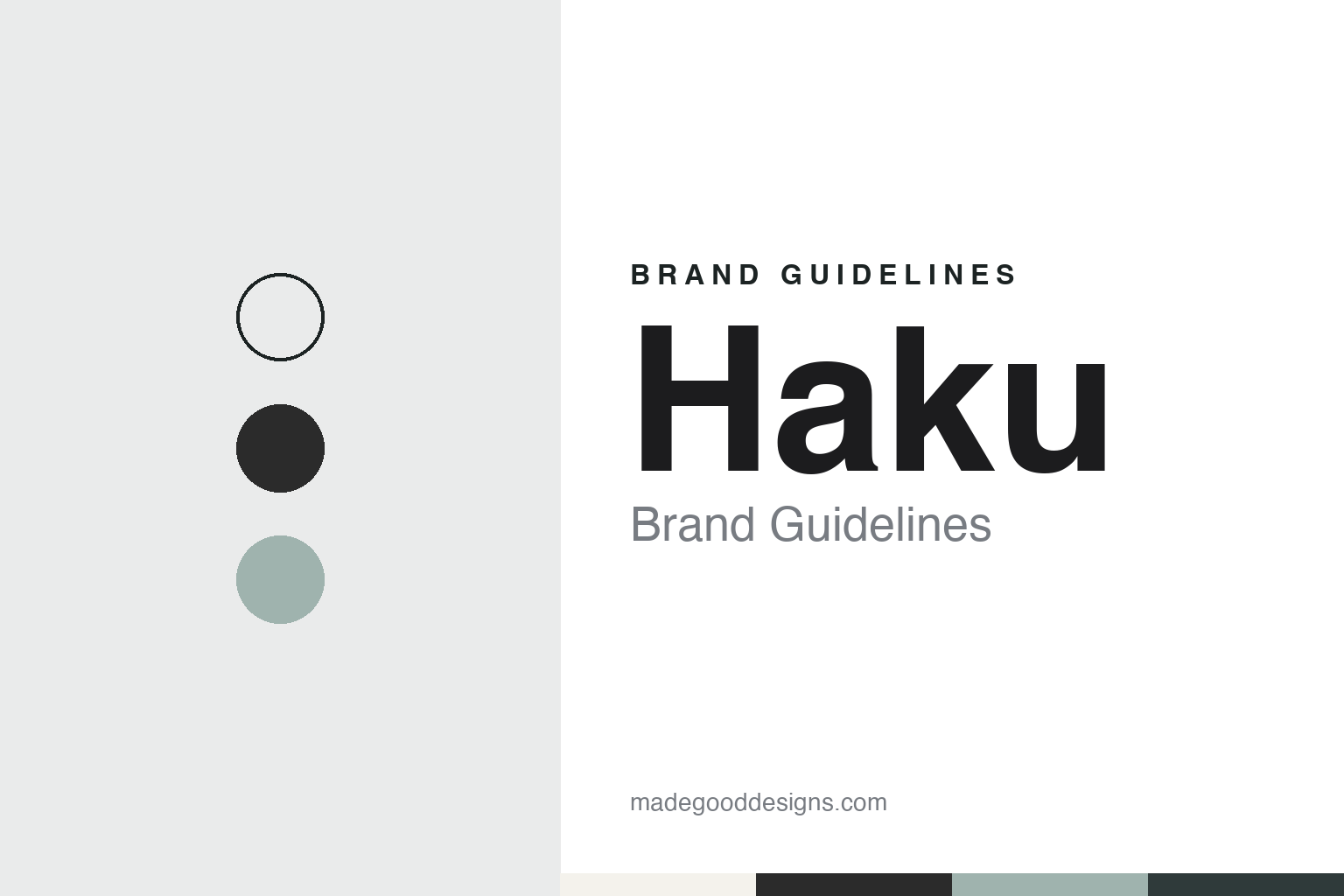
Haku Brand Guidelines
Suntory’s rice vodka from Kagoshima and Osaka, launched in 2018.
Aa
Two constants: a rice white, bamboo charcoal and stream green palette and a Mincho serif register. Abstract homage — not a Haku product or mark; no bottle, label or logo is reproduced.
The third Japanese spirit
A rice vodka that followed a gin and a whisky into the House of Suntory range.
Haku is a vodka made by Suntory, the Japanese drinks group that began as Shinjiro Torii’s wine shop in Osaka, and it is sold under the company’s House of Suntory banner alongside its Japanese whiskies and gin. The name is the Japanese word haku, written with the character for “white” — a reference to the white rice from which the spirit is distilled.
The vodka was launched abroad before it was sold at home. The Japanese business daily Nikkan Kogyo Shimbun reported on 10 October 2018 that Beam Suntory, the American spirits arm of Suntory Holdings, had launched the craft gin Roku and the Japanese-rice craft vodka Haku in the United States. The Japanese drinks site Nomunication, citing Kyodo News in October 2018, wrote that the vodka was aimed first at luxury hotels and Japanese restaurants rather than ordinary liquor stores, and that launches in Japan and Europe were planned for the following year. Beverage Industry listed Haku among its new products on 22 October 2018.
The other markets followed in 2019. The Morning Advertiser reported on 10 April 2019 that the House of Suntory had introduced Haku to the British on-trade, and Suntory says the vodka made its Japanese debut in April 2019. In Australia, Food & Drink Business reported in August 2019 that Haku would reach liquor stores nationwide from September that year, describing it as the third launch in a premium range that already included Roku gin and Toki whisky, and as the House of Suntory’s first premium craft Japanese vodka.
Colour
Rice from Kagoshima, charcoal from bamboo and a bottle that suggests moving water.
The making of Haku is split between two places, and the company tells the story in that order. Production begins in Kagoshima, the prefecture at the southern tip of Kyushu that is known for its distilled spirits. There, the Morning Advertiser reported in 2019, Japanese white rice is fermented with koji rice into a mash and distilled, first in pot stills and then again through pot and column stills. The spirit then travels to Osaka, where it is blended and filtered through bamboo charcoal. Food & Drink Business named the site as Suntory’s Liquor Atelier in Osaka.
The bamboo charcoal is the brand’s signature step. Suntory describes the filtration as a proprietary method that absorbs impurities and gives the vodka a smooth character, and in 2018 it told Beverage Industry that the process leaves a delicately sweet and subtle flavour. Those are the company’s descriptions of its own product. At the British launch in 2019 Kazuyuki Torii, then Suntory’s specialist for gin and spirits, recommended the vodka neat, on the rocks or as a Haku-Hi, with chilled soda water and a twist of lemon peel.
The bottle carries much of the identity, and the company’s account of it has developed over time. In the 2018 launch material printed by Beverage Industry, Suntory said the curved lines on the bottle represented streams glistening through nature in Japan as they run through the four seasons. The House of Suntory’s current product page describes the glass as embossed with a pattern inspired by rice stems moving in the wind, and says the label is made from traditional washi paper in honour of Japanese crafts, including calligraphy in bamboo charcoal ink. Both readings point the same way: the bottle is meant to be read as a piece of Japanese craft before it is read as a vodka.
Typography
Design and documentation.
The seven brands in this group are vodka, liqueur and gin names: Svedka, Wyborowa, Beluga, Haku, Fireball, Passoã and Whitley Neill. Spirits brands in general sit at many different points in the trade, from family houses that still carry a founder’s name to labels that now belong to much larger drinks groups, and a single brand can be sold everywhere from a corner shop to a hotel bar.
A spirits brand’s identity is usually carried less by a single bottle than by a label, a name and the place it promises, because the company behind the name may have changed hands, moved its production or grown far beyond the place where it started. That makes the questions behind each name worth asking plainly: who started it, who owns it now, and where its spirit is actually distilled, blended and bottled.
Each guide separates what independent sources record from what the company says about itself — its founding story, its owners over time, where its spirit is made and how its bottles and labels have changed — and marks plainly what rests only on the company’s own word.
Aa
A Mincho serif for a rice spirit dressed in washi. (Specimen set in Shippori Mincho, a serif STAND-IN; NOT the Haku logo.)
Haku
A small brand inside a large group, and its first global campaign.
Haku belongs to a company that has changed its own name since the vodka appeared. Beam Suntory was formed in 2014, when Suntory took over the American bourbon maker Beam, and the business was renamed Suntory Global Spirits in 2024; Global Drinks Intel names Suntory Global Spirits as the vodka’s producer. Within that group Haku sits in the House of Suntory portfolio of Japanese spirits, beside Roku gin and the Toki, Hibiki, Yamazaki and Hakushu whiskies.
For most of its life the brand was promoted market by market. That changed in September 2026, when Global Drinks Intel reported that Suntory Global Spirits was giving Haku its first global marketing push. The campaign, called “Made to Shine” and organised by the House of Suntory business unit, included digital and social work, events and cocktail masterclasses in New York, and named the singer and actor Rina Sawayama as the brand’s first global ambassador, with a video advertisement rolling out in markets including Australia, Britain and the United States. The campaign, the report said, was meant to draw on international interest in Japanese culture and on the reputation of Tokyo’s cocktail bars.
The name needs a little care. Haku is a common Japanese word and also a given name, familiar to many from the river spirit in Hayao Miyazaki’s film Spirited Away, so searches for the vodka are best made with “Suntory” or “vodka” attached.
For a design guide, Haku shows how a spirit with almost no colour of its own can build an identity from material and process — rice, bamboo charcoal, washi and a bottle textured like moving water or wind through rice. Compare Suntory, the Osaka group behind it, and Gekkeikan, the Kyoto sake house that also turns Japanese rice into a drink. For this guide we use rice white, bamboo charcoal and stream green with a serif, an unofficial interpretation; no product or logo is reproduced.
Explore & save
Keep Haku’s identity on hand — save it to a board in the Made Good inspiration library.
Haku identity set
Pin the Haku rice white, bamboo charcoal and stream green palette and the Mincho serif register to your own board.