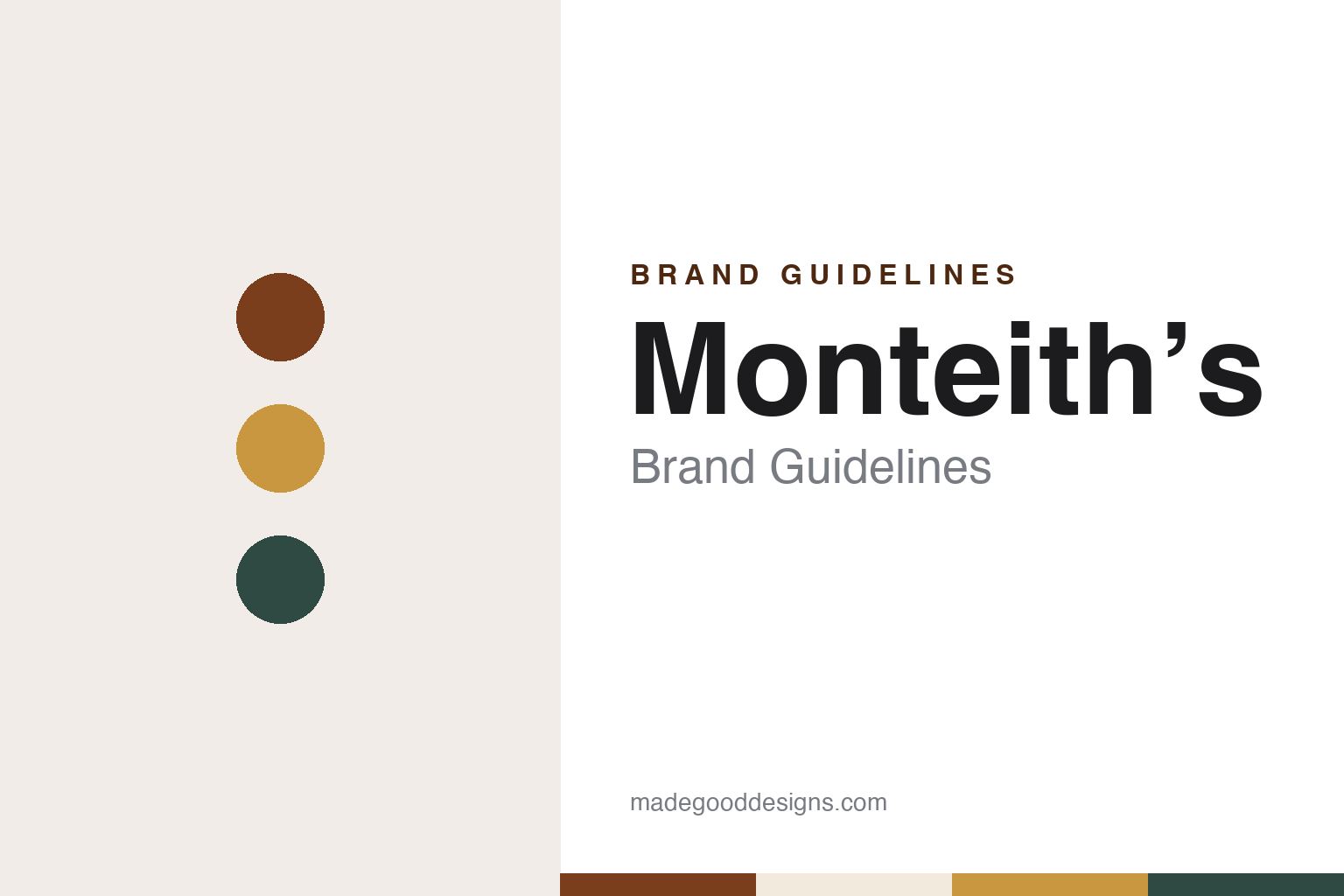
Monteith’s Brand Guidelines
The West Coast beer dated to Reefton in 1868.
Aa
Two constants: a copper, malt gold and slate green palette and a sturdy heritage serif register. Abstract homage — not a Monteith’s product or mark; no label, logo or bottle is reproduced.
A Reefton brewer and the Phoenix Brewery
A gold-town brewery, a merger and a central plant in Greymouth.
Monteith’s traces its story to Reefton, a gold-mining town on the West Coast of New Zealand’s South Island. The company says its legacy begins in 1868, when Stewart Monteith joined the Phoenix Brewery in Reefton as head brewer and a shareholder, and that he took full ownership of the brewery in 1890. During those years, the company says, many of the brewery’s beers carried the Monteith name and locals knew the business as “Monteith’s Brewery.” The beer writer Michael Donaldson, reporting for Brews News in November 2020, spells the brewer’s first name Stuart and notes that the brewery itself was called Phoenix.
In 1927 the Phoenix Brewery merged with a group of small West Coast breweries to form a new company headed by Monteith’s son, William, the company says. English Wikipedia names the towns of the merged breweries as Reefton, Hokitika and Kumara and says the new Westland Breweries was based on Turumaha Street in Greymouth; Brews News says that is the site of the present brewery. According to English Wikipedia, the Greymouth site had only a bottling plant until 1949, when a central brewery began to take over the work of the group’s other plants, and the original Phoenix Brewery in Reefton made its last beer in 1963.
In 1969 the West Coast company joined the Dominion Breweries group, the company says, and English Wikipedia says the brewery then became known as DB Westland Breweries. Under DB the Greymouth brewery kept making its own beers, among them a Monteith’s ale, which the company describes as one of the only Westland brands still in production by 1990.
Colour
A family name, a trademark and “since 1868” on every label.
The Monteith’s name as a brewery brand is much younger than its founding date. The company says that in 1990, to recognise the family’s legacy, the Westland company was renamed the Monteith’s Brewing Company, the name was trademarked, and “since 1868” was added to all of its communications and packaging. In a December 2020 article for Pursuit of Hoppiness, Donaldson argued that Monteith’s as a brand has existed only since 1990 and called its link to the original brewer tenuous. English Wikipedia also gives 1990 for the rename, while Donaldson’s Brews News report of November 2020 dates it to 1993.
The brand soon became bound up with the Coast itself. English Wikipedia says DB closed the Greymouth brewery on 22 March 2001 and reopened it four days later after a public outcry. RNZ, reporting in August 2024, said the 2001 plan had been to move production to Auckland, and that the backlash forced DB to relent and keep brewing some of the range in Greymouth. Brews News described the 2001 campaign as nationwide protests that made DB reverse its decision.
In 2012 DB rebuilt the Greymouth site as a new-look brewery and taproom, the company says; English Wikipedia says the transformed brewery was officially reopened on 25 July 2012 after 18 months of refurbishment. The company now calls the Greymouth brewery a Qualmark Gold visitor experience. Marking what it counts as 150 years of brewing, Monteith’s launched a campaign called “Brewed for Right Now” in 2018, and in 2022 it moved into cans for the first time with two hazy beers, West Coastin’ Hazy IPA and Gold Dust Hazy Pale Ale, alongside its Phoenix IPA, the company says.
Typography
Design and documentation.
The seven brands in this group are all New Zealand beers: Speight’s, Steinlager, Monteith’s, Tui, Lion Red, Panhead and Emerson’s. Most of them belong to one of two brewing groups. Lion, owned by Japan’s Kirin since it bought Lion Nathan in 2009, owns Speight’s, Steinlager and Lion Red, all of which trace back to the old New Zealand Breweries, as well as two younger names it bought: Emerson’s, the Dunedin brewery it took over in November 2012, and Panhead, the Upper Hutt brewery it agreed to buy in May 2016. DB Breweries, founded in 1930 and part of Heineken since Heineken bought out Asia Pacific Breweries in 2012, owns Tui and Monteith’s.
A beer brand’s identity is usually carried less by the liquid than by a name, a label, a can and years of advertising, and the company behind the name may have changed hands, moved its brewing or grown far beyond the town it started in. Some of these names are more than a century old — Speight’s was founded in Dunedin in 1876 — while others are recent: the Monteith’s name has been used for the Greymouth brewery only since 1990, and Steinlager took its name in 1962, four years after it was launched as Steinecker. That makes the questions behind each name worth asking plainly: who started it, who owns it now, and where its beer is actually brewed today.
Each guide separates what independent sources record from what the company says about itself — its founding story, its owners over time, where its beer is made and how its labels and advertising have changed — and marks plainly what rests only on the company’s own word.
Aa
A sturdy heritage serif for a beer that puts its founding date on the label. (Specimen set in Playfair Display, a serif STAND-IN; NOT the Monteith’s logo.)
Monteith’s
From a West Coast brewery to DB and Heineken.
Monteith’s belongs to DB Breweries, the Auckland brewer founded in 1930 by Henry Kelliher and W. J. Coutts, English Wikipedia says. DB has owned the business since the West Coast company joined its group in 1969. English Wikipedia says Asia Pacific Breweries acquired DB in 2004 and was itself bought by Heineken in 2012; it lists DB’s parent today as Heineken Asia Pacific.
The beer is no longer brewed commercially on the West Coast. In November 2020 DB proposed moving commercial production out of Greymouth to its other New Zealand breweries, with up to seven jobs at risk, Brews News and 1News reported; Brews News added that most of the beer was already brewed in Timaru or Auckland and that DB said the Monteith’s gastropub and brewery experience would stay open. RNZ reported in August 2024 that, after a 2020 announcement, DB had moved all remaining Monteith’s production to its Timaru and Auckland breweries. The company still invites visitors to its brewery experience in Greymouth.
The range today is split, the company says, between the Classics — Monteith’s Original, Golden Lager, Summer Ale and Radler — and a changing Batch Brewed range. The Radler name has a history of its own: in July 2011 the Intellectual Property Office of New Zealand ruled that DB could keep its trademark on the word “Radler,” The New Zealand Herald reported, after a challenge led by the Society of Beer Advocates. The brand also runs the Monteith’s Wild Food Challenge, which the company says brought together more than 60 restaurants, pubs and eateries around the country in May 2026.
For a design guide, Monteith’s shows how a family name and a date on the label can become a whole identity, and how a town can stay at the centre of a brand’s story after the brewing moves elsewhere. Compare Tui, another DB beer with a regional brewery home, and Tiger Beer, the Singapore lager of Asia Pacific Breweries, now in the Heineken group. For this guide we use copper, malt gold and slate green with a sturdy serif, an unofficial interpretation; no product or logo is reproduced.
Explore & save
Keep Monteith’s’s identity on hand — save it to a board in the Made Good inspiration library.
Monteith’s identity set
Pin the Monteith’s copper, malt gold and slate green palette and the sturdy heritage serif register to your own board.


