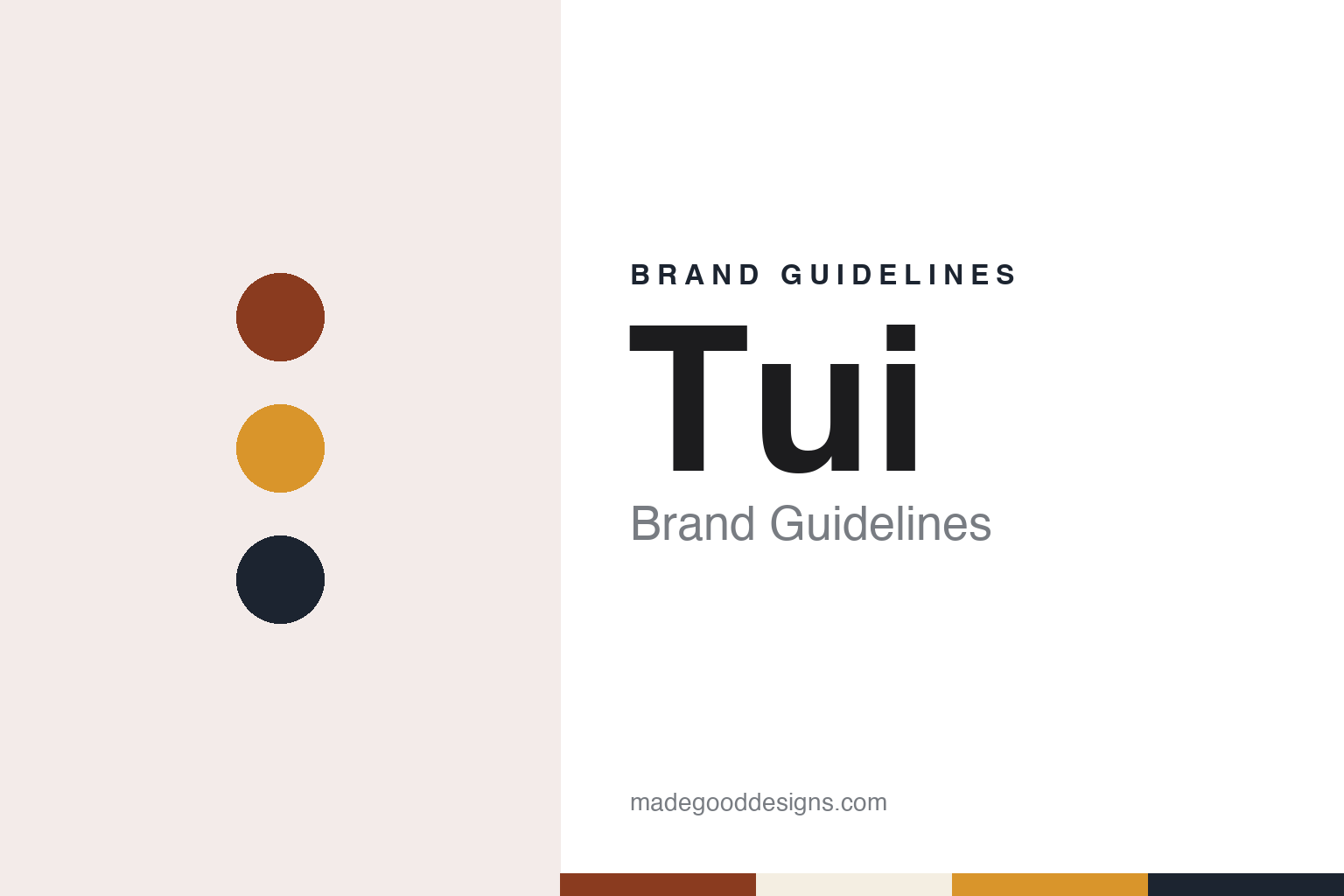
Tui Brand Guidelines
The 1889 Mangatainoka beer behind “Yeah Right.”
Aa
Two constants: a brick red, amber and blue-black palette and a bold condensed sans register. Abstract homage — not a Tui product or mark; no label, logo, billboard or bottle is reproduced.
A sawmiller’s brewery and a brick tower
From Wagstaff’s brewery to Tui Brewery Ltd.
Tui began as a small country brewery at Mangatainoka, in the Tararua District of the lower North Island. Heritage New Zealand says the former sawmiller Henry Wagstaff started brewing there in 1889, and that by 1893 the local paper was praising the reputation of his beer. The brand gives the same start, saying Tui was first brewed on the banks of the Mangatainoka River in 1889 by Wagstaff; English Wikipedia names Edward Russell alongside him as a founder.
The brewery changed hands early. Heritage New Zealand says Wagstaff sold the business in 1903 to Henry Cowan, a cooper from Auckland, who renamed it the North Island Brewery, and that in 1923 the company became Tui Brewery Ltd. The tūī that gives the beer its name is a native New Zealand bird, English Wikipedia notes. In 1931 the company built the structure that still anchors the brand: a seven-storey brick brew tower in the Stripped Classical style, built so that brewers could use gravity to turn malt into beer, according to Heritage New Zealand, which entered the tower on its list as a Category 1 historic place in 1989.
In 1964 the brewery won a three-year contract to brew Guinness, which led to a new plant, and in 1969 it was sold to Dominion Breweries, Heritage New Zealand says. For most of its life the beer stayed regional. The brand itself says that for more than 100 years Tui was “the best kept secret” of the bars of the Wairarapa and Hawke’s Bay.
Colour
A statement, a reply and a country in on the joke.
Tui became a national name through advertising. Its “Yeah Right” billboards set a short, plainly untrue statement above the brand’s two-word reply, and English Wikipedia, citing Stuff, dates the campaign from 1997. Campaign Brief reported in October 2024 that Saatchi & Saatchi led the original billboards, and quoted Sean Cummins, founder of the agency cummins&partners, saying he wrote the campaign while in New Zealand, supported by art director Jason Ross and Richard Maddocks. The brand still credits its following to quality beer and what it calls viral advertising.
The lines regularly drew complaints. English Wikipedia, citing 3 News, records a billboard about texting while driving that was pulled down after a complaint in May 2009, a complaint upheld in November 2012 over a billboard about Kim Dotcom, and controversy in April 2013 over a billboard that followed New Zealand’s legalisation of same-sex marriage. In 2010, English Wikipedia says, a church that parodied the format with its own billboard was threatened with legal action; 3 News reported in June 2010 that DB would buy the church a new billboard.
Lincoln University historian Greg Ryan told RNZ in 2024 that the billboards of the late 1990s and early 2000s, together with the beer’s strong student links, made Tui a national brand rather than a Manawatū and Wairarapa one. Accounts of when the billboards stopped differ: English Wikipedia, citing Stuff, says the campaign ran until 2016, while Campaign Brief said the billboards ran for sixteen years until 2013. In October 2024 DB brought them back, with Saatchi & Saatchi leading the creative, Special handling public relations and dentsu Aotearoa handling media, Campaign Brief reported.
Typography
Design and documentation.
The seven brands in this group are all New Zealand beers: Speight’s, Steinlager, Monteith’s, Tui, Lion Red, Panhead and Emerson’s. Most of them belong to one of two brewing groups. Lion, owned by Japan’s Kirin since it bought Lion Nathan in 2009, owns Speight’s, Steinlager and Lion Red, all of which trace back to the old New Zealand Breweries, as well as two younger names it bought: Emerson’s, the Dunedin brewery it took over in November 2012, and Panhead, the Upper Hutt brewery it agreed to buy in May 2016. DB Breweries, founded in 1930 and part of Heineken since Heineken bought out Asia Pacific Breweries in 2012, owns Tui and Monteith’s.
A beer brand’s identity is usually carried less by the liquid than by a name, a label, a can and years of advertising, and the company behind the name may have changed hands, moved its brewing or grown far beyond the town it started in. Some of these names are more than a century old — Speight’s was founded in Dunedin in 1876 — while others are recent: the Monteith’s name has been used for the Greymouth brewery only since 1990, and Steinlager took its name in 1962, four years after it was launched as Steinecker. That makes the questions behind each name worth asking plainly: who started it, who owns it now, and where its beer is actually brewed today.
Each guide separates what independent sources record from what the company says about itself — its founding story, its owners over time, where its beer is made and how its labels and advertising have changed — and marks plainly what rests only on the company’s own word.
Aa
A bold condensed sans for a beer best known from billboards. (Specimen set in Oswald, a sans STAND-IN; NOT the Tui logo.)
Tui
From a Tararua brewery to DB and Heineken.
DB Breweries, the Auckland brewer founded in 1930 as Dominion Breweries, has owned Tui since it bought the Mangatainoka brewery in 1969. English Wikipedia says Asia Pacific Breweries acquired DB in 2004 and was itself bought by Heineken in 2012; it lists DB’s parent today as Heineken Asia Pacific.
Tui is no longer brewed at Mangatainoka. RNZ reported in August 2024 that DB had closed the main production plant there in 2015, installing a smaller brewery to supply its taproom and the local community with specialty beers, and that after pandemic restrictions in 2020 and 2021 it shifted the remaining production to its Timaru and Auckland breweries in 2021. DB marketing director Fraser Shrimpton told RNZ that Mangatainoka remains “the spiritual home of Tui,” with the Tui HQ café and bar and the brewery tower, which DB had earthquake-strengthened. In August 2024 DB stopped selling brewery tours at the site and offered a beer-tasting experience instead, RNZ reported.
The flagship is Tui East India Pale Ale, a 4% pale lager, English Wikipedia says, and the brand lists Tui Golden Lager and Tui Dark beside it. The range now reaches beyond beer: the company says it launched Tui Brewed Vodka Sodas in 2019, and it also sells the low-carb Tui Ultra and canned vodka drinks in lemon, red and blue.
For a design guide, Tui shows how a regional lager named after a native bird, with a heritage brick tower as its landmark, can be carried across a whole country by a single two-word line of copy. Compare Monteith’s, the West Coast beer DB also owns, and Speight’s, the Dunedin beer of the rival Lion group. For this guide we use brick red, amber and blue-black with a bold condensed sans, an unofficial interpretation; no product or logo is reproduced.
Explore & save
Keep Tui’s identity on hand — save it to a board in the Made Good inspiration library.
Tui identity set
Pin the Tui brick red, amber and blue-black palette and the bold condensed sans register to your own board.


