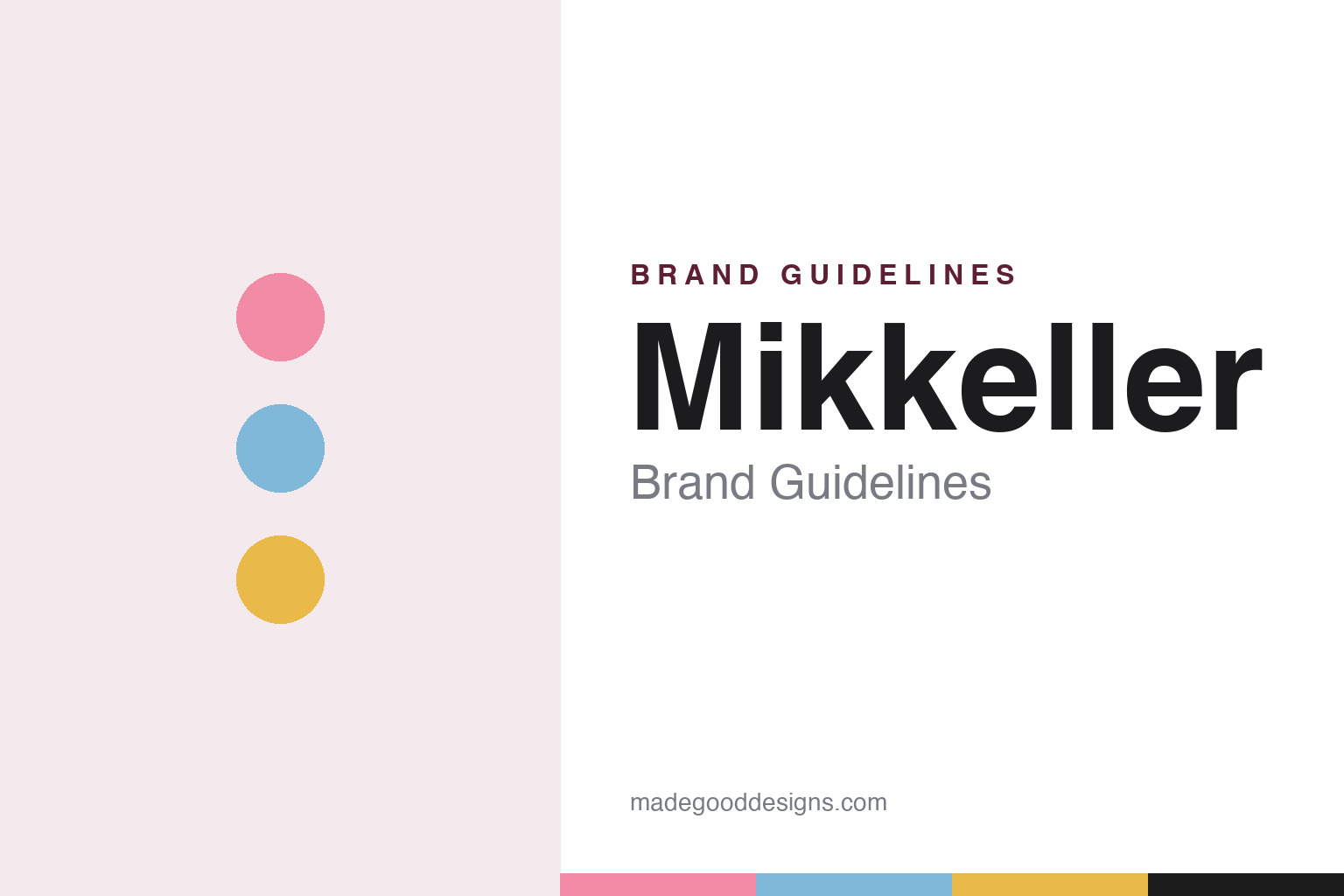
Mikkeller Brand Guidelines
The Copenhagen brewer behind Keith Shore’s label characters.
Aa
Two constants: a label pink, sky blue and mustard palette and a rounded friendly sans register. Abstract homage — not a Mikkeller product or mark; no label, character, logo or can is reproduced.
Two home brewers in Copenhagen
From a kitchen experiment to a brewery without a brewery.
Mikkeller was founded in Copenhagen in 2006 by two home brewers, Mikkel Borg Bjergsø, a school teacher, and the journalist Kristian Klarup Keller. English Wikipedia, citing the company’s own history, says the pair began by trying to clone existing beers, went on to write their own recipes and entered Danish home-brewing competitions, and named the company after their home-brewing operation. An oatmeal coffee stout called Beer Geek Breakfast brought the young company early attention in late 2006.
The partnership was short. Danish Wikipedia says the brewery was run by Bjergsø alone from 2007, and English Wikipedia, citing a 2012 interview on the food site Food GPS, says Keller left to return to journalism while Bjergsø wanted to keep creating new recipes.
What made Mikkeller unusual was how it brewed. Rather than build a brewery, it rented time and equipment at other people’s, a model the beer world calls “gypsy” or “cuckoo” brewing. English Wikipedia says the company has brewed mainly at De Proefbrouwerij in Belgium, as well as at host breweries in Denmark, Norway, the United Kingdom and the United States. The model allowed a stream of new beers: when First We Feast profiled the company in January 2014, it said Mikkeller had produced more than 600 beers in eight years, sold in 40 countries. A Christmas beer, Santa’s Little Helper, has been a fixture since the early years, Danish Wikipedia notes.
Bars followed the beer. Danish Wikipedia says the first Mikkeller Bar opened in the Vesterbro district of Copenhagen in 2010, and that a second, Mikkeller & Friends, opened in Nørrebro in March 2013, a venture with the younger Copenhagen brewer To Øl. English Wikipedia records a licensed bar in San Francisco from July 2013 and a bar in Bangkok from January 2014, and reports that Mikkeller opened its first brewery of its own in San Diego in April 2016, in a building previously used by AleSmith, citing the San Diego Union-Tribune. From 2012 the company has also run an annual beer festival in Copenhagen, renamed Mikkeller Beer Celebration Copenhagen in 2017.
Colour
Henry, Sally and a bright, limited palette.
Mikkeller’s look belongs largely to one illustrator. First We Feast reported in January 2014 that the Philadelphia-based designer Keith Shore had first come across the brand at his local beer shop, admired the labels and contacted Bjergsø, and that his first label for Mikkeller was for I Hardcore You, a collaboration with the Scottish brewer BrewDog. PhillyVoice reported in June 2017 that Mikkeller had hired Shore as a freelancer in 2010; First We Feast said he joined the team full-time as art director in August 2013.
The labels are built around characters. Shore told First We Feast that the Mikkeller characters were based on drawings he had been playing with before he started working for the brewery, and that his designs rely on characters and colour to tell the story, with typography taking “a backseat.” The magazine described his work as deceptively childlike, with cartoonish figures, bold lines and a bright but limited palette, and listed Esther Pearl Watson, David Hockney and Henri Matisse among the artists he admired. Each label, he said, began in his sketchbook before being scanned and refined in Illustrator, and he was often working on 10 to 20 labels at once. PhillyVoice quoted Shore as saying he had begun developing a character in the hope that, if people liked it, the brewery could not let him go. Mikkeller’s print shop says two of his early figures grew into the brewery’s label mascots, a couple it calls Henry & Sally.
The labels have also been a place for special effects and guest collaborators. PhillyVoice described a beer label for Scandinavian Airlines printed with glow-in-the-dark ink meant to show up under black light, and It’s Nice That reported in October 2017 that Shore and the illustrator Ben Kopp drew three cans for a Twin Peaks beer made with David Lynch for Lynch’s Festival of Disruption, aiming, in Shore’s words, for “minimal colours and imagery.”
The work has since passed to a second hand. Mikkeller’s print shop says Shore has withdrawn from the brewery’s day-to-day operation to run his own business, and that his longtime assistant designer, Luke Cloran, has created most of Mikkeller’s art in recent years.
Typography
Design and documentation.
The seven brands in this group are all Nordic beer names: Mikkeller, To Øl, Nøgne Ø, Aass, Karhu, Lervig and Amager Bryghus. They span two centuries of brewing. Aass was founded in Drammen in 1834 and is still owned by the Aass family, English Wikipedia records; Karhu is a Finnish beer brand that belongs to the brewer Sinebrychoff, part of the Carlsberg Group. The rest are products of the craft-beer wave that began around the turn of this century: Nøgne Ø in Grimstad in 2002, Lervig in Stavanger in 2003, Mikkeller in Copenhagen in 2006, Amager Bryghus on the island of Amager in 2007 and To Øl in Copenhagen in 2010.
A beer brand’s identity is usually carried less by a single bottle than by a name, a label and the place it promises, because the company behind it may have changed hands, taken on investors or moved its brewing somewhere else entirely. Some of these names began as “gypsy” brewers that rented other breweries’ equipment before, in some cases, building their own; others became part of larger brewing groups. That makes the questions behind each name worth asking plainly: who started it, who owns it now, and where its beer is actually brewed.
Each guide separates what independent sources record from what the company says about itself — its founding story, its owners over time, where its beer is brewed and how its labels and cans have changed — and marks plainly what rests only on the company’s own word.
Aa
A rounded, friendly sans for a label world led by drawing. (Specimen set in Fredoka, a sans-serif STAND-IN; NOT the Mikkeller logo.)
Mikkeller
A founder-led brewery with two outside shareholders.
Mikkeller remains led by its founder, but not wholly owned by him. Good Beer Hunting reported in December 2021 that the US investment firm Orkila Capital had invested in Mikkeller in 2020 and again in late 2021, the second time to support the business as it recovered from the pandemic; the then chief executive, Kenneth Madsen, told the publication the 2021 deal did not change the controlling stakes.
In January 2024 a second outside shareholder joined. The Danish broadcaster DR and The Local Denmark reported on 16 January 2024 that Carlsberg had agreed to buy a 20 percent minority stake in Mikkeller, in a deal due to take effect in late 2024, with Carlsberg distributing Mikkeller beer through its sales channels and Mikkeller’s bars and restaurants unaffected. Both reported that Bjergsø would keep a majority of the shares and remain chief executive. The trade site Inside.beer reported the same day that Orkila Capital would remain the second-largest shareholder. Carlsberg Denmark’s chief executive, Peter Haahr Nielsen, told Inside.beer that Carlsberg had an interest in Mikkeller keeping its special character.
The brand has also travelled through partnerships. English Wikipedia, citing The Guardian in 2018, records two London pubs opened with the singer Rick Astley, and says a Mikkeller brewery at Citi Field in New York, announced in 2017, closed in 2020.
For a design guide, Mikkeller shows how a brewery with hundreds of short-run beers can hold together through an illustrator’s cast of characters and a bright, limited palette rather than a fixed label template. Compare To Øl, the Copenhagen brewery started by two of Bjergsø’s former students, and Tuborg, the Copenhagen lager brand Carlsberg also owns. For this guide we use label pink, sky blue and mustard with a rounded sans, an unofficial interpretation; no product or logo is reproduced.
Explore & save
Keep Mikkeller’s identity on hand — save it to a board in the Made Good inspiration library.
Mikkeller identity set
Pin the Mikkeller label pink, sky blue and mustard palette and the rounded friendly sans register to your own board.