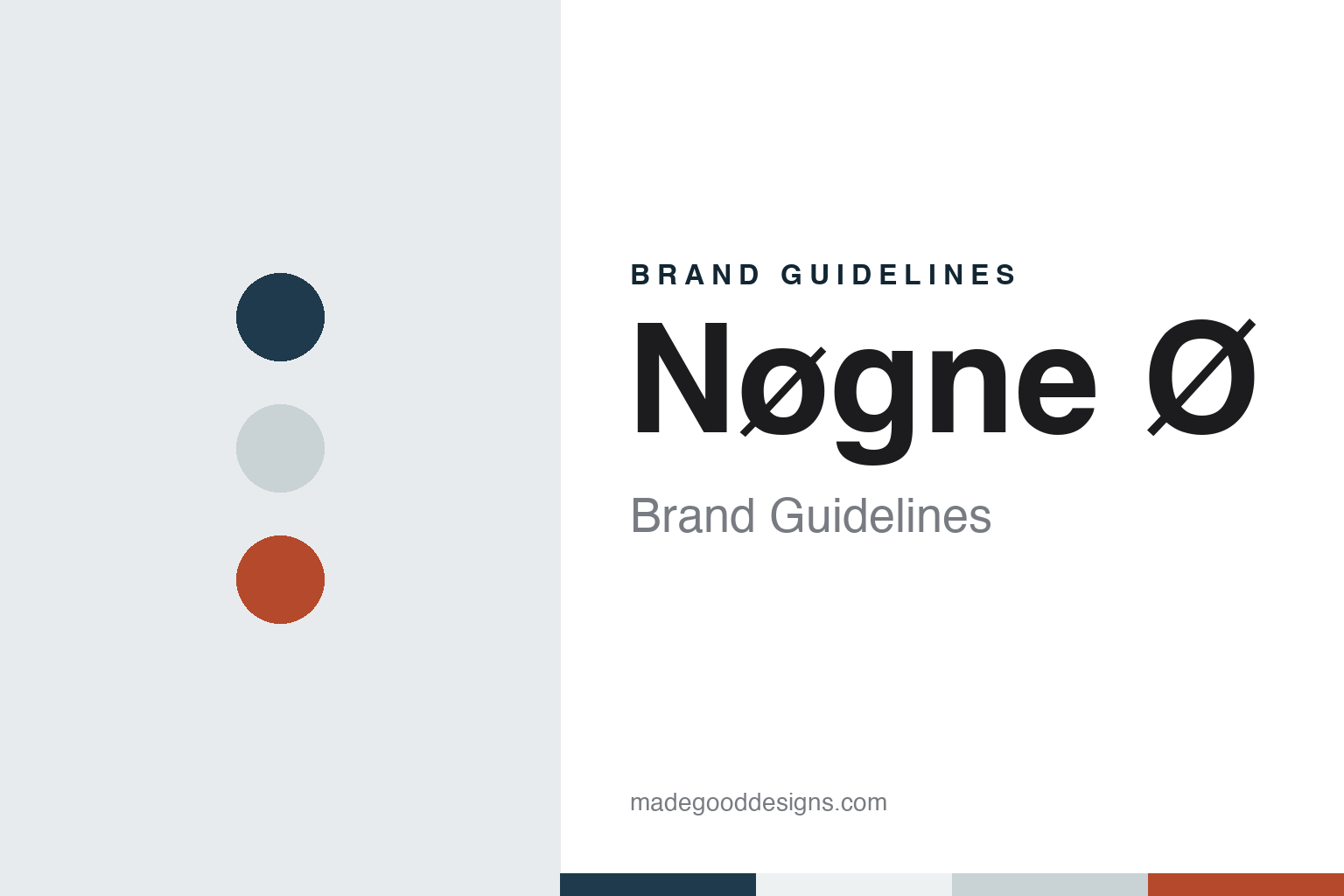
Nøgne Ø Brand Guidelines
The Grimstad brewery named from an Ibsen poem, founded 2002.
Aa
Two constants: a skerry blue, sea mist and rust buoy palette and a heavy grotesque sans register. Abstract homage — not a Nøgne Ø product or mark; no label, logo or bottle is reproduced.
A garage in Grimstad and a line from Ibsen
Two home brewers, a southern Norwegian town and a name from a poem.
Nøgne Ø was founded in 2002 in Grimstad, a small coastal town in the Agder region of southern Norway, by Gunnar Wiig and Kjetil Jikiun, English and Norwegian Wikipedia say. The company says the brewery started in a garage at Bergemoen in Grimstad, and that the first years ran on volunteer work and slow sales before the business could stand on its own feet.
The name is literary. Nøgne Ø means “naked island” in Norwegian, and the company says it is taken from Henrik Ibsen’s epic poem Terje Vigen. Ibsen lived in Grimstad in his youth, the brewery notes, and much of the poem is set among the islands and skerries of the Grimstad archipelago, so the name ties the beer to the bare rocks off the town’s own shoreline. When the brewery sold its majority stake in 2013, its managing director and head brewer said, in remarks quoted in Hansa Borg’s annual report, that Nøgne Ø had grown from a garage into a national brand and that its ties to Norway and to Sørlandet, the southern coast, were a large part of its identity. The full company name, Nøgne Ø – Det Kompromissløse Bryggeri, adds a second line of identity: the uncompromising brewery, a phrase the company still uses on its English-language site, alongside the slogan “There are no rules!”
Grimstad has stayed the home of the brewery throughout, though the building has changed. The company says it moved in 2005 into the old Rygene power station, near the municipal border with Arendal, Norwegian Wikipedia adds, and that a new brewery building beside the old power station was brought into use in 2016. English Wikipedia, citing BeerBay Magazine, dates the move to the new facilities to June 2017. Either way the brewery has not left the Rygene site, and the company says it now keeps around twenty regular beers, brews twenty-five to thirty new ones a year and ages beer in some 240 oak barrels.
Colour
Ales, a sake experiment and collaborations with the new wave.
Ale has been the brewery’s core. English Wikipedia says the brewery has made more than thirty styles of ale, with a core range alongside seasonal beers such as the Christmas beer God Jul. Hansa Borg’s 2013 annual report described Nøgne Ø as starting in a garage in Grimstad in 2002 and growing into a national brand, producing more than twenty kinds of beer as well as sake.
That sake was one of the brewery’s more unusual chapters. Nøgne Ø has described itself as the first sake brewery in Europe; Norwegian Wikipedia says sake production began in 2010 and, citing the company, that it ended in March 2018. Norwegian Wikipedia also records that the Grimstad ale Norsk Høst received the Matmerk “Spesialitet” mark in 2016, a Norwegian food-quality label.
Nøgne Ø has also brewed with other craft breweries. Norwegian Wikipedia, citing the Vinmonopolet listing, says Black Tokyo Horizon was brewed together with Mikkeller of Copenhagen and BrewDog of Scotland. The brewery is also an importer: English Wikipedia says Nøgne Ø brings the German Weihenstephaner beers into Norway. In 2022 Brauwelt International described it as one of Norway’s best-known craft breweries.
Typography
Design and documentation.
The seven brands in this group are all Nordic beer names: Mikkeller, To Øl, Nøgne Ø, Aass, Karhu, Lervig and Amager Bryghus. They span two centuries of brewing. Aass was founded in Drammen in 1834 and is still owned by the Aass family, English Wikipedia records; Karhu is a Finnish beer brand that belongs to the brewer Sinebrychoff, part of the Carlsberg Group. The rest are products of the craft-beer wave that began around the turn of this century: Nøgne Ø in Grimstad in 2002, Lervig in Stavanger in 2003, Mikkeller in Copenhagen in 2006, Amager Bryghus on the island of Amager in 2007 and To Øl in Copenhagen in 2010.
A beer brand’s identity is usually carried less by a single bottle than by a name, a label and the place it promises, because the company behind it may have changed hands, taken on investors or moved its brewing somewhere else entirely. Some of these names began as “gypsy” brewers that rented other breweries’ equipment before, in some cases, building their own; others became part of larger brewing groups. That makes the questions behind each name worth asking plainly: who started it, who owns it now, and where its beer is actually brewed.
Each guide separates what independent sources record from what the company says about itself — its founding story, its owners over time, where its beer is brewed and how its labels and cans have changed — and marks plainly what rests only on the company’s own word.
Aa
A heavy grotesque sans for a brewery that calls itself uncompromising. (Specimen set in Archivo Black, a sans STAND-IN; NOT the Nøgne Ø logo.)
Nøgne Ø
From founders’ company to Hansa Borg, and on to Royal Unibrew.
The independent years ended in 2013. Hansa Borg Bryggerier, the Bergen-based brewing group, announced in November 2013 that it had bought 54.44 per cent of the shares, and its 2013 annual report records the purchase as completed in December. The report says talks began that summer after Nøgne Ø’s owners concluded the company needed more strength in distribution and sales; managing director Tore Nybø and head brewer Kjetil Jikiun stayed on as shareholders and in their posts, and Nøgne Ø continued as a separate company. The report adds that the four largest shareholders before the sale all remained owners, and that the Grimstad brewery fitted Hansa Borg’s strategy of building national positions through strong regional brands such as Hansa, Borg and CB. Hansa Borg’s chief executive, Lars A. Midtgaard, said the founders’ spirit would not only survive but be developed further.
Jikiun left the brewery in 2015, English and Norwegian Wikipedia say. Hansa Borg later bought out the remaining shareholders: Brauwelt International reported in April 2022 that Hansa Borg has owned the whole of Nøgne Ø since 2020.
The owner above the owner then changed. The Danish brewer Royal Unibrew, which had held 25 per cent of Hansa Borg since 2002, agreed in January 2022 to buy the remaining 75 per cent. Norway’s Competition Authority approved the deal on 13 May 2022, with conditions concerning the distribution of cider and flavoured alcoholic drinks, and inside.beer reported later that month that the purchase had been completed. Nøgne Ø has therefore been part of Royal Unibrew’s Norwegian business since 2022, while its brewery remains in Grimstad; its website today carries a Royal Unibrew whistleblower link in the footer.
One practical note: the old address nogne-o.com now forwards to the brewery’s Norwegian domain, nogne-o.no, which carries an English-language edition.
For a design guide, Nøgne Ø shows how a single unusual letter and a line from a national poet can carry a small brewery’s identity well beyond its home town. Compare Mikkeller, the Copenhagen brewery that collaborated with it, and BrewDog, the Scottish craft brewer of the same generation. For this guide we use skerry blue, sea mist and rust buoy with a heavy sans, an unofficial interpretation; no product or logo is reproduced.
Explore & save
Keep Nøgne Ø’s identity on hand — save it to a board in the Made Good inspiration library.
Nøgne Ø identity set
Pin the Nøgne Ø skerry blue, sea mist and rust buoy palette and the heavy grotesque sans register to your own board.


